


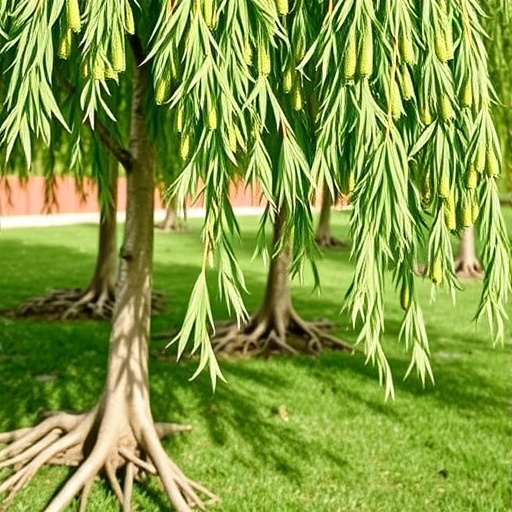
Willow trees have quietly shaped human medicine for millennia, from ancient brews of willow bark to the synthesis of aspirin, yet the chemistry behind this botanical pharmacy has never been fully predictable. A new study from Polish researchers now reveals just how dramatically the medicinal potential of willows shifts with species, plant organ, season, and even the soil in which the tree takes root. The findings, published in BMC Plant Biology, offer both a practical guide for harvesting nature’s anti-inflammatory arsenal and a sober reminder that ecological context can confound even the best-designed phytochemical studies.
The research team, led by Dorota Gawenda-Kempczyńska of the Ludwik Rydygier Collegium Medicum at Nicolaus Copernicus University in Bydgoszcz, set out to map the phenolic chemistry of five willow species growing in natural sites across Poland. The species studied were grey willow (Salix cinerea), brittle willow (Salix × fragilis), purple willow (Salix purpurea), almond-leaved willow (Salix triandra), and basket willow (Salix viminalis). Each species was represented by a single individual growing at its own distinct natural location, and bark and leaves were sampled from every tree at four time points during the 2022 growing season. In parallel, the team characterised the soil at each site, measuring parameters including sodium, calcium, magnesium, and potassium levels, as well as cation exchange capacity.
The methodological approach combined spectrophotometric assays with high-performance liquid chromatography coupled to a photodiode array detector, or HPLC-PDA, a technique that allows researchers to separate and quantify individual phenolic compounds with precision. On the antioxidant front, the team employed two widely used radical-scavenging assays, ABTS and DPPH, both of which measure a compound’s ability to neutralise reactive free radicals in vitro. The researchers also compared freeze-dried and non-freeze-dried preparations of the plant material, a comparison designed to evaluate freeze-drying as a stabilisation method for phenolic compounds, which are notoriously prone to degradation during processing and storage.
The results paint a picture of remarkable chemical diversity across the sampled willows. Purple willow bark emerged as the standout source of salicin, the glycoside that famously inspired the development of aspirin, with the highest mean content recorded at 19.88 milligrams per gram of extract. Notably, salicin levels peaked before leaf development, a finding that carries immediate practical significance for anyone harvesting willow bark for medicinal purposes. The timing suggests that early spring, before the tree invests energy in foliage, may be the optimal window for collecting bark rich in this prized compound.
Meanwhile, the bark of brittle willow proved richest in (+)-catechin, a flavanol with its own documented antioxidant and anti-inflammatory credentials, and here the seasonal pattern was different, with catechin levels reaching their maximum in autumn. Almond-leaved willow leaves took the honours for flavonoid content, achieving an impressive 176.84 milligrams per gram of extract. These organ-specific and species-specific patterns underscore why willow-derived raw materials have long been known to vary markedly in quality: the identity of the species, the organ harvested, and the moment of collection each leave their distinct chemical fingerprint on the final product.
Perhaps surprisingly, given this chemical variability, antioxidant activity proved remarkably consistent. The ABTS and DPPH assays showed comparable radical-scavenging capacity across the sampled individuals, organs, and harvest times. This suggests that while the individual phenolic constituents may rise and fall with season and species, the overall antioxidant capacity of willow extracts remains relatively stable, perhaps because different compounds substitute for one another in maintaining a functional antioxidant defence. For formulators and researchers, this means that while the profile of specific active molecules may shift, the broad bioactivity of willow extracts is less sensitive to harvest conditions than the raw numbers for individual compounds might suggest.
One of the study’s more forward-looking contributions concerns processing. Freeze-dried preparations consistently contained more of the targeted phenolic compounds than non-freeze-dried ones, and freeze-drying increased phenolic recovery in the spectrophotometric assays. This is a meaningful result for the phytochemical and herbal products industries, where drying methods can make or break the potency of a final product. By removing water directly from the frozen state through sublimation, freeze-drying bypasses the liquid phase in which many phenolic compounds are vulnerable to enzymatic oxidation and thermal degradation. The finding positions freeze-drying as a preferred stabilisation strategy for preserving the therapeutic chemistry of willow raw materials.
The soil connection proved to be the most tantalising, and the most statistically striking, aspect of the study. Using Spearman rank correlation analysis, the researchers found that the highest flavonoid contents co-occurred with the highest soil sodium concentrations, with correlation coefficients of 0.86 for bark and 0.76 for leaves. Bark salicin correlated positively with soil calcium and cation exchange capacity, while in leaves, soil magnesium showed a positive correlation with total phenolic content and (+)-catechin. These are substantial correlations by the standards of field ecology, suggesting that the mineral nutrition of the soil may play a meaningful role in shaping the secondary metabolism of willows.
Here, however, the researchers are admirably candid about the limits of their design. Because each species was sampled from a single individual at a separate site, species identity and site conditions are completely confounded. Every correlation they report between soil parameters and metabolite content is descriptive, not causal. It is impossible to say, from this data, whether the sodium-rich soil actually drove flavonoid production in a given tree, or whether the tree species best at accumulating flavonoids simply happened to be growing in sodium-rich ground. The team frames these patterns as a foundation for future replicated, multi-site studies in which species and site effects can be properly disentangled, a necessary next step before soil management can be recommended as a tool for enhancing willow chemistry.
That caveat notwithstanding, the study delivers a coherent big-picture message. Phenolic composition differed primarily between plant organs and between the sampled individuals, with season acting as a secondary, compound-dependent modifier. In other words, the first order of business when sourcing willow material is deciding which organ of which species you want; the second is choosing the right moment in the growing calendar. The chemistry co-varied with selected soil parameters, notably the contents of magnesium, sodium, calcium, and potassium, pointing to edaphic conditions as a factor worth investigating systematically rather than ignoring.
The broader significance of the work lies at the intersection of pharmacognosy, agriculture, and environmental science. Salix species are already widely used as sources of phenolic compounds for pharmaceutical and nutraceutical applications, and they are increasingly planted in short-rotation coppice systems for biomass and environmental remediation. If soil conditions can be shown, in properly replicated experiments, to modulate salicin, catechin, and flavonoid levels, then willow plantations could one day be managed not only for wood production but as cultivated medicinal gardens, with soil chemistry tuned to enhance specific bioactive profiles. Conversely, natural variation in soil chemistry could explain why wild-harvested willow bark, the traditional source of salicin-rich remedies, has always been so variable in potency.
The study was funded by the Ludwik Rydygier Collegium Medicum in Bydgoszcz, Nicolaus Copernicus University in Toruń, with article processing charges covered by the YUFÉ CONNECTS European academic cooperation project financed by the Polish National Agency for Academic Exchange. The work also benefited from international collaboration, drawing on expertise from institutions in Poland and the Czech Republic, including the Medical University of Lublin, Pomeranian Medical University in Szczecin, and Masaryk University in Brno.
For now, the willow stands in the Polish countryside have shared a chemical secret that herbalists may have sensed for generations: the same tree, in the same season, in different ground, is not the same medicine. As researchers design the multi-site, replicated studies that this pioneering survey calls for, the humble willow may yet yield even more precise answers about how to coax the maximum therapeutic value from one of humanity’s oldest medicinal trees.
Cite Scienmag News
Alan Morgan. (September 9, 2026). What drives phenolic compound levels in willows: species, organ, season, and soil. Scienmag. https://scienmag.com/what-drives-phenolic-compound-levels-in-willows-species-organ-season-and-soil/
Alan Morgan. "What drives phenolic compound levels in willows: species, organ, season, and soil." Scienmag, 9 September 2026, https://scienmag.com/what-drives-phenolic-compound-levels-in-willows-species-organ-season-and-soil/. Accessed 9 September 2026.
Alan Morgan. "What drives phenolic compound levels in willows: species, organ, season, and soil." Scienmag. September 9, 2026. https://scienmag.com/what-drives-phenolic-compound-levels-in-willows-species-organ-season-and-soil/


