


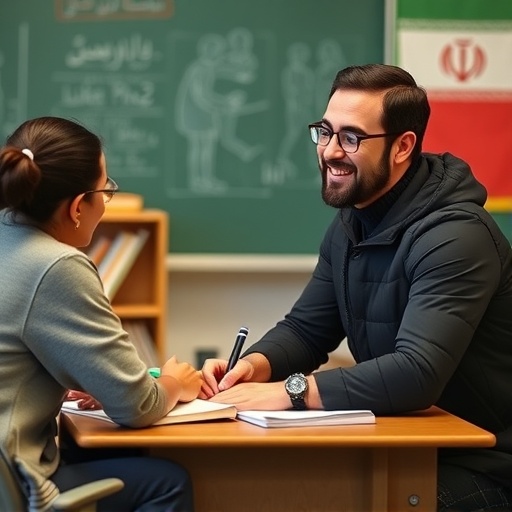
What makes a teacher love their work—and what makes a teacher love their students? A new study from Iran offers one of the first quantitative answers to that question, showing that the emotional lives of English language teachers, particularly their sense of psychological wellbeing and their day-to-day enjoyment of teaching, can be statistically modeled as drivers of what researchers call “loving pedagogy.” The research, published in the journal Discover Psychology, suggests that compassionate, caring teaching is not simply a personality trait but an outcome that can be predicted—and potentially cultivated—by attending to teachers’ emotional health.
The study was conducted by Seyed Mohammad Reza Amirian, Fatemeh Akbari, and Zahra Bayat of the Department of English Language and Literature at Hakim Sabzevari University in Sabzevar, Iran. Drawing on data from 201 Iranian English as a Foreign Language (EFL) teachers working across a variety of teaching contexts, the researchers set out to model how two affective variables—psychological wellbeing (PWB) and foreign language teaching enjoyment (FLTE)—contribute to the enactment of loving pedagogy in the classroom.
Loving pedagogy is a concept rooted in positive psychology, an approach that has reshaped how researchers think about emotion in education over the past two decades. Rather than focusing exclusively on negative states such as anxiety, burnout, and stress, positive psychology examines the constructive emotional resources that allow individuals to flourish. Within this framework, loving pedagogy emphasizes empathetic connection, emotional relationality, and genuine care in teaching. In practical terms, a teacher practicing loving pedagogy is attentive to students’ emotional needs, builds warm and trusting relationships, and treats the classroom as a space of mutual care rather than mere knowledge transmission. The authors note that these traits have become increasingly valued in foreign language teaching, a field where emotional dynamics between teachers and learners are known to shape motivation, engagement, and achievement.
Despite its conceptual appeal, loving pedagogy has remained empirically underexplored, particularly in relation to the psychological states that might underpin it. The research team identified a specific gap: while scholars have theorized that a teacher’s own wellbeing and enjoyment might feed into their capacity for loving, caring instruction, few studies had tested this relationship using rigorous statistical modeling. The present study was designed to bridge that lacuna.
To do so, the researchers adopted a quantitative, cross-sectional correlational design. Data were collected from 201 EFL teachers through validated instruments measuring the three constructs of interest: psychological wellbeing, foreign language teaching enjoyment, and loving pedagogy. Psychological wellbeing refers to a teacher’s overall sense of emotional contentment, purpose, and functioning in life, while foreign language teaching enjoyment captures the positive, energizing emotions teachers experience specifically in the act of teaching a language. Loving pedagogy, the outcome variable, reflects the degree to which teachers enact empathy, care, and emotional connection in their professional practice.
The analytical centerpiece of the study was structural equation modeling, or SEM, a multivariate statistical technique that allows researchers to test hypothesized networks of relationships among latent psychological constructs simultaneously. Unlike simple correlation analysis, SEM accounts for measurement error and evaluates how well an entire theoretical model fits the observed data. In this case, the researchers specified a model in which PWB and FLTE serve as antecedents—predictor variables—of loving pedagogy, and then estimated both the strength and the statistical significance of each pathway.
The results were striking in their clarity. Both psychological wellbeing and foreign language teaching enjoyment significantly predicted loving pedagogy, but they did so with notably different magnitudes. Teaching enjoyment emerged as the strongest antecedent, with a standardized regression coefficient of β = 0.55 and an explained variance of R² = 0.186. In plain terms, the more teachers enjoyed the act of teaching itself, the more likely they were to practice loving, caring pedagogy—and this single variable accounted for a meaningful share of the variation in loving pedagogy scores across the sample. Psychological wellbeing, meanwhile, showed a smaller but still statistically significant effect, with β = 0.28 and R² = 0.009. Beyond its direct contribution, wellbeing may also interlock with enjoyment, since the study found that the three constructs were strongly intercorrelated with one another, painting a picture of a tightly woven emotional system in which a teacher’s general contentment, their pleasure in teaching, and their capacity for caring instruction reinforce one another.
The overall model demonstrated acceptable fit to the data, lending statistical credibility to the theoretical proposition that loving pedagogy does not arise in an emotional vacuum. Rather, it appears to be fueled from two directions: the broad, stable reservoir of a teacher’s psychological wellbeing, and the more immediate, context-bound experience of joy in the classroom. The finding that enjoyment is the stronger predictor is particularly noteworthy. It suggests that the everyday emotional texture of teaching—the moments of humor, connection, and satisfaction that occur in real time—may matter even more for compassionate instruction than a teacher’s baseline life satisfaction.
The implications of the study reach well beyond the Iranian context. Around the world, language teachers face mounting pressures: large classes, standardized curricula, high-stakes testing, and, increasingly, the emotional labor of supporting students through turbulent times. If loving pedagogy depends on teachers’ emotional resources, then policies that ignore teacher wellbeing risk eroding the very relational qualities that education systems claim to prize. The authors argue that their findings highlight “the necessity of instilling teacher’s emotional contentment and teaching joy to engender loving and compassionate teaching spaces that respect the emotional wellbeing of learners and teachers alike.”
The study also carries practical consequences for teacher education. Pre-service and in-service training programs, the researchers suggest, should incorporate explicit attention to wellbeing and enjoyment—not as optional wellness add-ons, but as foundational components of professional development. Institutional support plays a role as well: school administrators and policymakers can influence teachers’ emotional lives through workload management, collegial support structures, recognition of teachers’ efforts, and working conditions that allow joy to flourish rather than be squeezed out by administrative burden. The authors frame their work as providing “a new framework for conceptualizing the effect of affective experience on pedagogic orientation,” positioning loving pedagogy as an outcome that education systems can deliberately nurture.
Methodologically, the study contributes to a growing movement in applied linguistics and educational psychology that treats teachers’ emotions as central rather peripheral to instructional quality. Positive psychology has already transformed research on language learners, spawning entire literatures on learner wellbeing, engagement, and enjoyment. This study extends that lens to the teacher’s side of the desk, connecting three constructs—wellbeing, enjoyment, and loving pedagogy—that had previously been studied largely in isolation.
The research also raises questions for future inquiry. Because the design was cross-sectional and correlational, it captures associations at a single point in time rather than proving causation. It remains possible, for instance, that teachers who practice loving pedagogy come to enjoy their work more, rather than the reverse—or that the relationships are bidirectional and mutually reinforcing. Longitudinal studies, experimental interventions aimed at boosting teacher enjoyment, and replications in other cultural and educational contexts would help clarify the causal architecture suggested by the model. The sample, while reasonably sized at 201 participants, was drawn from a single national context, and loving pedagogy may take culturally specific forms that deserve comparative study.
Still, the core message of the research is likely to resonate with teachers everywhere: caring teaching is emotionally expensive, and the emotional accounts that fund it—wellbeing and enjoyment—require deliberate replenishment. A teacher who is depleted cannot easily offer empathy; a teacher who has lost the pleasure of teaching will struggle to build warm relationships with learners. By quantifying these links, the Hakim Sabzevari University team has transformed a largely philosophical ideal into an empirical target, one that teacher educators, school leaders, and policymakers can now measure, monitor, and support. In an era when teacher burnout makes headlines as often as student achievement does, the finding that joy in teaching may be the single strongest predictor of loving pedagogy offers both a warning and an invitation: protect teachers’ joy, and their capacity to care for students is likely to follow.
Cite Scienmag News
Glenn Wilkins. (September 9, 2026). Study links teacher wellbeing and joy to loving pedagogy in Iran. Scienmag. https://scienmag.com/study-links-teacher-wellbeing-and-joy-to-loving-pedagogy-in-iran/
Glenn Wilkins. "Study links teacher wellbeing and joy to loving pedagogy in Iran." Scienmag, 9 September 2026, https://scienmag.com/study-links-teacher-wellbeing-and-joy-to-loving-pedagogy-in-iran/. Accessed 9 September 2026.
Glenn Wilkins. "Study links teacher wellbeing and joy to loving pedagogy in Iran." Scienmag. September 9, 2026. https://scienmag.com/study-links-teacher-wellbeing-and-joy-to-loving-pedagogy-in-iran/


