


In the highlands and lowlands of Ethiopia’s Awash River Basin, a quiet data crisis has been undermining one of the most fundamental tasks in water management: knowing how much water the atmosphere pulls from soils, lakes, and crops every single day. Now, a team of researchers has delivered a practical fix — a locally recalibrated version of one of hydrology’s most trusted empirical equations that works with nothing more than a thermometer’s daily high and low. The study, published in the open-access journal Heliyon, offers a blueprint for data-scarce regions worldwide where the gold standard for evapotranspiration estimation has long been out of reach.
The quantity at the heart of the research is reference evapotranspiration, abbreviated ETo — the combined loss of water through evaporation from the soil surface and transpiration through plant leaves, expressed for a standardized reference crop of well-watered grass. ETo is the linchpin of irrigation scheduling, reservoir planning, and hydrological modeling: multiply it by a crop-specific coefficient, and you obtain the actual water demand of maize, sugarcane, cotton, or any other crop. Underestimate it, and crops wilt; overestimate it, and precious water is wasted in a basin that can spare none.
Since 1998, the scientific community has had a single global benchmark for computing this quantity: the FAO-56 Penman-Monteith equation. Physically based and rigorously derived, the Penman-Monteith method explicitly accounts for the two “doors” through which water vapor escapes — the aerodynamic pathway, governed by wind speed and humidity gradients, and the stomatal pathway, governed by surface resistance that mimics the physiology of leaves. It requires net radiation, soil heat flux, air temperature, wind speed at two meters, and vapor pressure deficit, all blended through a formula whose psychrometric and aerodynamic terms approximate the behavior of an ideal grass surface. When complete weather stations feed it, few methods match its reliability.
The trouble is that in much of the developing world, complete weather stations barely exist. The new study reports a striking figure for Ethiopia: only about 18.6 percent of the country’s weather stations record all the variables the Penman-Monteith equation demands. Radiation sensors, anemometers, and hygrometers are expensive to buy and harder to maintain, while thermometers are cheap, robust, and nearly ubiquitous. Across Ethiopia, as in many developing countries, temperature and rainfall are often the only consistently measured variables — and in some records, even those arrive with quality-control gaps that render them unreliable for physically demanding calculations.
That is precisely why the Hargreaves-Samani equation, developed in the 1980s, has endured. Its structure is disarmingly simple: ETo equals a constant of 0.0023 multiplied by extraterrestrial radiation — the solar energy arriving at the top of the atmosphere, computed from latitude and the day of the year — times the mean daily temperature raised in a term involving temperature plus 17.8, times the square root of the diurnal temperature range, the difference between daily maximum and minimum temperature. The equation’s genius is its embedding of the temperature range, which acts as a rough proxy for cloudiness: on clear days, days are hot and nights are cool, inflating both evaporation and the equation’s output. Only temperature data, plus the site’s latitude and elevation, are needed.
But simplicity carries a cost. The Hargreaves-Samani equation was fitted to specific climatic conditions and its embedded constants are not universal. In windy, arid regions it tends to overshoot; in humid or highland settings it can undershoot. In Ethiopia’s Awash Basin — a 114,123-square-kilometer catchment stretching from peaks of 4,200 meters down to Lake Abe at 250 meters near the Djiboutian border — the new study confirmed this bias with unusual precision. Working with daily weather records from 1985 to 2021, supplied by the Ethiopian Meteorology Institute and the Ethiopian Institute of Agricultural Research, the team found that the original equation overestimated average daily ETo by 8.9 percent in the hot, dry lower basin, where it produced 5.14 millimeters per day against the Penman-Monteith benchmark of 4.72. In the middle basin, the overestimate was a milder 3.4 percent. Yet in the cool upper highlands, near Addis Ababa, the equation flipped direction, underestimating ETo by 2.4 percent. The same equation, three different errors — a compelling argument that calibration cannot be skipped.
What sets the new work apart from earlier calibration efforts is its approach and scope. Previous attempts in Ethiopia mostly built linear regressions between Hargreaves and Penman-Monteith outputs at individual stations, leaving the equation’s internal structure untouched and offering no picture of the basin as a whole. The researchers instead dissected the Hargreaves-Samani equation itself. First, they swept the equation’s power exponent — the 0.5 applied to the diurnal temperature range — through twenty alternative values from 0.40 to 0.60, generating twenty modified equations and selecting the exponent that maximized the correlation with the Penman-Monteith standard. Then, they split the equation into two physically meaningful components: one anchored in the 0.0023 coefficient coupled to mean temperature, and another anchored in the 17.8 offset. A multiple linear regression, fitted by least squares against Penman-Monteith outputs, reweighted each component and produced a new intercept, yielding a fully recalibrated “modified Hargreaves-Samani” equation with new location-specific coefficients a, b, c, and d.
The team built separate calibrated models for the upper, middle, and lower reaches of the basin, using 70 percent of the data for calibration and holding out 30 percent for validation. Their evaluation was exhaustive: the coefficient of determination, mean absolute error, mean absolute percentage error, root mean squared error, Nash-Sutcliffe efficiency, the index of agreement, and percent bias — a suite of statistics that probes not only how close predictions land to observations but also whether systematic skews remain. The Nash-Sutcliffe efficiency, borrowed from streamflow modeling, is particularly unforgiving of bias, since it compares model errors against the variance of the observations themselves. The recalibrated models, the authors report, tracked the Penman-Monteith benchmark far more faithfully than the original equation across all three sub-basins, converting a rough temperature shortcut into a dependable estimation tool.
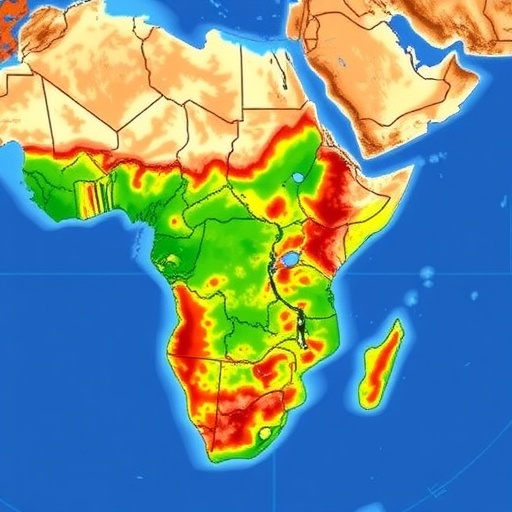
Crucially, the researchers did not stop at point estimates. They carried their calibrated equations to thirty-five stations across and around the basin and used Kriging — a geostatistical interpolation technique that models spatial autocorrelation through variograms and weights neighboring observations by their covariance structure, rather than by simple distance as in inverse-distance-weighting — to generate continuous, basin-wide maps of monthly reference evapotranspiration. These maps reveal the basin’s steep hydro-climatic gradients in a single visual sweep: lower evapotranspiration over the cool, moist western highlands, climbing to intense atmospheric water demand across the hot arid plains of the middle and northeastern Rift. For planners, such surfaces are the difference between a scattered table of station numbers and an actionable picture of where, and when, water stress peaks.
The stakes in the Awash Basin could hardly be higher. The basin is home to roughly 18.6 million people, 34.4 million livestock, and nearly 200,000 hectares of irrigated farmland, and it hosts some of Ethiopia’s most important urban centers — including the capital itself. Modern irrigated agriculture there dates to the 1950s, and rainfall is wildly uneven: mean annual totals swing from as little as 100 millimeters to as much as 1,700, delivered bimodally in the lower basin and unimodally in the upper, with about 71 percent falling between June and October. In a basin consistently ranked among Ethiopia’s most water-stressed, an inflated ETo estimate translates directly into over-abstracted rivers and shrinking lakes; a deflated one, into failed irrigations. The calibrated temperature-based models give local water managers a scientifically defensible estimate using data they already collect.
The study’s implications ripple well beyond Ethiopia. In Lebanon’s Bekaa Valley, in Mali, in Senegal’s Sahel, in South Korea, South Africa, Texas, and Uzbekistan, researchers have repeatedly documented the Hargreaves-Samani equation’s over- or under-estimation tendencies, with the direction of the error tracking local wind and humidity regimes. The lesson reinforced by the Awash work is that the equation’s constants are starting points, not endpoints — and that recalibrating its internal coefficients, rather than merely rescaling its output, extracts substantially more accuracy from the same single weather variable. As machine-learning approaches to evapotranspiration attract attention for their flexibility, the authors’ work is a reminder that in regions lacking the large, high-quality datasets such models require, a thoughtfully recalibrated empirical equation remains the most practical science available.
For millions of farmers along the Awash, the change will be invisible — a formula buried in planning software, a revised number in an irrigation schedule. But it may be the difference between water budgets that reflect reality and those that do not, in one of the places on Earth where that difference matters most.
Cite Scienmag News
Violet Maxwell. (September 8, 2026). Mapping evapotranspiration in Ethiopia’s Awash Basin with limited climate data. Scienmag. https://scienmag.com/mapping-evapotranspiration-in-ethiopias-awash-basin-with-limited-climate-data/
Violet Maxwell. "Mapping evapotranspiration in Ethiopia’s Awash Basin with limited climate data." Scienmag, 8 September 2026, https://scienmag.com/mapping-evapotranspiration-in-ethiopias-awash-basin-with-limited-climate-data/. Accessed 8 September 2026.
Violet Maxwell. "Mapping evapotranspiration in Ethiopia’s Awash Basin with limited climate data." Scienmag. September 8, 2026. https://scienmag.com/mapping-evapotranspiration-in-ethiopias-awash-basin-with-limited-climate-data/


