


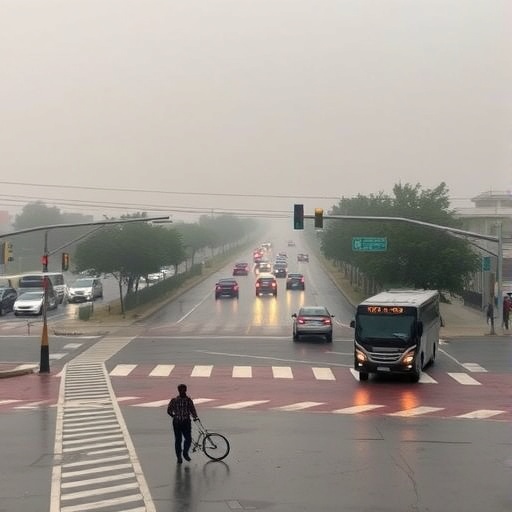
The air at Accra’s busiest traffic intersections is far more toxic than the city’s average air quality readings suggest, and a new study shows that the weather cannot take most of the blame. Researchers who measured fine particulate matter, or PM2.5, at nine urban traffic hotspots across the Ghanaian capital found median concentrations ranging from 16.75 micrograms per cubic meter at low-density traffic sites to 54.90 micrograms per cubic meter at high-density intersections, figures that dramatically exceed the World Health Organization’s 24-hour guideline of 15 micrograms per cubic meter. The study, published in the journal Environmental Monitoring and Assessment, offers one of the most detailed pictures yet of how meteorology and traffic combine to shape the air breathed by millions of commuters, street vendors, and residents in West Africa’s sprawling capital.
PM2.5 refers to particles smaller than 2.5 micrometers in diameter, roughly thirty times narrower than a human hair. Because of their minute size, these particles evade the respiratory system’s natural defenses, penetrating deep into the lungs and crossing into the bloodstream. Decades of epidemiological evidence have linked chronic exposure to PM2.5 with cardiovascular disease, stroke, lung cancer, aggravated asthma, and adverse pregnancy outcomes, including elevated risks of stillbirth. In rapidly urbanizing cities across Sub-Saharan Africa, where vehicle fleets are often aged and emissions regulations are weakly enforced, roadside populations experience some of the highest exposure levels in the world. Yet the specific contribution of weather conditions to pollution at individual traffic hotspots has remained poorly characterized, complicating efforts to design effective interventions.
The research team, led by Abraham Ayensu-Ntim of BOST Energies Limited and the University of Energy and Natural Resources, together with David Adu-Poku, Samuel Kumi, and Jackson Adiyiah Nyantakyi, set out to close this gap. They deployed an Aeroqual Ranger portable dust monitor to capture ambient PM2.5 concentrations across nine traffic intersections in Accra, deliberately scheduling measurements to span both the Harmattan season, when dry, dust-laden winds sweep westward from the Sahara, and the non-Harmattan period. In parallel, they obtained daily meteorological data, including air temperature, relative humidity, wind speed, and rainfall, from automatic weather stations operated by the Ghana Meteorological Agency. By pairing pollutant measurements with weather observations, the researchers could apply Pearson correlation analysis, a statistical technique that quantifies the strength and direction of linear relationships between variables, to disentangle how each meteorological factor influenced particulate levels at the sites.
The spatial results were striking. Sites were classified into three categories according to traffic density, and the differences between them were substantial. High-density traffic areas recorded a median PM2.5 concentration of 54.90 micrograms per cubic meter, more than three and a half times the WHO guideline and nearly twice the level found at commercial and business districts, which registered a median of 34.26 micrograms per cubic meter. Low-density traffic areas fared considerably better, with a median of 16.75 micrograms per cubic meter, though even these relatively quieter locations sat just above the international 24-hour limit. The single most polluted site was Ashaiman, a densely populated commercial hub on Accra’s periphery, where the median concentration reached 54.90 micrograms per cubic meter. The researchers attributed Ashaiman’s extreme readings to a convergence of factors: severe traffic congestion, a fleet dominated by aged vehicles with poor emission controls, and extensive roadside commercial activity that places pedestrians and vendors in direct, prolonged contact with exhaust plumes.
To understand whether weather could explain these patterns, the team examined the correlation coefficients between PM2.5 and each meteorological parameter. During the non-Harmattan season, the results followed classic expectations of atmospheric physics. Temperature showed a significant positive association with PM2.5, with a correlation coefficient of r = 0.353 and a p-value below 0.01, indicating a relationship unlikely to have arisen by chance. Higher temperatures can promote photochemical activity and enhance vertical mixing patterns that keep particles suspended near the surface, while also encouraging evaporation that concentrates airborne particulates. Conversely, rainfall, wind speed, and relative humidity each displayed negative correlations with PM2.5 during the wetter season. These inverse relationships are physically coherent: rainfall scavenges particles from the atmosphere through wet deposition, as raindrops collide with and remove particulates en route to the ground, while stronger winds enhance horizontal dispersion, diluting pollutant plumes emanating from idling engines and congested intersections. Elevated relative humidity similarly favors particle deposition and hygroscopic growth that removes fine particles from the respirable range.
The Harmattan season told a more complicated story. This annual phenomenon, driven by dry trade winds blowing dust from the Sahara Desert across West Africa, typically elevates regional particulate background levels. But the researchers found something unexpected: during the Harmattan, wind speed showed only a weak positive association with PM2.5, with a correlation coefficient of just 0.079 and a p-value of 0.450, which falls well short of statistical significance. Rather than dispersing pollution, stronger winds during this dry season appear to contribute to localized dust resuspension, lifting deposited road dust and soil particles back into the air, and to the dry atmospheric transport of dust from distant sources. In other words, the usual cleansing effect of wind is largely neutralized, or even reversed, when the air itself carries a heavy load of mineral dust and surface moisture is absent. This seasonal reversal has practical implications, since it suggests that measures effective at reducing pollution during the wet season may perform differently during the Harmattan months.
Perhaps the study’s most consequential finding, however, is what the correlations did not show. Although meteorological parameters clearly modulated PM2.5 levels, the strength of these relationships was modest, and the systematic differences between site categories persisted across seasons. The dominant driver of pollution at Accra’s traffic hotspots, the researchers concluded, remains localized vehicular emissions rather than weather. High-density intersections generated median concentrations roughly three times those of low-density sites, a gradient that tracks directly with traffic volume, congestion, and fleet age rather than with any meteorological variable. This interpretation aligns with earlier source-apportionment work in the region, including characterization studies at Ashaiman that identified traffic-related sources as major contributors to fine particulate pollution in Greater Accra.
The public health stakes are considerable. Street traders, traffic wardens, commercial drivers, and commuters spend hours each day in the immediate vicinity of these intersections, often at sidewalk distances where exhaust plumes have had little time to disperse. Previous research in Accra has documented elevated respiratory and cardiovascular symptoms among street traders working at traffic hotspots, and global assessments by the Health Effects Institute have identified traffic-related air pollution as a significant risk factor for childhood asthma and other conditions across Sub-Saharan Africa. Because the WHO guideline of 15 micrograms per cubic meter is designed to protect against chronic health harm, sustained median levels several times that threshold at locations where people congregate daily represent a serious and ongoing exposure crisis.
The authors argue that their findings carry a clear policy message. Since weather is not the principal culprit, waiting for favorable meteorology, or attributing pollution episodes to seasonal dust alone, will not solve Accra’s air quality problem. Instead, they call for emission-focused policies and targeted interventions aimed squarely at the vehicle fleet and traffic management. Concrete measures could include stricter vehicle inspection and emissions testing regimes, incentives to retire or retrofit aged diesel vehicles, congestion reduction strategies such as improved public transport and traffic signal optimization, and the protection of roadside populations through urban design that increases distance between pedestrians and exhaust sources. The Harmattan findings add nuance to such efforts, suggesting that dust-control measures, such as paved and regularly cleaned road surfaces, could yield particular benefits during the dry season when resuspension amplifies existing emissions.
The study also contributes methodologically to a growing body of air quality research in data-sparse regions. By combining a portable monitoring instrument capable of capturing seasonally contrasting conditions with official meteorological records and straightforward statistical analysis, the researchers produced actionable site-specific evidence at modest cost, an approach that could be replicated in other rapidly growing African cities where reference-grade monitoring networks remain limited. As Accra’s population continues to expand and vehicle ownership rises, the team’s message is unambiguous: without deliberate, emission-centered policy action, the air at the city’s traffic intersections will remain hazardous to the health of the people who depend on them every day.
Cite Scienmag News
Russell Cooper. (September 7, 2026). Weather patterns drive PM2.5 pollution at Accra traffic intersections. Scienmag. https://scienmag.com/weather-patterns-drive-pm2-5-pollution-at-accra-traffic-intersections/
Russell Cooper. "Weather patterns drive PM2.5 pollution at Accra traffic intersections." Scienmag, 7 September 2026, https://scienmag.com/weather-patterns-drive-pm2-5-pollution-at-accra-traffic-intersections/. Accessed 7 September 2026.
Russell Cooper. "Weather patterns drive PM2.5 pollution at Accra traffic intersections." Scienmag. September 7, 2026. https://scienmag.com/weather-patterns-drive-pm2-5-pollution-at-accra-traffic-intersections/


