


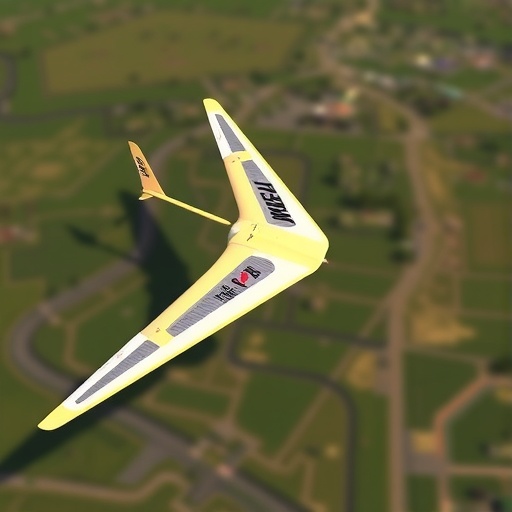
Researchers at the University of Stuttgart have shown that an aircraft can design itself. In a study published in Aerospace Systems, Simon Grimm, Eric Price, and Aamir Ahmad describe a fully automated design pipeline in which a gradient-descent optimizer directly drives a parametric CAD model of a tailless flying-wing UAV glider, evaluates every candidate design with high-fidelity computational fluid dynamics, and then closes the loop in the most convincing way possible: by building the optimized aircraft and flying it. The flight tests confirmed what the simulations predicted, marking a rare instance in which a machine-optimized airframe’s stability has been experimentally validated in the real world.
Flying wings occupy a peculiar place in aeronautics. Theoretically, they offer a superior drag-to-payload ratio because nothing is wasted on a fuselage and tail that generate weight and drag without producing lift. In practice, they are notoriously difficult to design. A conventional tailed aircraft achieves pitch stability through a positive incidence angle between the main wing and the horizontal tailplane. A flying wing has no tail, so the wing itself must be inherently stable, which can only be achieved through a carefully tuned combination of wing sweep, wing twist, and airfoil selection. The center of gravity sits at the heart of this problem, because even small shifts dramatically alter whether the aircraft returns to its original state after a disturbance or tumbles uncontrollably.
The challenge is that all of these parameters are deeply coupled. Change the sweep angle and you alter the lift distribution, which changes the pitching moment, which shifts the required center of gravity position, which affects how the components inside the airframe must be arranged, which changes the geometry again. Designing such an aircraft is therefore a highly nonlinear problem in which small geometric changes cause large swings in stability and performance. Previous attempts to automate flying-wing design have typically fallen short in one of three ways: they relied on low-fidelity aerodynamic models such as XFoil or vortex-lattice codes that miss crucial flow physics, they worked with abstract geometry representations that cannot be directly turned into a manufacturable CAD model, or they ignored stability altogether in pursuit of lower drag. Almost none of them ended with an actual airplane in the air.
The Stuttgart team’s pipeline addresses all three shortcomings at once. At its heart is a parametric FreeCAD model in which thirteen design variables define the aircraft’s geometry, including root chord, semi-span, leading-edge sweep angle, taper ratio, wing twist, airfoil thickness, camber, and reflex parameters. Because the geometry lives in a real parametric CAD system rather than an abstract mathematical surface, the optimizer can track the position and weight of every internal component at each iteration, compute the center of gravity precisely, and account for the aerodynamic effects of details like electronics bay covers, pylons, or pods. When the optimization finishes, the same CAD file that drove the process is ready for detailed design and manufacturing, with no translation step in between.
At every iteration, the current design is meshed and evaluated with Reynolds-Averaged Navier–Stokes simulations in OpenFOAM, a level of fidelity far beyond the panel methods and 2D airfoil codes common in earlier UAV optimization work. The pitch moment curve produced by each simulation is then analyzed to extract two quantities that matter enormously for a tailless aircraft: the location of the aerodynamic center and the pitching moment at zero lift. From these, the team computes the static margin, the distance between the center of gravity and the aerodynamic center expressed as a fraction of the reference chord. A positive static margin means the aircraft is statically stable; values between roughly 5 and 15 percent are considered the sweet spot between stability and maneuverability. The team targeted a static margin of 12 percent.
The optimizer itself is a gradient-descent scheme adapted to the peculiar realities of CFD-based design. Because the objective function is a black box, gradients are estimated with forward finite differences, requiring 14 CFD runs per iteration for 13 design variables. The authors chose forward over central differences deliberately: central differences would need 26 evaluations per iteration for a formally more accurate second-order gradient, but the dominant error source is not truncation error—it is the numerical noise inherent in meshing artifacts and solver residuals, which is comparable to or larger than the first-order truncation term. Doubling the computational cost for a marginally better gradient estimate that is already noise-dominated makes little sense. The team verified this empirically, showing that the run-to-run difference in the objective from repeating the same CFD case was smaller than every one of the 24 finite-difference steps sampled at that design, confirming that the step sizes sit comfortably above the noise floor.
One subtlety of the method is gradient normalization. Because the design variables live in wildly different units—millimeters, degrees, dimensionless airfoil parameters, meters per second—a raw gradient would be dominated by whichever variable happens to have large numerical values. After normalizing the gradient to unit length and rescaling each component by a sensible step size for its own variable, the design moves fastest along the parameters to which the objective is most sensitive, each measured in its natural units. The learning rate decays exponentially over iterations, borrowing an idea from stochastic gradient descent in machine learning, since the numerical noise in the CFD objective has stochastic properties of its own. An interesting consequence is that the step length never vanishes near a minimum, so the design oscillates gently around the optimum rather than asymptotically settling, with convergence enforced by the decaying learning rate instead of a vanishing gradient.
The objective function combines four weighted penalty terms: static margin, trim moment, lift balance, and endurance. The first two encode the primary goal—longitudinal stability—while the latter two act as guardrails that keep the design within a practically flyable region rather than as primary objectives. The lift term ensures that lift equals weight at the cruise angle of attack, and the endurance term penalizes designs whose required power exceeds what the battery and propulsion system can deliver over a two-hour flight target, computed with an efficiency chain covering propeller aerodynamics, electronics, and a safety factor for energy-intensive onboard computation. The trim term is deliberately asymmetric: negative pitching moments at zero lift are penalized far more strongly than positive ones, because a negative trim moment signals an unstable configuration, pushing the optimizer toward small, safe, positive values.
After ten iterations, roughly 6.5 hours of wall-clock time on a desktop workstation, the optimizer had reduced the total objective from 102.0 to 10.3. The static margin landed at 11.02 percent, comfortably within the accepted 9 to 15 percent band around the target, and the trim moment reached 8.22 × 10⁻² newton-meters, both within tolerance. The secondary guardrail targets were not fully met: required power came in at 36.47 watts against a 29.48-watt target, implying about 1.62 hours of endurance rather than the desired 2 hours, and lift at the operating point fell 2.06 newtons short of the aircraft’s weight. The authors attribute these shortfalls to a fundamental tension in tailless configurations: enforcing a positive static margin and near-zero trim moment shifts the aerodynamic center forward, which increases induced drag at the operating point. Interestingly, the optimizer also drove the airfoil’s camber and reflex parameters to zero, producing a nearly symmetrical airfoil—stable and easy to manufacture, but suboptimal for lift generation, since a symmetrical section generates less lift and achieves minimum drag at the zero-lift angle, directly conflicting with the lift requirement.
The critical validation came next. The team manufactured a prototype from the optimized geometry using a positive foam mold and composite skin, cutting polystyrene core sections with a hot-wire CNC cutter from airfoil sections exported directly from the CAD file. Minor modifications to the electronics bay were re-simulated and shown to be aerodynamically negligible. Then came the flight tests, conducted in calm conditions with the aircraft flown manually, throttle-only, at speeds between 10 and 20 meters per second. Instrumented with an IMU logging at roughly 120 Hz and GPS-derived flight-path data, the prototype was flown through deliberate upsets and hands-off segments.
The results were unambiguous. When disturbed, the aircraft’s pitch angle was restored by a counteracting pitch rate, and the short-period oscillation—the fast mode that governs immediate attitude response—decayed so rapidly that the aircraft returned to trim within roughly 0.6 seconds with a single overshoot. In uncontrolled flight, the aircraft exhibited a persistent low-frequency oscillation with a period of 5 to 6 seconds, dominated by pitch-angle swings of about 25 degrees while the angle of attack stayed bounded. Combined with the out-of-phase exchange between airspeed and altitude, this identified the oscillation as the classic lightly damped phugoid mode: a slow, benign trading of kinetic and potential energy characteristic of gliders, not a sign of instability. In other words, both static and dynamic longitudinal stability—exactly what the simulations had predicted—were demonstrated in the air.
The work, published as open access under DOI 10.1007/s42401-026-00530-w, comes with the complete optimization framework, the FreeCAD model, the objective-function scripts, and the CFD setup files publicly available on GitHub, enabling direct reproduction. The authors acknowledge the result is a local minimum in a non-convex design space and outline future work including more detailed mass modeling, multipoint optimization across mission conditions, and inclusion of wall shear stresses in the force integration, which would sharpen the power and endurance predictions that suffered most from the missed secondary targets. For now, though, the study stands as a compelling demonstration that stability-driven, CAD-integrated, high-fidelity optimization can deliver not just numbers on a plot, but an aircraft that flies—and flies the way the mathematics said it would.
Cite Scienmag News
Denise Maddox. (September 7, 2026). Machine-optimized CAD design yields stable flying wing UAV glider. Scienmag. https://scienmag.com/machine-optimized-cad-design-yields-stable-flying-wing-uav-glider/
Denise Maddox. "Machine-optimized CAD design yields stable flying wing UAV glider." Scienmag, 7 September 2026, https://scienmag.com/machine-optimized-cad-design-yields-stable-flying-wing-uav-glider/. Accessed 7 September 2026.
Denise Maddox. "Machine-optimized CAD design yields stable flying wing UAV glider." Scienmag. September 7, 2026. https://scienmag.com/machine-optimized-cad-design-yields-stable-flying-wing-uav-glider/


