


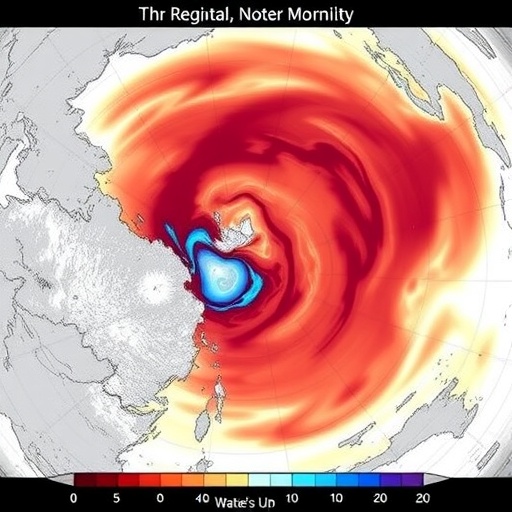
Every winter, a vast dome of cold, dense air pools over Siberia, generating one of the most powerful surface pressure systems on the planet: the Siberian High. Far above it, at altitudes approaching 30 kilometers, the stratospheric polar vortex—a cyclonic whirlwind of frigid air encircling the Arctic—spins in near isolation. For decades, scientists have understood that these two features of the winter atmosphere are not as separate as they appear. Now, new research reveals that the connection between them has been strengthening at a remarkable pace, and that the Siberian High itself, acting directly rather than through the well-studied Ural blocking pattern, has become a leading driver of polar vortex disruption. The finding promises to sharpen forecasts of some of the most severe cold snaps that strike East Asia.
The study, conducted by Wenqing Zhang and Bingyi Wu of Fudan University’s Department of Atmospheric and Oceanic Sciences and published in the journal Climate Dynamics, documents a significant decadal intensification in the dynamical link between December Siberian High activity and January weakening of the stratospheric polar vortex. Using reanalysis datasets spanning several decades, including the NCEP1 reanalysis and the high-resolution ERA5 product from the Copernicus Climate Change Service, the researchers traced how variations in the surface anticyclone over Siberia translate into disturbances tens of kilometers aloft. Their analysis shows that when the Siberian High intensifies in December, upward-propagating planetary waves—gigantic, slow-moving oscillations in the atmosphere—grow markedly stronger in the weeks that follow, eroding the stratospheric vortex and priming it for dramatic warming events.
The mechanism at work is rooted in fundamental atmospheric dynamics. Planetary waves are generated in the troposphere by large-scale contrasts in topography and land–ocean temperature distribution, and their ability to propagate upward depends critically on the background wind structure. A strong Siberian High alters the zonal and meridional flow patterns over Eurasia in ways that favor the vertical transmission of wave activity into the stratosphere. Once there, these waves deposit momentum and heat into the polar night jet through what atmospheric scientists describe using the Eliassen–Palm framework, a diagnostic tool developed in the early 1980s that quantifies the interaction between waves and the mean flow. The result is a deceleration of the polar night jet, a descent of warm air toward the pole, and ultimately a weakening—and sometimes a wholesale breakdown—of the polar vortex.
What makes the new finding scientifically provocative is its relationship to Ural blocking, the persistent anticyclonic anomaly that frequently develops over the Ural Mountains region and has long been regarded as the principal tropospheric gateway to stratospheric disruption. Previous studies, including influential work published in Geophysical Research Letters and the Journal of Geophysical Research–Atmospheres, established that Ural blocking episodes precede many stratospheric sudden warming events, channeling wave energy upward from the North Atlantic and Eurasian sectors. Zhang and Wu, however, demonstrate that the strengthening Siberian High–polar vortex coupling over recent decades is decoupled from Ural blocking activity. In other words, the Siberian High exerts a direct influence on the stratosphere that operates independently of the blocking pattern traditionally considered the primary mediator of troposphere–stratosphere interactions.
This distinction matters because it reshapes how scientists should think about the chain of causation connecting surface weather to stratospheric state. If Ural blocking were the sole conduit, forecasters monitoring the stratosphere would focus on blocking indices. The new analysis shows that this approach misses an increasingly important signal. By applying rigorous statistical diagnostics to the reanalysis record, the authors establish that the Siberian High has emerged as a robust and independent precursor to vortex weakening, with a marked increase in the upward flux of planetary wave activity originating from the Eurasian interior. The decadal trend they identify suggests that this pathway has been growing more influential even as attention in the field has remained fixed on blocking events farther west.
The polar vortex, once disturbed, does not quietly recover. Decades of research, famously led by Mark Baldwin and Todd Dunkerton’s 1999 analysis of Arctic Oscillation propagation, have shown that anomalies in the stratosphere descend back into the troposphere over a period of weeks, shifting the jet stream and surface pressure patterns in predictable ways. A weakened or displaced polar vortex typically favors a negative Arctic Oscillation, with blocking highs over the high latitudes and frigid polar air spilling into the midlatitudes. For East Asia, this chain of events has repeatedly culminated in record-breaking cold outbreaks, from the brutal East Asian winters associated with weak vortex states to the extreme cold episodes studied in the aftermath of major sudden stratospheric warmings. The practical stakes of predicting vortex behavior are therefore substantial.
Herein lies the most immediately valuable contribution of the Zhang and Wu study: the direct Siberian High–to–polar vortex pathway provides critical predictive skill for the intraseasonal reversal of East Asian surface temperatures. Because the Siberian High is a tropospheric feature observable in real time, its December intensity can serve as an early warning indicator for January stratospheric disturbances roughly one month in advance. That lead time falls squarely within the sub-seasonal forecasting range, a notoriously difficult window where conventional weather prediction loses accuracy and seasonal prediction has not yet gained traction. Stratosphere–troposphere coupling has long been identified as one of the principal sources of predictability in this window, and the new work adds a concrete, monitorable tropospheric precursor to the forecaster’s toolkit.
The findings also feed into one of the liveliest debates in climate science: how Arctic amplification—the rapid warming of the high northern latitudes—interacts with midlatitude winter weather. Siberian High variability is itself linked to changes in Arctic sea ice, Eurasian snow cover, and the warm-Arctic, cold-continent pattern that has featured prominently in recent decades. Studies have connected low sea-ice minima in the Barents Sea to cold Eurasian winters, and sea-ice loss to vortex weakening through enhanced planetary wave propagation. By identifying the Siberian High as an independent and strengthening driver, the new research suggests that ongoing cryospheric change in the Arctic may be reorganizing the architecture of troposphere–stratosphere coupling itself, potentially making severe stratospheric disturbances more frequent or more predictable through surface-based signals.
Methodologically, the study exemplifies the growing sophistication of modern climate diagnostics. The authors evaluated wave activity using established measures of upward Eliassen–Palm flux, examined the temporal evolution of coupling strength across multiple decades of reanalysis data, and carefully separated the Siberian High signal from concurrent Ural blocking variability to establish independence. The use of both the long-running NCEP1 reanalysis and the more recent ERA5 dataset helps guard against artifacts arising from any single data product, an important consideration when diagnosing subtle, slowly evolving trends in atmospheric dynamics. The consistency of the strengthened coupling across these datasets strengthens confidence that the decadal signal is real rather than an artifact of data processing.
The implications extend to climate model evaluation as well. If the Siberian High pathway has been strengthening in observations, current and future climate simulations must be able to reproduce this trend for their projections of winter climate over Eurasia to be trusted. Model biases in representing blocking, Eurasian snow cover, surface temperature gradients, and stratospheric resolution all have the potential to distort the coupling chain identified here. As the researchers note, monitoring Siberian High variability beyond traditional blocking indices is necessary to improve sub-seasonal forecasts of stratospheric disturbances and the associated cold extremes—a recommendation that applies both to operational forecasting centers and to the model developers striving to simulate the coupled system faithfully.
For the public in East Asia, where winter cold extremes carry enormous consequences for energy demand, agriculture, transportation, and public health, the research offers a measure of hope that the deadliest surprises of winter may become somewhat less surprising. A stronger, more directly monitored link between a visible surface pressure system and the hidden stratospheric machinery above means that forecasters may soon issue earlier and more confident warnings when the ingredients for a vortex disruption begin to assemble over Siberia. In a warming world where the polar vortex has become a household phrase and sudden stratospheric warmings routinely make headlines, understanding precisely which parts of the troposphere hold the keys to the vortex—and how those keys are changing from decade to decade—is science with very tangible consequences. The Siberian High, long appreciated as the engine of the East Asian winter monsoon, now commands attention for a second, loftier role: as a rising force in the drama playing out at the edge of space.
Cite Scienmag News
Sloane Callahan. (September 7, 2026). Siberian high–polar vortex coupling strengthens over decades, independent of Ural blocking. Scienmag. https://scienmag.com/siberian-high-polar-vortex-coupling-strengthens-over-decades-independent-of-ural-blocking/
Sloane Callahan. "Siberian high–polar vortex coupling strengthens over decades, independent of Ural blocking." Scienmag, 7 September 2026, https://scienmag.com/siberian-high-polar-vortex-coupling-strengthens-over-decades-independent-of-ural-blocking/. Accessed 7 September 2026.
Sloane Callahan. "Siberian high–polar vortex coupling strengthens over decades, independent of Ural blocking." Scienmag. September 7, 2026. https://scienmag.com/siberian-high-polar-vortex-coupling-strengthens-over-decades-independent-of-ural-blocking/


