


Measles has staged a dramatic and dangerous comeback in Pakistan’s most populous province, and new surveillance data reveal that the epidemic’s burden is shifting steadily toward the youngest and most vulnerable children. A retrospective analysis of more than 72,000 suspected measles cases recorded between 2022 and 2026 in Punjab, home to roughly 125 million people, documents a sustained epidemic that peaked in 2024, claimed at least 184 lives, and left nearly half of all recent infections occurring in infants too young to be fully protected by routine vaccination schedules.
The study, published in BMC Infectious Diseases, draws on individual-level records from the provincial Expanded Program on Immunization vaccine-preventable disease surveillance line-list, spanning epidemiological week 1 of 2022 through epidemiological week 23 of 2026. Researchers affiliated with the World Health Organization and the Government of Punjab analyzed case counts, incidence rates per 100,000 population, age at illness onset, sex, vaccination status, outcomes, and district-level geographic distribution, applying population denominators adjusted for annual growth at the district level. The statistical toolkit was deliberately simple but rigorous: the Cochran-Armitage trend test to detect directional change in proportions over time, Wilson 95 percent confidence intervals to quantify uncertainty around proportions, and Spearman rank correlation to explore relationships between reported vaccine coverage and disease incidence.
The trajectory of the epidemic is stark. Reported cases rose from 6,613 in 2022 to a peak of 23,623 in 2024, corresponding to an incidence of 18.92 per 100,000 population. Cases declined to 19,913 in 2025 and stood at 9,898 through week 23 of 2026, suggesting the epidemic wave was receding by the time the surveillance window closed. Across the entire five-year period, 184 deaths were recorded, yielding a case fatality ratio of 0.25 percent. While that figure may appear modest, measles deaths are notoriously undercounted in routine surveillance, and the true toll of a virus with a basic reproduction number that can exceed 12 in unimmunized populations is likely considerably higher, particularly through delayed complications such as pneumonia and encephalitis in survivors.
Male cases predominated throughout the study period, accounting for 57 to 58 percent of reported cases each year, with an overall male-to-female ratio of 1.40 to 1. The authors did not identify a biological basis for this skew, and sex differences in measles susceptibility are generally minimal; care-seeking behavior and notification practices may partly explain the imbalance, a question that merits further investigation in settings where health-seeking patterns differ sharply by child sex.
The most alarming finding, however, concerns age. The proportion of cases occurring in infants under 12 months of age rose from 37.3 percent in 2022 (95 percent CI 36.2 to 38.5 percent) to 47.9 percent in 2026 (95 percent CI 46.9 to 48.9 percent), a trend confirmed by the Cochran-Armitage test with a z statistic of 12.77 and a p value below 0.0001. Consistent with this shift, the median age at infection fell from 18 months, with an interquartile range of 8 to 42 months, to 12 months, with an interquartile range of 7 to 36 months. This means that by 2026, nearly one in two reported measles infections struck babies who had not yet reached the age at which the first routine dose of measles-containing vaccine is typically administered. In epidemiological terms, the susceptible population was being replenished fastest at the very bottom of the age distribution, where neither herd immunity nor the standard two-dose schedule could reach them in time.
Vaccination status data sharpen the picture further. Zero-dose cases, meaning children who had received no doses of measles-containing vaccine before falling ill, peaked at 49.6 percent in 2024 (95 percent CI 49.0 to 50.2 percent), a statistically significant increase (z = 3.37, p = 0.0008). At the epidemic’s height, effectively half of all reported cases were in children who had never been reached by the immunization system at all. This is the signature of a post-pandemic immunity debt: routine services disrupted by COVID-19 left an accumulating cohort of unvaccinated children, and once measles was reintroduced into this pool, the virus exploited its exceptional transmissibility to burn through susceptible hosts in wave after wave.
Perhaps the most counterintuitive result is geographic. When the researchers correlated district-level reported first-dose measles-containing vaccine coverage with district measles incidence for 2024, they found a paradoxical positive association: districts reporting higher MCV1 coverage actually reported higher incidence, with a Spearman rho of plus 0.370 and a p value of 0.027. Far from suggesting that vaccination spreads disease, the authors interpret this as surveillance activity bias. Districts with nominally strong immunization programs tend to have stronger detection and reporting systems, so a greater fraction of true cases is captured. Districts with weak coverage and weak surveillance simultaneously under-detect cases and under-report coverage. The practical implication is sobering: nominal coverage statistics can mask pockets of unvaccinated children, and those pockets can silently accumulate enough susceptibility to ignite an epidemic even in areas whose paperwork looks reassuring.
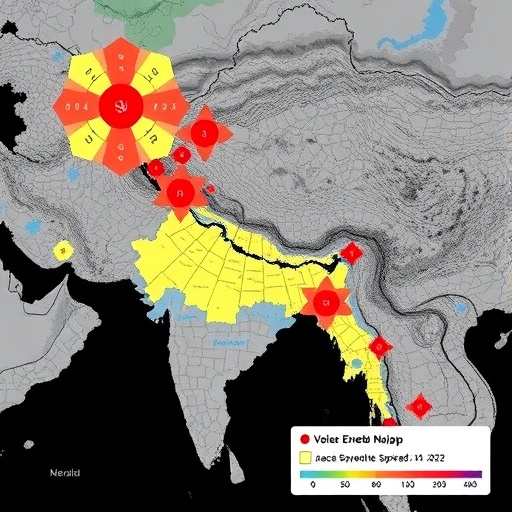
The geographic burden itself was highly uneven. In 2024, the districts of Chiniot and Jhang bore the highest incidence, at 62.95 and 59.98 per 100,000 population respectively, indicating focal transmission hotspots within the province rather than a uniformly distributed epidemic. Such clustering is characteristic of measles, which requires approximately 95 percent two-dose coverage to interrupt transmission; even a handful of districts falling well below that threshold can sustain province-wide chains of infection for years.
The study’s conclusions carry weight well beyond Punjab. The authors frame the findings as relevant to other high-burden countries in the WHO Eastern Mediterranean Region facing similar immunization system challenges, where post-pandemic measles resurgences have placed millions of unvaccinated children at risk across South Asia and beyond. Under the global Immunization Agenda 2030, the world committed to halving the number of zero-dose children and achieving regional measles elimination targets; the Punjab data show how far many districts remain from those goals in practice. The response strategies implied by the analysis include periodic intensification of routine immunization, supplementary immunization activities such as measles-rubella campaigns, the Reaching Every District approach to close coverage gaps, data quality self-assessments to expose the surveillance-coverage paradox, and leveraging the network of Lady Health Workers for door-to-door zero-dose outreach.
What makes the shifting age distribution particularly consequential is the biological window it exposes. Maternal antibodies, transferred across the placenta, wane during the first months of life, leaving infants susceptible before the first vaccine dose scheduled at nine months in Pakistan’s program. Infants who contract measles face elevated risks of severe pneumonia, diarrhea, and the rare but fatal late complication subacute sclerosing panencephalitis. A burden increasingly concentrated in this age group signals both that older cohorts have been partly depleted of susceptibles by infection and that transmission is intense enough to reach infants before their first dose, a hallmark of a high-force-of-infection epidemic sustained by a large zero-dose reservoir.
The case fatality ratio of 0.25 percent, derived from 184 deaths among 72,565 reported suspected cases, should also be read cautiously. Suspected cases in the surveillance system include laboratory-confirmed and epidemiologically linked cases as well as clinically compatible ones, and the denominator includes cases whose outcomes may be incompletely ascertained. International estimates place measles CFR at roughly 1 to 3 per 1,000 cases in general populations and several percent in displaced or malnourished groups, so the recorded deaths likely represent a floor rather than a ceiling.
Methodologically, the study’s strengths lie in its scale and granularity: five consecutive years of individual-level records across all 36 districts of Punjab, analyzed with transparent frequentist methods and population denominators adjusted for annual growth. Its limitations are those inherent to retrospective surveillance data, including dependence on case detection intensity, potential misclassification between suspected and confirmed cases, and missing vaccination histories, particularly among infants. The authors conducted the analysis as a secondary use of de-identified, routinely collected public health records, with an ethics exemption confirmed by the provincial EPI Cell Ethics Committee, and the work was carried out within routine WHO technical support activities to the Punjab Health Services Department without dedicated funding.
As Punjab’s case counts recede through 2026, the temptation will be to declare the crisis over. The data argue otherwise. A burden that now falls almost equally on infants, a zero-dose fraction that approached half of all cases at the epidemic peak, and a documented mismatch between reported coverage and true population immunity together indicate that the underlying susceptibility has not been resolved, merely partially discharged by infection. Unless the quality of immunization delivery, the reach of zero-dose outreach, and the sensitivity of surveillance improve in tandem, the same accumulation-and-ignition cycle documented between 2022 and 2026 stands ready to repeat. The study, by mapping precisely where and in whom the virus found its foothold, offers provincial and regional health authorities a data-driven starting point for breaking that cycle before the next susceptible cohort comes of age.
Cite Scienmag News
Kristina Jarvis. (September 7, 2026). Measles trends, age patterns, and geographic spread in Punjab, 2022–2026. Scienmag. https://scienmag.com/measles-trends-age-patterns-and-geographic-spread-in-punjab-2022-2026/
Kristina Jarvis. "Measles trends, age patterns, and geographic spread in Punjab, 2022–2026." Scienmag, 7 September 2026, https://scienmag.com/measles-trends-age-patterns-and-geographic-spread-in-punjab-2022-2026/. Accessed 7 September 2026.
Kristina Jarvis. "Measles trends, age patterns, and geographic spread in Punjab, 2022–2026." Scienmag. September 7, 2026. https://scienmag.com/measles-trends-age-patterns-and-geographic-spread-in-punjab-2022-2026/


