


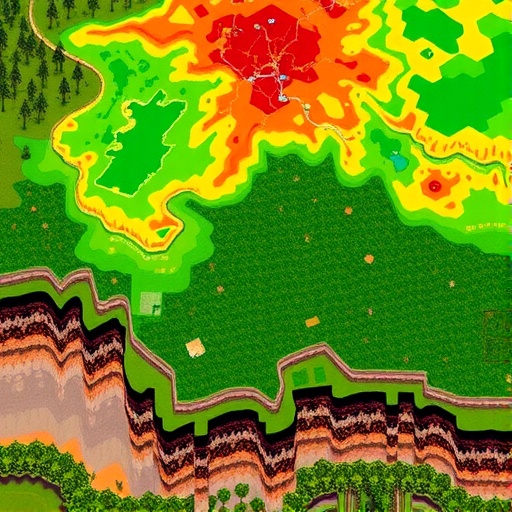
Ghana is quietly losing one of its most important climate assets, and the culprit is not the destruction of its famous forest reserves but the steady disappearance of the trees scattered across farms, villages, and roadsides outside them. A new study by researchers at the CSIR-Forestry Research Institute of Ghana has quantified, valued, and mapped the country’s carbon stocks in relation to six years of dramatic land cover change, revealing that “Trees Outside Forests” (TOF) have become the single largest driver of national carbon loss, with economic consequences running into the tens of billions of dollars.
The research, published in the journal Environmental Management, was led by Kwadwo Kyenkyehene Kusi, together with Comfort Nkrumah and Beatrice Darko Obiri. It provides one of the most comprehensive national-scale assessments of how land use and land cover (LULC) dynamics between 2018 and 2024 have reshaped Ghana’s carbon economy, and where the country is likely headed by 2030 if current trends continue under a Business-as-Usual scenario.
To build their assessment, the team combined several well-established geospatial tools. They began with Environmental Systems Research Institute (ESRI) global land cover data, derived from Sentinel-2 satellite imagery at a remarkably fine 10-meter resolution, and reclassified it for the Ghanaian landscape. Future land cover was projected using the MOLUSCE (Modules for Land Use Change Simulations) plugin in the open-source QGIS platform, which models transition potentials between land cover classes based on historical change patterns. Carbon stocks and their monetary value were then estimated with the InVEST (Integrated Valuation of Ecosystem Services and Tradeoffs) carbon model, developed by the Natural Capital Project, which pools carbon across four major reservoirs: aboveground biomass, belowground biomass, soil organic carbon, and dead organic matter.
The headline finding is stark. Trees Outside Forests, the trees that dot Ghana’s agricultural mosaic, including those on cocoa farms, in home gardens, and along riparian corridors, declined by 14 percent between 2018 and 2024, a loss of nearly 12,000 square kilometers of tree cover outside formal forest boundaries. The projection to 2030 is equally sobering: a further 6 percent decline, amounting to an additional 5,113 square kilometers. In contrast, Ghana’s gazetted forest reserves remained relatively stable over the study period, suggesting that formal protection is working to a degree, even as the informal tree landscape that stitches together much of the country’s rural carbon stock continues to erode.
The carbon arithmetic that follows from these land cover shifts is consequential. Total national carbon storage fell to 7,227 million tonnes of carbon in 2024, equivalent to 301.7 tonnes of carbon per hectare. This represents a substantial drop from the 2017 primary baseline of 8,055 million tonnes of carbon. Interestingly, the projections show a partial recovery to 7,563 million tonnes of carbon (315.7 tonnes per hectare) by 2030, driven by a projected expansion of the forest reserves. But here is the critical nuance: even with this projected rebound in protected areas, the study found no net carbon sequestration relative to the 2017 baseline. The country remains in a persistent carbon deficit, and the deficit is overwhelmingly attributable to the erosion of trees outside forests rather than to any catastrophic collapse of the formal reserve system.
This finding carries significant implications for how tropical nations account for and manage their carbon resources. Globally, trees outside forests have long been underappreciated in national carbon accounting, often treated as peripheral to the headline figures of deforestation within recognized forest boundaries. Yet research from other regions, including studies of trees outside forests in Great Britain and coastal Bangladesh, has demonstrated that these dispersed trees can store substantial quantities of carbon and, in some landscapes, rival the sequestration contributions of intact forests. Ghana’s experience suggests that when these trees are lost, the national carbon balance can tip into deficit even when protected areas remain intact.
The economic valuation in the study is equally striking. The researchers calculated that the economic losses attributable to carbon stock changes totaled US$12,032 million in 2024, equivalent to US$662 per hectare. By 2030, projected losses reach US$5,398 million, or US$347 per hectare. While the rate of loss slowed by 55 percent in the projected period compared to the historical period, the authors are careful to emphasize that this deceleration should not be mistaken for recovery. The national carbon Net Present Value remains consistently negative through 2030, meaning Ghana is not realizing any net economic gains in carbon terms relative to the 2017 baseline. In other words, even the most optimistic projection leaves the country worse off than it was before the current period of land cover transformation began.
The drivers of TOF decline in Ghana are multifaceted and reflect broader patterns across West Africa. Agricultural expansion, particularly for cocoa, has been implicated in previous research as a major driver of both deforestation and the loss of shade trees on farms. Population growth, urbanization, fuelwood harvesting, and changing land tenure arrangements all contribute to the pressure on trees outside formal forest boundaries. The loss of these trees is particularly insidious because it happens incrementally, tree by tree, farm by farm, often below the threshold of detection by conventional deforestation monitoring systems that focus on categorical forest loss.
For Ghana’s climate policy, the findings carry direct weight. The country has committed to ambitious Nationally Determined Contribution (NDC) targets under the Paris Agreement, and its national REDD+ strategy relies heavily on maintaining and enhancing carbon stocks across the landscape. If Trees Outside Forests continue to decline at projected rates, the country’s ability to meet these international commitments becomes increasingly uncertain. The study’s authors argue that the findings underscore the urgent need for targeted land management policies specifically aimed at protecting and restoring TOF, rather than focusing exclusively on forest reserves.
Such policies could take several forms. Incentivizing farmers to maintain and plant trees on agricultural land, strengthening tree tenure rights so that farmers benefit from the trees on their land, integrating TOF into national carbon accounting and payment for ecosystem services schemes, and promoting agroforestry systems that maintain high tree densities while sustaining crop production are all strategies that could help reverse the trend. The stability of Ghana’s forest reserves over the study period suggests that formal protection mechanisms do work, and that analogous mechanisms for trees outside forests could yield similar benefits.
The study also demonstrates the power of accessible, high-resolution geospatial data combined with open-source modeling tools for national-scale environmental assessment. The 10-meter resolution of the ESRI land cover data, itself derived from Sentinel-2 imagery and deep learning classification, allows for a much more nuanced picture of tree cover than coarser-resolution products, capturing individual trees and small clusters that would be invisible in traditional 30-meter or coarser datasets. The integration of MOLUSCE for projection and InVEST for valuation creates a replicable workflow that other tropical nations could adopt to assess their own carbon trajectories under different land use scenarios.
As the global community grapples with the twin challenges of climate change and biodiversity loss, studies like this one serve as a reminder that carbon is not confined to the world’s iconic forests. The trees that line Ghana’s roads, shade its cocoa farms, and dot its savannas are doing measurable, monetizable work for the climate. Losing them carries a price tag that the study now makes explicit: billions of dollars in economic value, and a carbon deficit that even the expansion of protected areas cannot fully offset. Whether Ghana and other nations can translate this understanding into policies that protect trees everywhere, not just inside forest boundaries, may well determine whether their climate commitments remain within reach.
Cite Scienmag News
Sloane Callahan. (September 7, 2026). Mapping Ghana’s Carbon Stocks Amid Changing Land Cover. Scienmag. https://scienmag.com/mapping-ghanas-carbon-stocks-amid-changing-land-cover/
Sloane Callahan. "Mapping Ghana’s Carbon Stocks Amid Changing Land Cover." Scienmag, 7 September 2026, https://scienmag.com/mapping-ghanas-carbon-stocks-amid-changing-land-cover/. Accessed 7 September 2026.
Sloane Callahan. "Mapping Ghana’s Carbon Stocks Amid Changing Land Cover." Scienmag. September 7, 2026. https://scienmag.com/mapping-ghanas-carbon-stocks-amid-changing-land-cover/


