


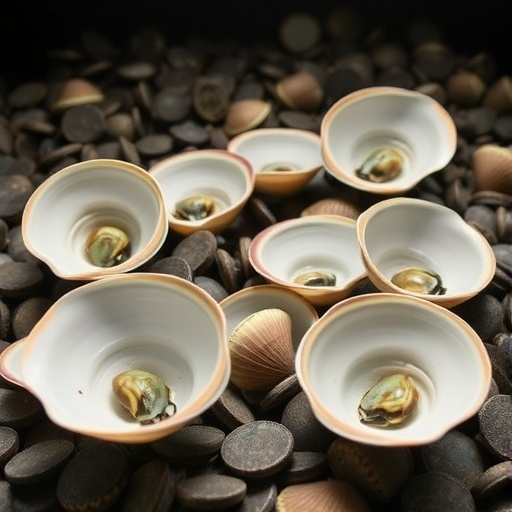
An invasive freshwater clam that hitchhiked its way into British waterways may hold the key to tracking hidden heavy metal pollution in rivers and canals, according to a new laboratory study that put hundreds of Asian clams through a meticulously controlled ten-day exposure experiment. The research, published in the journal Environmental Challenges, offers the first combined field-and-laboratory assessment of copper and zinc bioaccumulation in the Asian clam, Corbicula fluminea, in the United Kingdom, and suggests that the animal’s shell could serve as a long-lasting chemical archive of the waters it has lived in.
The Asian clam is native to eastern Asia, Australia and parts of Africa, but has spread widely across Europe, North and South America, largely through accidental releases such as freshwater ballast discharge from container ships and the aquaculture trade. It was first recorded in the United Kingdom on the Norfolk Broads in 1998 and has since colonised the River Thames, the Great Ouse, the River Trent, waters near Port Talbot in Wales and the River Medway. For this study, researchers collected clams from the Grand Union Canal in Loughborough, Leicestershire, a population believed to have spread from the River Trent, possibly transported on small pleasure boats, canoes, wetsuits or fishing equipment.
The team, led by Basmah Bushra of Loughborough University together with Paul J. Wood and Diganta B. Das, set out to answer a deceptively simple question: how much copper and zinc do these clams take up from their water, how quickly, and where in their bodies does the metal end up? The answer matters because heavy metal contamination of rivers is a global problem, particularly downstream of historic mining and industrial sites, and conventional water sampling often fails to capture it. Metal concentrations in environmental waters frequently fall below the detection limits of standard analytical instruments, and because metals bind to sediments, a single snapshot of the water column can badly misrepresent what organisms are actually exposed to over time. Living organisms, which integrate exposure across their lives, can fill that gap as biological monitors.
In the field phase of the study, the researchers collected ten water samples, ten sediment samples and one hundred clams from the canal. Water was drawn from about thirty centimetres below the surface; sediment was scraped from the upper ten centimetres of the canal bed; clams were netted and transported live to the laboratory. Physico-chemical measurements, including temperature, dissolved oxygen, pH and electrical conductivity, were taken in situ and all fell within World Health Organization guideline ranges, although the canal’s conductivity, averaging around 854 microsiemens per centimetre, sat slightly above the typical 400 to 600 range.
Chemical analysis of the field samples produced a consistent ordering: metal concentrations were highest in sediment, intermediate in clam tissue and lowest in the water. Average copper concentrations ranged from 0.05 to 0.06 milligrams per litre in water, 6.47 to 7.62 milligrams per kilogram in sediment and 2.54 to 2.93 milligrams per kilogram in clam tissue, while zinc reached 0.24 milligrams per litre in water, 24.41 milligrams per kilogram in sediment and just over 6 milligrams per kilogram in the clams. Encouragingly, every measurement was below the maximum limits set by international health and food safety standards, including WHO limits for drinking water, soils and aquatic organisms, meaning the canal site itself does not currently pose an obvious human health hazard.
The heart of the study, however, took place in the laboratory. The team collected a further six hundred clams and distributed them among ten mesocosms, each a fifteen-litre tank holding five centimetres of clean, metal-free sand, an air pump and a filter unit, with thirty clams per tank fed daily on suspended algae under a controlled day-night light cycle. Three mesocosms were dosed with copper at 1.3, 2.6 and 3.9 milligrams per litre, values chosen by doubling and tripling the WHO drinking-water guideline of 1.3 milligrams per litre. Three received zinc at 5, 10 and 15 milligrams per litre, again bracketing the WHO limit. Three more received combined copper-plus-zinc doses at low, medium and high levels, and a tenth tank served as an untreated control. Ten clams were sampled from each tank on days 3, 7 and 10, dissected into soft tissue and shell, digested or ground, and analysed using micro X-ray fluorescence and scanning electron microscopy with energy-dispersive X-ray analysis.
One unexpected complication emerged: in the higher-dosed tanks, pH collapsed dramatically, beginning around day three and falling to between 2 and 4, a level of acidity far outside normal freshwater conditions. The authors attribute this acidification to a combination of metal salt hydrolysis, insufficient buffering capacity in the tanks and secondary biological deterioration, and they caution that accumulation observed under such extreme pH conditions may not reflect what happens in natural rivers. They also stress that the ten-day exposure window is deliberately short, designed to gauge how rapidly the clams respond to elevated metal levels rather than to derive definitive long-term accumulation constants.
Despite that caveat, the uptake patterns were clear. Copper concentrations in soft tissue climbed from a low of 2.09 milligrams per kilogram in a control tank to a maximum of 3.98 milligrams per kilogram in the highest copper treatment on day ten, with means rising from roughly 2.25 to 3.98 milligrams per kilogram across the exposure period. Zinc in soft tissue behaved quite differently: concentrations barely budged, staying within a narrow band from about 6.04 to 6.09 milligrams per kilogram regardless of whether clams were in control tanks or the highest zinc exposures. The researchers interpret this plateau as biological saturation. Zinc is an essential trace element that clams physiologically regulate; once tissue storage capacity is reached, additional uptake is limited and excess zinc is excreted or detoxified. Copper, by contrast, accumulated progressively, suggesting that Corbicula fluminea is comparatively poor at excreting copper even when internal levels rise, a property that makes the species especially informative as a copper indicator.
The team quantified uptake using the bioaccumulation factor, the ratio of metal concentration in tissue to that in the surrounding water. For copper this factor rose from 45 in the control to nearly 57 in metal-treated tanks, reflecting greater uptake when more copper was available, while zinc factors hovered around 25 in both control and treated conditions. Because these factors exceed one, the clams concentrate metals from water substantially, underlining their biomonitoring value even at background contamination levels.
To formalise the dynamics, the researchers fitted their data to a first-order bioaccumulation kinetic model, in which the rate of metal accumulation depends on the balance between an uptake rate constant and an elimination rate constant, scaled by the dissolved metal concentration in the water. Because their ten-day dataset was not designed for rigorous parameter estimation, they borrowed uptake and elimination constants from a published biodynamic model for the amphipod Gammarus pulex and used the model as an indicative rather than calibrated predictor. Even so, estimated concentrations tracked the observed measurements closely for both metals and for single versus combined exposures, following the same rising trends across treatments. Notably, combined copper and zinc dosing produced no statistically significant difference from single-metal exposures, indicating that, at least over this short timeframe, the two metals did not interact synergistically or antagonistically in a measurable way.
Perhaps the most striking findings came from the shells. Calcium carbonate, the mineral that makes up the bulk of a bivalve shell, readily binds metals and locks them into the growing structure. On day ten, copper concentrations in shells ranged from 4.37 to 6.67 milligrams per kilogram, roughly 57 per cent higher than in soft tissue, while zinc in shells reached 16.23 to 21.65 milligrams per kilogram, more than double the soft-tissue level. Statistical analysis confirmed that the difference between shell and soft tissue was highly significant for both metals, whereas neither exposure dose nor day of sampling significantly altered shell concentrations. That pattern carries an important implication: most of the metal recorded in the shells was accumulated before the experiment even began, over the clams’ lifetimes in the canal. Because shells persist for decades to millennia after the animal dies, they can preserve a chronological record of pollution, making them potential high-resolution environmental archives.
The study has acknowledged limitations, including the short exposure duration, the severe pH swings at high doses, the use of literature-derived kinetic constants and modest sample sizes that limit statistical confidence. The authors call for longer experiments under environmentally realistic conditions, better analytical validation and extension to more ecotoxicologically significant metals such as cadmium, lead and mercury. Still, the implications are considerable. All measured concentrations, in field samples and mesocosms alike, remained below human health thresholds, yet the clams demonstrated they can act as sensitive, integrating sentinels of metal contamination, with shells offering a durable historical record and soft tissue providing a live read-out of recent exposure. In rivers scarred by legacy mining pollution, where conventional grab sampling can miss the story, an invasive clam may prove an unlikely but valuable ally in protecting both ecosystems and the people who depend on them.
Cite Scienmag News
Sloane Callahan. (September 7, 2026). Asian clam mesocosm study quantifies heavy metal bioaccumulation levels. Scienmag. https://scienmag.com/asian-clam-mesocosm-study-quantifies-heavy-metal-bioaccumulation-levels/
Sloane Callahan. "Asian clam mesocosm study quantifies heavy metal bioaccumulation levels." Scienmag, 7 September 2026, https://scienmag.com/asian-clam-mesocosm-study-quantifies-heavy-metal-bioaccumulation-levels/. Accessed 7 September 2026.
Sloane Callahan. "Asian clam mesocosm study quantifies heavy metal bioaccumulation levels." Scienmag. September 7, 2026. https://scienmag.com/asian-clam-mesocosm-study-quantifies-heavy-metal-bioaccumulation-levels/


