


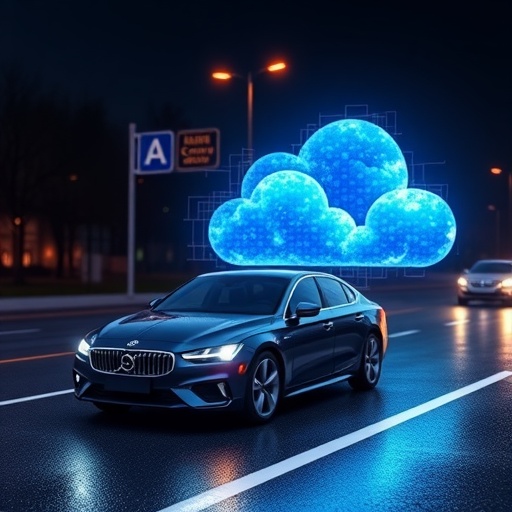
The race to build trustworthy intelligent transportation systems has taken a significant step forward, thanks to a new study that fuses classical control theory with blockchain technology to tame one of the most stubborn problems in connected vehicle networks: the unpredictability of moving cars. Researchers Lamaa Sellami of the CONPRI Laboratory at the University of Gabes in Tunisia and Bechir Alaya of Qassim University in Saudi Arabia have unveiled K-VADD-DPKI, a secure routing framework designed for Vehicular Cloud Computing, an emerging paradigm in which vehicles on the road double as mobile computing nodes, sharing data, offloading tasks, and cooperating to keep traffic flowing and passengers safe. Their work, published in the Journal of Network and Systems Management, addresses a fundamental tension at the heart of the Internet of Vehicles: the very mobility that makes vehicular networks useful also makes them fragile, and the openness that makes them flexible also makes them vulnerable to attack.
The starting point for the new framework is the Vehicle-Assisted Data Delivery protocol, known as VADD, which has long served as a backbone for data routing in highly dynamic vehicular environments. VADD belongs to a family of delay-tolerant, carry-and-forward routing schemes that accept a simple reality of vehicular ad hoc networks: continuous end-to-end paths rarely exist. Instead of demanding an unbroken wireless link between sender and receiver, VADD exploits the trajectories of vehicles themselves, allowing a car to physically carry data packets as it drives and to hand them off opportunistically to whichever neighboring vehicle offers the best probability of moving the data closer to its destination. This exploitation of vehicle trajectories, combined with delay-tolerant delivery mechanisms, ensures stable data dissemination even when traffic patterns fluctuate and connectivity comes and goes. It is a pragmatic strategy, but one that leaves substantial room for improvement, particularly when vehicle movements deviate from predictions and when malicious actors exploit the routing machinery.
Sellami and Alaya’s first major enhancement targets the mobility problem with a tool borrowed from estimation theory: the Kalman filter. Originally developed in the 1960s for guiding spacecraft on their way to the Moon, the Kalman filter is a recursive algorithm that produces optimal estimates of a system’s state by fusing noisy measurements with a mathematical model of the system’s dynamics. In the context of vehicular networking, the filter continuously ingests positional and velocity information from vehicles and produces refined predictions of where those vehicles will be moments into the future. This matters enormously for routing decisions. Traditional greedy and trajectory-based protocols rely on snapshots of vehicle positions that are stale almost as soon as they are computed, because cars traveling at highway speeds can move dozens of meters between beacon updates. By estimating vehicle movement with a Kalman filter, the routing layer can make proactive route adjustments, anticipating link breakages before they occur and steering packets toward neighbors whose predicted trajectories keep them in communication range. The result, the authors report, is a marked reduction in routing disruptions and a corresponding improvement in delivery reliability across the network.
Prediction alone, however, does nothing to defend the network against adversaries, and vehicular networks present an unusually rich attack surface. Because the network depends on vehicles acting as cooperative relays, a single malicious node can wreak havoc by participating in the routing protocol while quietly undermining it. Among the most damaging of such threats is the Black Hole Attack, in which a malicious node advertises itself as an ideal relay, luring packets toward it, only to intercept or silently discard them. The consequences range from data loss and inflated latency to a complete breakdown of communication in affected regions of the network. Defending against black holes requires a robust authentication and trust infrastructure, and this is where the second pillar of the proposed framework comes into play: a Decentralized Public Key Infrastructure, or DPKI, built on blockchain technology.
The problem that the DPKI component solves is architectural. Conventional public key infrastructures rely on centralized certificate authorities to vouch for the identities of network participants, issuing digital certificates that bind cryptographic keys to vehicles. In a vehicular cloud spanning cities and jurisdictions, such centralized authorities become single points of failure and attractive targets for compromise. Worse, they contradict the trust-free, peer-to-peer philosophy that underlies vehicular ad hoc networking. By decentralizing certificate management onto a blockchain, the researchers’ approach ensures that authentication records are transparent, tamper-resistant, and verifiable by any participant without dependence on any single authority. Every certificate issuance, revocation, and validation event becomes part of an immutable distributed ledger, making it prohibitively difficult for an attacker to forge credentials or for a compromised authority to quietly mis-issue them. The blockchain thus functions as a shared source of cryptographic truth, enabling trust-free authentication in which vehicles can verify one another’s identities through mathematics and consensus rather than through faith in a central gatekeeper.
The synthesis of these three elements, the robust routing foundation of VADD, the predictive intelligence of Kalman filtering, and the decentralized trust model of blockchain-based DPKI, is what distinguishes K-VADD-DPKI from earlier proposals. The framework operates as an integrated whole: the Kalman layer feeds forward-looking mobility estimates into the routing logic, allowing packets to be forwarded along paths that are likely to remain valid; the DPKI layer screens candidate relays, ensuring that only nodes with valid, blockchain-verifiable credentials participate in the data delivery process; and the underlying VADD machinery handles the opportunistic, carry-and-forward mechanics of moving data through a topology that never stops changing. When a suspected black hole node is encountered, the combination of cryptographic verification and behavioral screening substantially reduces the probability that packets will be steered into the attacker’s trap.
To evaluate the framework, the researchers turned to simulation, the standard methodology for studying vehicular networks at scale, where tools such as SUMO, the Simulation of Urban Mobility package, generate realistic microscopic traffic and couple it to network simulators that model wireless communication. The simulations compared K-VADD-DPKI against traditional routing schemes under conditions designed to stress both its mobility-handling and security properties, including scenarios featuring black hole attacks. The results confirmed that the hybrid model outperformed conventional approaches across three critical metrics: the packet delivery ratio, which measures the fraction of transmitted packets that successfully reach their destinations; latency, where the framework achieved reductions by avoiding failed handoffs and wasted detours; and energy efficiency, a metric of growing importance as vehicles carry increasingly power-hungry computing and communication hardware. By minimizing unnecessary retransmissions and route recomputations, the predictive layer directly reduces the radio and computational energy consumed per successfully delivered packet.
The implications of this work extend well beyond the laboratory benchmarks. Vehicular Cloud Computing is widely regarded as a foundational technology for Intelligent Transportation Systems, the vision of roads in which vehicles, infrastructure, and cloud services cooperate continuously to prevent collisions, optimize traffic flow, and deliver infotainment and safety services. Every application in that vision, from collision warnings that must arrive within milliseconds to cooperative mapping that tolerates seconds of delay, depends on data being delivered reliably through a network of fast-moving, intermittently connected nodes operated by mutually distrusting parties. A framework that simultaneously addresses reliability, through mobility prediction, and trustworthiness, through decentralized authentication, therefore attacks the two most persistent obstacles to deployment in a single coherent design. The security dimension is particularly timely: recent years have seen a steady accumulation of research documenting vulnerabilities in vehicular systems, including jamming attacks, distributed denial-of-service campaigns, and sophisticated interception strategies, all of which exploit weaknesses in how vehicles establish trust with one another.
The study also situates itself within a broader movement to bring blockchain technology into vehicular and mobile ad hoc networking. Previous efforts have explored blockchain for anonymous authentication using zero-knowledge proofs, for distributed intrusion detection combined with federated learning, and for securing key management in vehicle-to-vehicle communication using elliptic curve cryptography. What distinguishes the present work is the explicit coupling of this security apparatus to a mobility-aware routing core, recognizing that prediction and protection are not independent problems but intertwined ones. A perfectly authenticated relay is useless if the routing protocol hands it packets destined for a link that will break in the next two seconds; a perfectly predicted route is worthless if the relay at its far end is a black hole. By addressing both failure modes simultaneously, the framework reflects a maturing understanding of what vehicular network design actually requires.
Looking ahead, the authors position their work as laying the foundation for a secure, intelligent, and sustainable Vehicular Cloud Computing ecosystem aligned with the future of Intelligent Transportation Systems. The emphasis on sustainability is notable, reflecting a growing awareness within the networking research community that the energy budgets of connected vehicles, particularly electric ones, must be managed carefully as vehicular clouds scale to millions of participants. The Kalman-based predictive routing contributes to this goal not only by improving delivery statistics but by eliminating the wasteful control traffic and redundant transmissions that plague reactive protocols. As autonomous driving matures and the volume of safety-critical vehicle-to-everything traffic grows, frameworks of this kind, which fuse decades-old estimation mathematics with cutting-edge distributed ledgers, may well become the quiet infrastructure on which the smart cities of the coming decade depend. For now, the work stands as a compelling demonstration that the uncertainties of a world in motion can be anticipated, quantified, and, to a remarkable degree, engineered away.
Cite Scienmag News
Denise Maddox. (September 7, 2026). Kalman Prediction Eases Mobility Uncertainty in Vehicular Cloud Blockchain Security. Scienmag. https://scienmag.com/kalman-prediction-eases-mobility-uncertainty-in-vehicular-cloud-blockchain-security/
Denise Maddox. "Kalman Prediction Eases Mobility Uncertainty in Vehicular Cloud Blockchain Security." Scienmag, 7 September 2026, https://scienmag.com/kalman-prediction-eases-mobility-uncertainty-in-vehicular-cloud-blockchain-security/. Accessed 7 September 2026.
Denise Maddox. "Kalman Prediction Eases Mobility Uncertainty in Vehicular Cloud Blockchain Security." Scienmag. September 7, 2026. https://scienmag.com/kalman-prediction-eases-mobility-uncertainty-in-vehicular-cloud-blockchain-security/


