


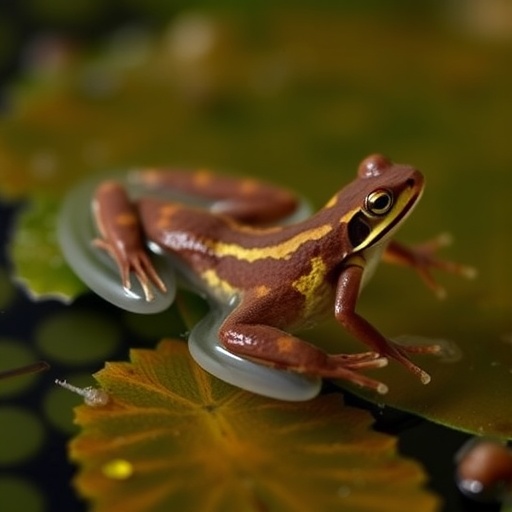
Microplastics have now been shown to subtly but measurably rewire the swimming behavior of one of North America’s most widespread amphibians, raising fresh concerns about what a plastic-polluted world is doing to the animals that live in its ponds and wetlands. In a new study published in the journal Ecotoxicology, researchers from The University of Winnipeg, Queen’s University, the University of Waterloo, and Environment and Climate Change Canada report that wood frog (Rana sylvatica) tadpoles exposed to a realistic mixture of common plastics throughout their development display distinct changes in how often, how intensely, and in what manner they move. The findings, led by Jess B. Lecours and Caleb T. Hasler at the University of Winnipeg together with Sam M. Gene, Diane M. Orihel, Barbara A. Katzenback, and Jennifer F. Provencher, suggest that even when microplastics do not kill or visibly sicken amphibian larvae, they may be quietly reshaping behaviors that underpin survival in the wild.
The wood frog is an ideal test case for this kind of question. It is one of the most cold-tolerant vertebrates in North America, breeding explosively in ephemeral spring ponds that often sit close to roads, agricultural runoff, and other sources of plastic debris. Because those temporary wetlands receive water from surrounding landscapes and accumulate whatever the meltwater carries, they are natural sinks for the plastic fragments shed by packaging, textiles, and everyday consumer products. Tadpoles developing in these ponds feed continuously, pumping water and organic material through their mouths, and in doing so they inevitably ingest particles small enough to pass as food. Earlier work by some of the same authors, including an outdoor mesocosm experiment published in Environmental Toxicology and Chemistry in 2025, had already shown that microplastics can affect wood frogs across multiple life stages, but the question of whether chronic exposure alters behavior specifically had remained open.
To answer it, the team designed an exposure experiment that tracked animals from the very start of life. Wood frog embryos were collected and raised for 49 days in water containing one of three treatments: a negative control with no microplastics, a low concentration of 50,000 microplastic particles per liter (the 1× treatment), and a high concentration of 500,000 particles per liter (the 10× treatment). Crucially, the exposure was not a single pristine polymer type chosen for laboratory convenience. The researchers used an equal-parts mixture of polystyrene, polypropylene, and polyethylene terephthalate — three of the most common plastics in the world — and the particles carried chemical additives, making the mixture a closer analog of the weathered, contaminated plastics actually found in the environment. Exposure began at the egg stage and continued through early larval development, ending when tadpoles had reached Gosner Stages 30 to 36, a window in which swimming becomes central to feeding, avoiding predators, and negotiating the pond environment.
The behavioral assays that followed were built for precision. Each tadpole was placed into an open testing arena and video-recorded for ten minutes, and the footage was then analyzed using automated tracking software — Ethovision XT14 — which converts an animal’s path into a continuous stream of quantitative data: total distance travelled, swimming velocity, the frequency and duration of different activity states, and the number of discrete “bouts” of movement at low, moderate, and high intensity. This approach belongs to a growing field sometimes called integrative behavioral ecotoxicology, which treats behavior not as a curiosity but as a sensitive, integrative readout of physiological stress. Because behavior sits at the interface between an animal’s internal state and its ecological performance, subtle shifts in movement can foreshadow consequences that gross toxicity tests miss entirely.
The results showed a clear pattern of suppressed and altered activity, with the two exposure doses producing partly different signatures. Tadpoles in the 1× treatment recorded fewer bouts of moderate activity than their unexposed counterparts, and although the differences did not reach statistical significance, there were consistent downward trends in swimming velocity and total distance travelled compared with control animals. In other words, even at the lower concentration, the plastics appeared to be sapping some element of routine locomotor performance. The 10× treatment told a complementary story: tadpoles at the high concentration spent less time in a high-activity state and completed fewer bouts of high-intensity movement than controls. High-speed swimming is precisely the behavior a tadpole deploys when a predator strikes or when it needs to sprint to a refuge, so a reduction in the capacity or inclination for such bursts could carry immediate fitness consequences in a pond crowded with hungry dragonfly nymphs and beetles.
Interpreting these effects requires thinking about what locomotion actually does for a tadpole. Activity level in larval amphibians is a classic ecological trade-off: animals that move more encounter more food and grow faster, but they also expose themselves more often to predators, which in turn detect and capture moving prey more readily. Decades of research on larval amphibians, including foundational work on the costs of antipredator behavior in wood frogs and related species, has shown that even small changes in the balance between foraging and vigilance can cascade through growth rates, time to metamorphosis, and ultimately survival to adulthood. If chronic microplastic exposure biases tadpoles toward lower activity — fewer bouts, less time at high intensity, trends toward slower and shorter swimming — then the plastic itself may be forcing the same kind of energetic compromise that a natural predator would, without any predator being present. At the population level, altered food-capture rates, shifted predator–prey dynamics, and changed patterns of habitat use within the pond are all plausible downstream outcomes, and the authors explicitly flag these as the ecological stakes of their findings.
What is causing the behavioral shifts remains an open physiological question, and the study is careful not to overclaim. Microplastics could interfere with locomotion through several non-exclusive routes. Ingested particles may physically occupy gut volume, diluting the nutrition available from normal food and reducing the energy reserves available for costly bursts of swimming — a mechanism supported by prior work in fish showing that polystyrene exposure alters behavior, energy reserves, and nutritional composition. Plastics also carry additive chemicals, some of them endocrine-active or neurotoxic, that can leach into gut tissues and potentially disrupt neuromuscular function, a route consistent with studies linking micro- and nanoplastics to neurobehavioral toxicity through the brain–gut–microbiota axis in fish. There may also be immunological costs: recent research on African clawed frog tadpoles found that ingesting polyethylene terephthalate microplastics weakened resistance to ranavirus and compromised antiviral immunity, suggesting that the immune and energetic budgets of exposed larvae are drawn down in ways that could plausibly manifest as reduced activity. The Canadian team’s own stated priority for future research — linking the observed behavioral changes to the energetic and developmental status of the tadpoles — targets exactly this mechanistic gap.
The statistical pattern also deserves careful reading, because it illustrates a challenge that runs through behavioral ecotoxicology as a whole. Not every metric the researchers quantified reached conventional significance thresholds; some effects emerged as clear, directional trends rather than confirmed differences. The authors themselves situate this honestly, noting that behavioral variation between species and between studies is a hallmark of the microplastics literature, and citing recent methodological arguments that genuine negative or weak findings must be recognized and reported rather than buried. The value of this study lies partly in its design discipline: chronic exposure across an entire developmental window, a mixture of environmentally common polymers with additives, two orders of magnitude of concentration spanning realistic to elevated levels, and objective, automated quantification of behavior rather than subjective scoring. Together these features make the observed suppression of activity states difficult to dismiss as experimental noise, even where individual p-values fall short.
The broader context makes the findings timely. Humanity has produced roughly ten billion tonnes of plastic since the mid-twentieth century, and a substantial fraction has escaped into the environment, fragmenting into particles now detected everywhere from alpine lakes to Arctic ice. Freshwater systems, and small ponds in particular, are efficient traps for these fragments, and surveys from the Yangtze River Delta to European wetlands have documented microplastics in waterbodies and in the larvae of toads, frogs, and newts along gradients of human pressure. Amphibians, meanwhile, are the most threatened vertebrate class on Earth, facing declines driven by habitat loss, disease, climate change, and chemical pollution, and the global conservation community has repeatedly called for better understanding of emerging contaminants. There has long been debate over whether amphibians are especially sensitive sentinels of environmental contamination or, conversely, comparatively robust; studies like this one — showing sublethal, behavior-level impacts at concentrations achievable in polluted wetlands — argue that the group deserves the cautionary treatment regardless of where that debate settles.
For now, the image that emerges is a sobering one: ponds that look pristine, tadpoles that look healthy, and beneath the surface a quiet erosion of the rapid, energetic movements that keep a young amphibian alive. The wood frog’s range stretches across most of Canada and the eastern United States, which means the behaviors measured in this study belong to an animal that millions of North Americans hear chorusing every spring. If microplastics can dampen those animals’ high-speed escapes and moderate foraging bouts during the weeks they spend as larvae, the cumulative cost across a breeding season — and across a landscape threaded with plastic — may be far larger than any single pond experiment can capture. The Canadian team’s next step, connecting the movement data to energetics and development, will help determine how deep those costs run, and whether the plastic in the water is doing to tadpoles what predators have always done, only more slowly and without ever revealing itself.
Cite Scienmag News
Sloane Callahan. (September 7, 2026). Microplastics Alter Swimming Behavior in Wood Frog Tadpoles. Scienmag. https://scienmag.com/microplastics-alter-swimming-behavior-in-wood-frog-tadpoles/
Sloane Callahan. "Microplastics Alter Swimming Behavior in Wood Frog Tadpoles." Scienmag, 7 September 2026, https://scienmag.com/microplastics-alter-swimming-behavior-in-wood-frog-tadpoles/. Accessed 7 September 2026.
Sloane Callahan. "Microplastics Alter Swimming Behavior in Wood Frog Tadpoles." Scienmag. September 7, 2026. https://scienmag.com/microplastics-alter-swimming-behavior-in-wood-frog-tadpoles/


