


Micro- and nanoplastics are in our food, water and the air we breathe. They are showing up in our bodies, from testicles to brain matter.

Credit: Martin Dee
Micro- and nanoplastics are in our food, water and the air we breathe. They are showing up in our bodies, from testicles to brain matter.
Now, University of British Columbia researchers have developed a low-cost, portable tool to accurately measure plastic released from everyday sources like disposable cups and water bottles.
The device, paired with an app, uses fluorescent labeling to detect plastic particles ranging from 50 nanometres to 10 microns in size – too small to be detected by the naked eye – and delivers results in minutes.
The method and findings are detailed in ACS Sensors.
“The breakdown of larger plastic pieces into microplastics and nanoplastics presents significant threats to food systems, ecosystems, and human health,” said Dr. Tianxi Yang, an assistant professor in the faculty of land and food systems, who developed the tool. “This new technique allows quick, cheap detection of these plastics, which could help protect our health and ecosystems.”
Nano and microplastics are byproducts of degrading plastic materials such as lunchboxes, cups and utensils. As very small particles with a large surface area, nanoplastics are particularly concerning to human health due to their increased ability to absorb toxins and penetrate biological barriers within the human body.
Detecting these plastics typically requires skilled personnel and expensive equipment. Dr. Yang’s team wanted to make detection faster, more accessible and more reliable.
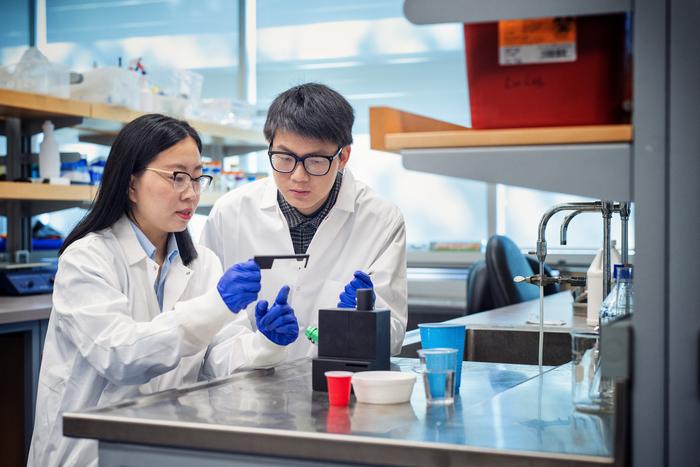
They created a small, biodegradable, 3D-printed box containing a wireless digital microscope, green LED light and an excitation filter. To measure the plastics, they customized MATLAB software with machine-learning algorithms and combined it with image capture software.
The result is a portable tool that works with a smartphone or other mobile device to reveal the number of plastic particles in a sample. The tool only needs a tiny liquid sample – less than a drop of water – and makes the plastic particles glow under the green LED light in the microscope to visualize and measure them. The results are easy to understand, whether by a technician in a food processing lab or just someone curious about their morning cup of coffee.
For the study, Dr. Yang’s team tested disposable polystyrene cups. They filled the cups with 50 mL of distilled, boiling water and let it cool for 30 minutes. The results showed that the cups released hundreds of millions of nano-sized plastic particles, roughly one-hundredth the width of a human hair and smaller.
“Once the microscope in the box captures the fluorescent image, the app matches the image’s pixel area with the number of plastics,” said co-author Haoming (Peter) Yang, a master’s student in the faculty of land and food systems. “The readout shows if plastics are present and how much. Each test costs only 1.5 cents.”
The tool is currently calibrated to measure polystyrene, but the machine-learning algorithm could be tweaked to measure different types of plastics like polyethylene or polypropylene. Next, the researchers aim to commercialize the device to analyze plastic particles for other real-world applications.
The long-term impacts of ingesting plastic from beverages, food, and even from airborne plastic particles are still being studied but show cause for concern.
“To reduce plastic ingestion, it is important to consider avoiding petroleum-based plastic products by opting for alternatives like glass or stainless steel for food containers. The development of biodegradable packaging materials is also important for replacing traditional plastics and moving towards a more sustainable world,” said Dr. Yang.
Journal
ACS Sensors
Method of Research
Computational simulation/modeling
Article Title
Cost-Effective and Wireless Portable Device for Rapid and Sensitive Quantification of Micro/Nanoplastics
Article Publication Date
12-Aug-2024
Cite Scienmag News
Bethany Barker. (August 27, 2024). How much microplastic are you drinking? New UBC tool can tell you in minutes. Scienmag. https://scienmag.com/how-much-microplastic-are-you-drinking-new-ubc-tool-can-tell-you-in-minutes/
Bethany Barker. "How much microplastic are you drinking? New UBC tool can tell you in minutes." Scienmag, 27 August 2024, https://scienmag.com/how-much-microplastic-are-you-drinking-new-ubc-tool-can-tell-you-in-minutes/. Accessed 3 September 2026.
Bethany Barker. "How much microplastic are you drinking? New UBC tool can tell you in minutes." Scienmag. August 27, 2024. https://scienmag.com/how-much-microplastic-are-you-drinking-new-ubc-tool-can-tell-you-in-minutes/

