


In the rugged agricultural heartland of Southwest China, where limestone bedrock shapes both the landscape and the livelihoods of farming communities, an invisible threat has been quietly accumulating in soil, crops, and the bodies of residents themselves. A new study published in Environmental Geochemistry and Health has, for the first time in such a setting, connected the dots across the entire exposure pathway, tracing heavy metals from contaminated farmland through the food supply and into human hair and nail samples collected from local adults and children. The findings paint an unsettling picture: cadmium pollution in the region’s cultivated soils is so severe that it exceeds standard contamination indices by an order of magnitude, food crops regularly violate national safety limits for cadmium and chromium, and formal probabilistic risk modeling indicates that both children and adults face health risks well above thresholds considered acceptable. Perhaps most strikingly, the researchers found distinct age-related fingerprints of metal accumulation in the human biomonitoring samples, suggesting that exposure patterns differ in ways that current risk assessments may systematically overlook.
The research, led by Zelan Wang and Jie Yao of Guizhou Medical University and the Guizhou Center for Disease Control and Prevention, together with Ting Yang, Changhu Lin and Chenglong Tu, focused on a typical karst agricultural town in Southwest China. Karst landscapes, formed by the dissolution of soluble carbonate rocks such as limestone and dolomite, are geochemically unusual. The soils that develop from carbonate bedrock are often thin, alkaline or locally acidic, and naturally enriched in certain trace elements. At the same time, karst regions of provinces like Guizhou host substantial mineralization, including lead-zinc deposits whose mining and smelting have historically added industrial contamination to an already elevated natural background. This duality, where geology and human industry overlap, has long complicated the question of responsibility: how much of the metal burden in local food and people stems from ancient rock, and how much from smokestacks, tailings, and traffic? The new study was designed to confront that ambiguity head-on by sampling every link in the chain from environment to human.
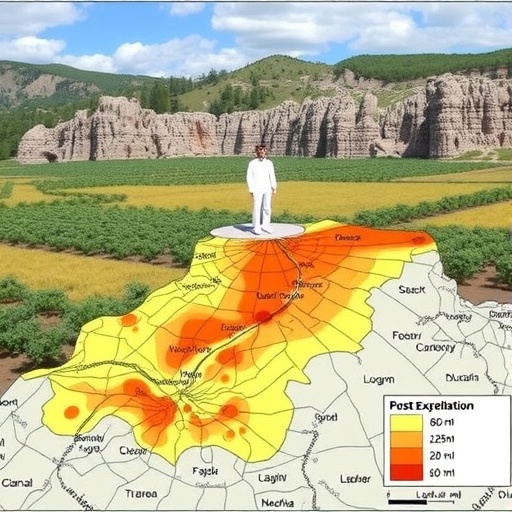
The team collected and analyzed three environmental compartments: cultivated soils, surface water, and agricultural food crops. In the soils, the results were unequivocal. Concentrations of cadmium, lead, and zinc were strongly enriched relative to background values, and cadmium stood out as the driver of severe pollution. Using the single-factor pollution index, cadmium registered values exceeding 10, a level that classifies soils as heavily contaminated by any conventional grading scheme, while the integrated Nemerow pollution index surpassed 1, confirming that overall soil quality is compromised. By contrast, the region’s surface water told a different story entirely: samples met Class I quality standards, the strictest category in China’s environmental water quality framework. This contrast is scientifically meaningful. It indicates that contaminated water is not the primary vehicle moving metals through the landscape. Instead, the soil itself, and the crops grown in it, act as the principal conduit between geological and industrial sources and the dinner plates of local residents.
The food crop analysis revealed how efficiently this contamination is transferred into the human food supply. Agricultural products in the study area frequently exceeded national food safety limits for cadmium and chromium, and among all the metals examined, cadmium exhibited the highest bioaccumulation potential, meaning plants absorb and retain it at disproportionately high concentrations relative to soil levels. This tendency is well documented in crops grown on cadmium-rich acidic soils, but the magnitude observed here, combined with the fact that local populations consume locally grown staples daily, creates a chronic exposure scenario rather than an occasional one. Because cadmium accumulates in the kidneys and has a biological half-life measured in decades, repeated dietary intake even at moderate levels can lead to substantial body burdens over time. The crop findings thus transformed what might have been a routine soil survey into a pressing public health question: were these contaminated foods actually making their way into people’s bodies?
To answer that question, the researchers turned to human biomonitoring, analyzing hair and nail samples as non-invasive biomarkers of metal exposure. Keratin-rich tissues such as hair and nails sequester trace elements during growth, providing a time-integrated record of exposure that blood or urine cannot easily match for elements like cadmium and lead. The results revealed clear age-specific accumulation patterns. Children showed higher levels of zinc, chromium, and nickel in their hair and nails, while adults carried greater burdens of lead, cadmium, copper, and arsenic. Multivariate statistical analysis of the biomonitoring data reinforced these distinctions. The elevated zinc in children may partly reflect the higher physiological demand for this essential element during growth and development, but the elevated chromium and nickel point to genuine exposure differences, possibly related to behavior, diet composition, or contact with contaminated dust and soil. The adult pattern, dominated by lead and cadmium, is consistent with years of cumulative dietary intake from contaminated staple foods.
To quantify the health implications, the team employed Monte Carlo simulation, a probabilistic technique that runs thousands of exposure calculations using random samples drawn from the measured concentration distributions, rather than relying on single-point estimates that can either overstate or understate risk. The output was sobering. The hazard index, a measure of aggregate non-carcinogenic risk across multiple metals and pathways, reached 4.55 for children, more than four times the threshold value of 1 that separates acceptable from unacceptable risk. Children’s higher respiratory rates per unit body weight, greater hand-to-mouth activity, and developing physiology all contribute to this elevated vulnerability. More alarmingly, the total carcinogenic risk, expressed as the probability of developing cancer over a lifetime of exposure, was calculated at 1.71 × 10⁻³ for adults and 1.42 × 10⁻³ for children, both far above the commonly accepted upper limit of 1 × 10⁻⁴. Within these aggregate figures, nickel and cadmium emerged as the dominant contributors, making them clear priority targets for intervention.
Understanding where the metals came from was the remaining analytical challenge, and for this the researchers applied Positive Matrix Factorization, a receptor modeling technique that decomposes concentration data into a set of source profiles and source contributions by finding the mathematical combination of factors that best explains the observed elemental patterns. The PMF analysis resolved four major factors, whose elemental loading patterns suggested contributions associated with mining, industrial, and traffic activities; lithogenic or geological sources tied to the natural composition of the karst bedrock; and agricultural inputs such as fertilizers and amendments. This multi-source picture aligns with the study’s central thesis: neither geology nor human activity alone can account for the contamination. Instead, the two converge in this karst agroecosystem, with naturally metal-rich parent material providing a high baseline and anthropogenic activities pushing concentrations past critical thresholds in some locations. This has direct regulatory implications, because remediation strategies calibrated for purely industrial contamination may be poorly matched to landscapes where the geochemical background itself is elevated.
The authors are careful in their interpretation, noting that the elemental loading patterns from PMF suggest, rather than prove, particular source associations. This epistemic caution is appropriate: receptor models identify statistical structure in the data, but definitive source attribution typically requires corroborating evidence such as isotopic signatures or spatial analysis of contamination relative to known emission points. Nevertheless, the convergence of multiple lines of evidence, including severe cadmium pollution in soils, the clean bill of health for surface water, high crop bioaccumulation, quantified human health risks, and age-differentiated biomonitoring patterns, makes a compelling case that dietary intake of contaminated local food is the dominant exposure route and that cadmium and nickel should be treated as priority elements for risk control in vulnerable karst regions.
The broader significance of the work extends well beyond a single Chinese town. Karst terrains cover a substantial fraction of southern China and similar landscapes worldwide, from the Dinaric Alps to parts of Southeast Asia and Central America, and many of these regions support dense agricultural populations. The methodological framework deployed here, combining multi-compartment environmental sampling, PMF source apportionment, Monte Carlo risk quantification, and human biomonitoring in a single integrated design, offers a template that other affected regions can adopt. Most contamination studies stop at the soil or the crop; few follow the contaminant all the way into human tissue and then close the loop back to source. That closure is what allows evidence-based prioritization: without knowing both where metals originate and who is most exposed, regulators cannot efficiently allocate scarce remediation resources.
For the residents of the study area, the practical message is urgent but not without solutions. Options for cadmium in karst agricultural soils include the use of soil amendments such as lime or biochar to reduce metal mobility and plant uptake, selection or breeding of low-accumulating crop varieties, and targeted replacement of the most contaminated cropland with non-food uses. The identification of children as the group facing the highest non-carcinogenic hazard underscores the need for interventions that protect the youngest members of farming communities, whether through dietary diversification, imports of safe staple foods, or hygiene measures that reduce incidental soil ingestion. The study, funded by the National Natural Science Foundation of China and Guizhou Medical University, demonstrates that in landscapes where geology and industry conspire, only a full-chain assessment, from bedrock to bloodstream, can reveal the true scale of the risk and point the way toward effective public health action.
Cite Scienmag News
Russell Cooper. (September 6, 2026). Heavy metal contamination and human exposure assessed in karst agricultural region. Scienmag. https://scienmag.com/heavy-metal-contamination-and-human-exposure-assessed-in-karst-agricultural-region/
Russell Cooper. "Heavy metal contamination and human exposure assessed in karst agricultural region." Scienmag, 6 September 2026, https://scienmag.com/heavy-metal-contamination-and-human-exposure-assessed-in-karst-agricultural-region/. Accessed 6 September 2026.
Russell Cooper. "Heavy metal contamination and human exposure assessed in karst agricultural region." Scienmag. September 6, 2026. https://scienmag.com/heavy-metal-contamination-and-human-exposure-assessed-in-karst-agricultural-region/


