


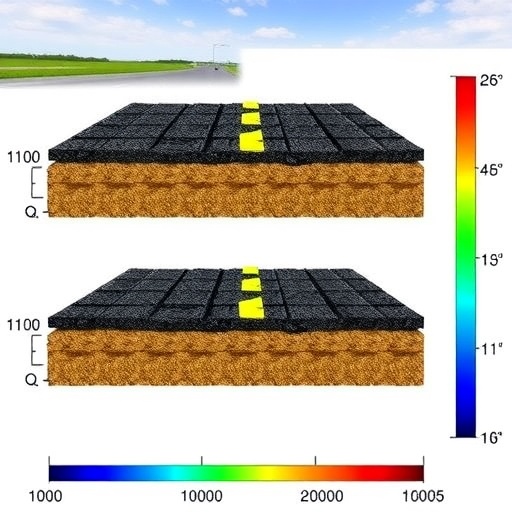
Beneath the smooth surface of an asphalt highway lies a hidden architecture of layered materials—asphalt concrete, base, subbase, and subgrade—whose individual stiffnesses ultimately determine whether a road will carry heavy traffic for decades or crumble prematurely into ruts and cracks. Knowing precisely how stiff each buried layer is has long been one of pavement engineering’s most stubborn challenges, because the most valuable evidence lies underground, out of sight and out of reach of conventional inspection. A new study published in Results in Engineering by Sooho Jung, Kyu-Dong Jeong, and Sungho Mun tackles this problem head-on, presenting an integrated framework that reconciles two fundamentally different field-testing philosophies—the nondestructive falling weight deflectometer and the destructive dynamic cone penetrometer—to determine the layered material stiffnesses of asphalt pavement structures with unprecedented rigor.
The falling weight deflectometer, or FWD, has been a cornerstone of pavement evaluation since the early 1990s. The device operates on a deceptively simple principle: a set of weights is dropped onto a platform fitted with rubber buffers, and the resulting impulse travels through a loading plate onto the pavement surface. A load cell records the time history of the applied pressure, while an array of geophone sensors, spaced at radial distances ranging from 0 to 180 centimeters from the center of the 30-centimeter loading plate, measures how much the surface deflects at each point. The resulting pattern of deflections, known as a deflection basin, encodes the stiffness of every layer beneath the surface. Stiffer layers produce shallower, flatter basins; weak layers allow deeper, broader deformation. But translating a measured basin into individual layer moduli requires an iterative inverse procedure called back-calculation, in which a theoretical multilayered elastic model is adjusted until its predicted deflections match the field measurements within a specified tolerance. Programs such as MODULUS have performed this task for over three decades, yet the reliability of the output depends entirely on the quality and stability of the input deflection data—something the new study shows cannot be taken for granted.
The researchers discovered that the very first drops of the FWD weight can contaminate the measurements. Soils, particularly subgrade materials, can exhibit nonlinear behavior under repeated loading, and the initial impacts disturb the layered structure, producing deflection basins that do not reflect the true elastic steady state. To quantify this effect, the team introduced a diagnostic metric called the displacement and force ratio, or DFR, calculated as the measured displacement divided by the applied FWD load at each sensor location. By analyzing how the DFR basin evolves across sequential drops at seven randomly chosen test sections, they found that the first loading event causes disproportionately greater structural disturbance, and that repeated drops at 40 or 50 kilonewtons drive the DFR distribution toward convergence. At 50 kilonewtons, the relative errors between successive drops at the first sensor fell from 0.202 to 0.034, while at 40 kilonewtons they dropped from 0.073 to 0.017—a clear mathematical signature of stabilization. On this basis, the study recommends using the third drop at the 50-kilonewton level, or the second or third drop at 40 kilonewtons, when compiling deflection data for back-calculation. Notably, the Cambodian Ministry of Public Works and Transport has historically relied on the second loading data at 50 kilonewtons, a practice the new findings suggest could be refined.
The destructive counterpart to the FWD is the dynamic cone penetrometer, a device that drives a cone-shaped tip into the ground with a standardized hammer and records the penetration achieved per blow. Stiffer soils resist the cone and yield lower penetration rates; softer soils allow the tip to advance more readily. The raw cumulative blow counts are converted into the dynamic cone penetration index, defined as the incremental penetration depth divided by the corresponding blow count. Because the DCP directly interrogates subsurface layers rather than inferring their properties from surface response, it provides an independent, physically grounded measure of in-situ strength that can be converted into the California Bearing Ratio, the dimensionless strength metric used worldwide for pavement design. The study evaluated three established correlation equations linking CBR and DCPI—those of Harison, Livneh, and Webster and colleagues—to assess whether constructed layers on Cambodian national roads satisfied the required design values.
The field laboratory for this investigation was provided by Roads 2 and 22 in Cambodia, built with financing from Korea’s Economic Development Cooperation Fund, a public fund that supports industrial development and economic stability in partner nations. This setting gave the research a practical mandate that extends far beyond academic curiosity: if the framework can verify that constructed pavements meet quality control and quality assurance standards, the same methodology can be applied to evaluate other EDCF-funded roads and to judge whether Cambodia’s national standards—which have been in use since the World Bank donated three Kuab FWDs to the country—are adequate for modern traffic demands. The work thus sits at the intersection of geotechnical science, international development, and infrastructure policy, demonstrating how rigorous field mechanics can inform decisions about billions of dollars in road investment.
At the heart of the study lies the concept of resilient modulus, the stiffness parameter that describes how pavement materials recover elastically under repeated traffic loading. The resilient modulus is the preferred input for multilayered elastic analysis programs and finite element method simulations because it captures a wide range of material stiffnesses across the layered system. The researchers compared multiple published conversion techniques: two methods for translating subgrade properties into resilient modulus, and two distinct approaches for converting the base and subbase DCP indices into equivalent moduli. For the asphalt concrete layer itself, which behaves as a viscoelastic material whose stiffness depends strongly on temperature and loading rate, the team determined dynamic moduli from Marshall test results, performance grade binder characteristics, and representative viscoelastic properties. Each converted modulus became an input to a forward calculation, and the acid test was simple: would a layered model built from DCP-derived stiffnesses reproduce the deflection basin actually measured by the FWD?
To answer that question, the researchers employed a discrete spectral program capable of analyzing the asphalt layered structure, computing theoretical deflection basins from the converted layer moduli and comparing them point-by-point against field measurements at six test sites. This forward-modeling validation loop—destructive testing feeding stiffness estimates into a spectral solver whose predictions are checked against nondestructive measurements—constitutes the four-stage framework that forms the study’s central contribution. The stages proceed logically: first, evaluate FWD load-level nonlinearity to identify stable deflection basins suitable for reliable back-calculation; second, conduct DCP tests to quantify subsurface and subgrade strength and assess whether current CBR criteria suffice for quality assurance; third, estimate subgrade and granular layer stiffnesses through DCPI-to-resilient-modulus correlations while determining asphalt-layer dynamic moduli from mixture and binder testing; and fourth, compare field-measured basins with discrete spectral program predictions to validate the models and examine discrepancies between the AASHTO overlay design approach and applicable national standards.
The significance of this framework extends into the mechanics of the comparison itself. Classical design methods, including the American Association of State Highway and Transportation Officials overlay design procedure, rest on correlations between CBR values and elastic moduli—relationships such as the NAASRA equation, which expresses the elastic modulus in megapascals as 16.2 times the CBR raised to the power of 0.7 for values up to 5, and the Heukelom and Klomp correlation for fine-grained soils with low swelling potential. But as the study emphasizes, if the elastic modulus is not determined correctly, the derived modulus of subgrade reaction becomes unreliable, and every design calculation downstream inherits that error. By quantitatively assessing discrepancies between design-based material properties and the in-service structural stiffness actually measured in the field, the framework gives engineers a defensible way to decide when a pavement needs rehabilitation and when it can safely remain in service under extreme traffic loads.
The methodological care underlying the results reflects a broader lesson for infrastructure science: measurement protocols matter as much as measurement devices. A deflection basin collected too early in a loading sequence, or at a load level where the subgrade behaves nonlinearly, can bias back-calculated moduli in ways that propagate silently into rehabilitation decisions costing millions. Similarly, converting DCP indices to CBR values through multiple competing regression equations demands that engineers understand which correlation best represents their specific soils and regional conditions. The Cambodian roads provided an ideal proving ground precisely because they combined tropical heat—air temperatures of 35 to 38 degrees Celsius and pavement surface temperatures reaching 44 degrees during testing, conditions that significantly soften asphalt concrete—with layered structures whose as-built properties could be compared against original design documents supplemented by ground-penetrating radar surveys of layer thickness.
In an era when nations across Southeast Asia and beyond are investing heavily in road networks as engines of economic growth, the ability to verify independently that constructed pavements actually possess their designed stiffness is a matter of public accountability as much as engineering. The integrated FWD–DCP framework developed by Jung, Jeong, and Mun offers a template for that verification, bridging the gap between what designers specify, what contractors build, and what vehicles will ultimately impose on the structure. By demonstrating that carefully sequenced nondestructive testing, validated against direct destructive penetration measurements and rigorous spectral forward modeling, can deliver trustworthy layered stiffness profiles under real field conditions, the study transforms pavement evaluation from a matter of assumption into a matter of measurable, checkable fact—a shift that could echo through quality assurance standards from Phnom Penh to far beyond.
Cite Scienmag News
Denise Maddox. (September 6, 2026). New field-testing methods reveal stiffness of asphalt pavement layers. Scienmag. https://scienmag.com/new-field-testing-methods-reveal-stiffness-of-asphalt-pavement-layers/
Denise Maddox. "New field-testing methods reveal stiffness of asphalt pavement layers." Scienmag, 6 September 2026, https://scienmag.com/new-field-testing-methods-reveal-stiffness-of-asphalt-pavement-layers/. Accessed 6 September 2026.
Denise Maddox. "New field-testing methods reveal stiffness of asphalt pavement layers." Scienmag. September 6, 2026. https://scienmag.com/new-field-testing-methods-reveal-stiffness-of-asphalt-pavement-layers/


