


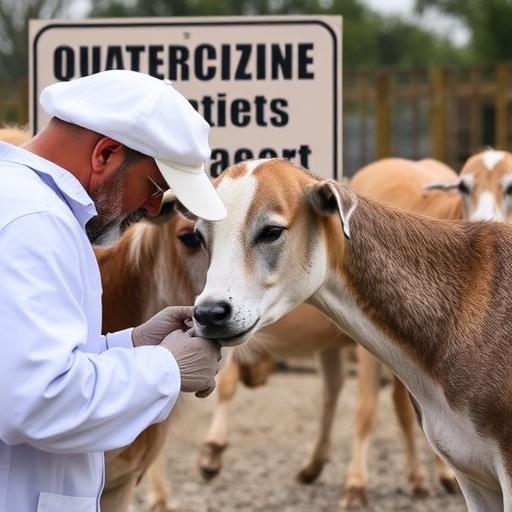
In the global fight against animal and zoonotic disease, the most important battles are often fought not in laboratories or hospitals but at borders, in dusty inspection sheds at land crossings, in quarantine stations at seaports and airports where livestock, animal products, germplasm, and feed are held, tested, and sometimes destroyed. A new review published in Discover Animals argues that this frontline defense—veterinary border quarantine—has been chronically undervalued, particularly in low- and middle-income countries, where it is treated as an administrative compliance formality rather than the strategic public health infrastructure the authors contend it truly is. The paper, led by Muhammad Yasir Alhassan of Symbiosis Institute of Health Sciences in India, with Farida Abubakar and Abba Idris of Usmanu Danfodiyo University in Nigeria, synthesizes regulatory, operational, epidemiological, and institutional evidence to explain why quarantine systems in many countries underperform and what realistic pathways exist to modernize them.
The stakes are considerable. The global movement of live animals, meat, milk, semen, embryos, feed ingredients, and biological materials has created expanding routes by which pathogens of high epidemic potential can be translocated into countries lacking the biosecurity capacity to intercept them. The review catalogues the primary culprits: transboundary animal diseases such as highly pathogenic avian influenza, African swine fever virus, foot-and-mouth disease virus, lumpy skin disease virus, and peste des petits ruminants virus. These pathogens circulate at elevated intensity in exactly the regions that host most of the world’s livestock, sustain extensive informal cross-border trade, and contain critical wildlife interfaces—yet often lack the institutional, technical, and financial resources to run quarantine systems to international standards. The intersection of high pathogen pressure, porous borders, and thin institutional capacity, the authors write, makes LMIC border quarantine the most consequential and simultaneously the most constrained node in global biosecurity.
Conceptually, the review distinguishes quarantine from its neighbors in the animal health governance architecture. Import risk analysis generates probabilistic estimates of pathogen entry for given commodities and trading partners; internal movement control regulates redistribution within national territories after an introduction; surveillance detects pathogens already circulating. Quarantine, by contrast, is the procedural intervention that converts regulatory authority into physical action at the border—the officer who inspects, the laboratory that tests, the facility that detains, and the mandate that authorizes destruction or re-export. Its epidemiological rationale is that interrupting pathogen introduction before domestic amplification is far more resource-efficient than controlling spread after establishment, a principle of particular importance for pathogens with high transmission rates and short generation intervals, where a single undetected infected consignment can seed an outbreak requiring enormous national resources to contain.
The legal scaffolding for this work rests on three principal international instruments. The World Trade Organization’s Agreement on the Application of Sanitary and Phytosanitary Measures permits quarantine measures that are scientifically justified, proportional to assessed risk, and applied consistently across trading partners. The World Organisation for Animal Health (WOAH) Terrestrial Animal Health Code provides the risk-based technical reference for import permits, veterinary certification, and disease-free status recognition, while the WOAH Manual of Diagnostic Tests and Vaccines for Terrestrial Animals underpins laboratory confirmation. The International Health Regulations govern notification and response for zoonotic pathogens at points of entry, and the Convention on International Trade in Endangered Species adds a parallel permit layer for wildlife consignments—one whose documentation requirements, the review notes, sometimes conflict with veterinary quarantine procedures at busy airports and seaports, demanding inter-agency coordination that is frequently absent in LMIC border management.
Yet the evidence assembled shows that underperformance in LMIC quarantine is driven less by the absence of standards than by what happens, or fails to happen, beneath them. Weak governance independence emerges as the binding constraint: where the veterinary authority lacks legal independence from political influence, adequate funding, or authority to act against powerful trading interests, quarantine integrity is compromised regardless of technical capacity. Thin diagnostic capacity compounds the problem—centralized veterinary laboratories capable of processing quarantine samples are often distant from border posts, with transit times exceeding the stability of labile pathogens, promoting prolonged detention or, worse, informal clearance without testing. Many LMIC systems, the review observes bluntly, can inspect visually but cannot test diagnostically. Workforce shortages, fragmented data systems, and the absence of compensation mechanisms for traders whose consignments are destroyed add further friction, creating disincentives for compliance and enforcement alike.
The structural dominance of informal trade looms largest of all. In sub-Saharan Africa, the majority of cross-border livestock movements occur outside formal channels, bypassing official points of entry entirely and rendering quarantine inspection structurally inapplicable to the bulk of introduction risk. Network analysis of small ruminant movements in Uganda documented extensive trade through informal routes with minimal veterinary oversight, concluding that strategies depending exclusively on official border quarantine will miss most transboundary disease pathways. Cross-border camel circuits in the Horn of Africa, informal cattle movement across Yunnan Province’s borders in China, and the intercontinental flow of unregulated meat imports through European checkpoints all illustrate the same mismatch: quarantine systems calibrated to formal trade volumes are addressing a minority share of the actual risk. Notably, stochastic modeling of foot-and-mouth disease risk at the Thailand–Myanmar border found that complete elimination of informal trade channels was more effective than formal inspection procedures under conditions of high smuggling prevalence, though even partial quarantine compliance substantially reduced introduction risk.
The review also surveys a technological frontier that could reshape border quarantine within the decade. Portable nucleic acid amplification platforms, including isothermal amplification and miniaturized PCR systems, now enable field-deployable detection of priority pathogens at border posts, cutting test turnaround from days to hours and allowing perishable samples to be tested before biological degradation. Digital veterinary health certificates, cryptographically secured and verifiable in real time against issuing-authority databases, could suppress the fraudulent documentation that systematic reviews have identified as a persistent pathway for unregulated product movement. Risk-based targeting—directing inspection intensity toward consignments with the highest estimated introduction probability, informed by trade volumes, disease status, commodity hazards, and interception histories—has demonstrated measurable detection gains in well-resourced settings, including a validated systems analysis of Australian biosecurity borders. Machine learning applied to biosecurity assessment data has uncovered risk profiles invisible to conventional analysis, and whole-genome sequencing of intercepted pathogens can phylogenetically attribute outbreak strains to specific trade routes, creating an evidentiary basis for adjusting import conditions.
The authors are careful, however, to flag a specific and uncomfortable evidence gap: none of these tools—portable diagnostics, digital certification, AI-assisted targeting—has published field validation data from LMIC border posts under routine operating conditions. Their demonstrated performance comes from higher-resource settings; whether the gains transfer to contexts where power supply, connectivity, and maintenance capacity differ substantially is an immediate priority for field research. The review also acknowledges its own limits: it is a purposive narrative synthesis rather than a systematic review, and the underlying literature itself remains geographically concentrated, with Central Africa beyond Cameroon, most of Latin America outside Brazil, and much of Southeast Asia underrepresented.
The conceptual heart of the paper is its reframing of quarantine as One Health infrastructure. The One Health Joint Plan of Action, developed jointly by the FAO, UNEP, WHO, and WOAH, positions strengthened border biosecurity as integral to pandemic prevention, explicitly endorsing investment in LMIC veterinary capacity as a global health security priority—with an implementation timeline through 2026 that the authors describe as an immediate policy window. The review argues that inspection protocols addressing both the animal health status of consignments and the zoonotic risk they pose are more faithful to One Health principles than livestock-only screening, and that veterinary and public health border functions should be coordinated rather than run in parallel siloes. An assessment at the Libya–Tunisia border documented exactly the cost of non-integration: incomplete surveillance integration, restricted information sharing, and inadequate coordination for shared zoonotic threats, even where both countries were formally committed to One Health.
Ultimately, the authors make an economic as much as a scientific argument. Cost-benefit analyses of national veterinary service preparedness have found that returns to prevention investment substantially exceed the costs of outbreak response, yet preparedness funding consistently falls below optimal levels—most acutely at border posts, where capital investment in facilities, diagnostic equipment, and information technology must be sustained alongside recurrent personnel and consumables spending. Evidence from the COVID-19 pandemic adds a sobering lesson in enforcement: adherence and consistency of application were stronger determinants of epidemic control than the formal stringency of the measures themselves, suggesting that well-enforced moderate quarantine measures outperform nominally strict ones with poor compliance. Reframing border quarantine as strategic infrastructure—comparable to national laboratory systems or emergency response capacity—rather than administrative overhead, the review concludes, is the necessary condition for attracting the development bank instruments, global health security funds, and pandemic preparedness financing that LMIC systems need. Governance reform, the authors insist, is a precondition for returns on technical investment, not a parallel priority: without legal independence, enforcement authority, and accountability, no portable PCR machine or digital certificate will deliver the protection that formal regulatory mandates promise.
Cite Scienmag News
Kristina Jarvis. (September 5, 2026). Border veterinary quarantine: overlooked one health shield against zoonotic disease invasion. Scienmag. https://scienmag.com/border-veterinary-quarantine-overlooked-one-health-shield-against-zoonotic-disease-invasion/
Kristina Jarvis. "Border veterinary quarantine: overlooked one health shield against zoonotic disease invasion." Scienmag, 5 September 2026, https://scienmag.com/border-veterinary-quarantine-overlooked-one-health-shield-against-zoonotic-disease-invasion/. Accessed 5 September 2026.
Kristina Jarvis. "Border veterinary quarantine: overlooked one health shield against zoonotic disease invasion." Scienmag. September 5, 2026. https://scienmag.com/border-veterinary-quarantine-overlooked-one-health-shield-against-zoonotic-disease-invasion/


