


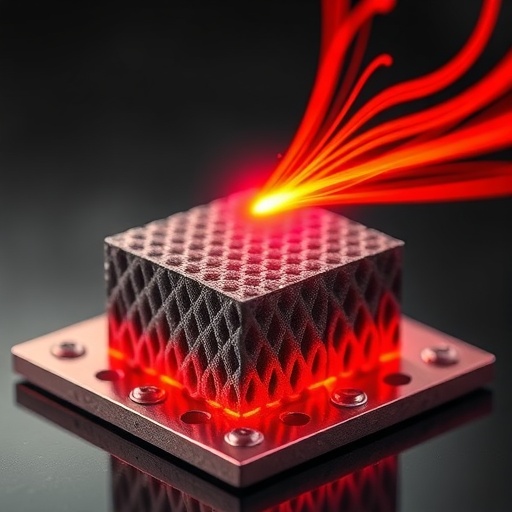
In a result that could reshape how engineers think about radio-frequency signal control, a team of researchers in Brazil and Mexico has demonstrated a giant enhancement of electromagnetic power transmission in ceramic samples of bismuth ferrite, one of the rarest commodities in materials science: a single-phase multiferroic that works at room temperature. By firing radio-frequency pulses along the surface of multiferroic BiFeO3 ceramics while subjecting them to carefully oriented magnetic fields, the researchers measured transmitted power gains of up to approximately 240 percent, a level of amplification achieved without any conventional electronic gain element such as a transistor or vacuum tube. The study, published in Applied Nanoscience, combines meticulous experimentation with a decades-old theoretical framework to reveal that the secret lies in coherent magnetostatic surface waves, spin excitations that ripple across the ceramic’s surface and couple constructively with the traveling electromagnetic pulse.
The material at the heart of the discovery, BiFeO3, has long fascinated physicists for its unusual combination of properties. It crystallizes in a rhombohedrally distorted perovskite structure belonging to the space group R3c, in which bismuth ions are displaced along the pseudocubic [111] direction and the oxygen octahedra surrounding iron are tilted in antiphase. This arrangement produces both ferroelectricity, with a Curie temperature near 1098 kelvin, and G-type antiferromagnetism, with a Néel temperature near 643 kelvin, meaning both orders survive comfortably above room temperature. The material also boasts a large remanent polarization of roughly 100 microcoulombs per square centimeter and a lead-free composition, making it attractive for sustainable electronics. Yet while most prior research on BiFeO3 ceramics has focused on boosting static or low-frequency magnetoelectric coefficients, typically on the order of 1 millivolt per centimeter-oersted, the new work demonstrates a qualitatively different functionality: active, dynamic amplification of electromagnetic energy under radio-frequency excitation.
The experimental design was elegantly simple. Rectangular ceramic samples were fitted with an emitting antenna at one end and a receiving antenna at the opposite end, so that electromagnetic pulses propagated along the longitudinal surface between them. The input power was fixed at 10 milliwatts, and rectangular pulses with widths of 5, 10, and 15 microseconds were transmitted at a repetition period of 2 milliseconds. Three distinct propagation geometries were tested. In the first, the pulse traveled perpendicular to both the static magnetic field and the oscillating magnetic field; in the second, it propagated parallel to the oscillating field but perpendicular to the static field; and in the third, it ran parallel to the static field and perpendicular to the oscillating field. Static fields up to 3 kilooersted and oscillating fields up to 100 oersted were applied. The systematic variation allowed the team to probe the anisotropic coupling between the traveling wave and the magnetically excited surface modes.
Quantitative microstructural analysis helped ensure that the observed effects were not artifacts of poor sample quality. Scanning electron microscopy images collected across different surface regions, with grain sizes determined from more than 150 grains using equivalent circular diameter analysis, yielded an average grain size of 1.8 plus or minus 0.4 micrometers and a mean surface roughness of approximately 0.22 plus or minus 0.05 micrometers. These values confirm a dense, relatively smooth ceramic surface, favorable for minimizing extrinsic scattering during surface-wave propagation. Magnetic characterization reinforced the physical picture: magnetization measured at 300 kelvin from minus 14 to plus 14 kilooersted showed a nearly linear, hysteresis-free response characteristic of the dominant antiferromagnetic state, with a subtle change in slope around 3 kilooersted hinting at field-responsive uncompensated surface spins. Alternating-current susceptibility measurements between 0 and 320 kelvin showed smooth behavior with no anomalies, confirming that no additional magnetic transition intrudes on the operational regime of the transmission experiments.
The power measurements revealed a striking dependence on geometry. When the RF pulse propagated perpendicular to both the static and oscillating magnetic fields, the transmitted power rose by approximately 240 percent. The configuration with propagation parallel to the oscillating field produced a gain of roughly 150 percent, while the geometry parallel to the static field yielded around 55 percent. To interpret these numbers, the team modeled the excitation and propagation within the Damon–Eshbach theoretical framework, the classic 1961 description of magnetostatic modes in ferromagnetic slabs, here extended for the first time in this form to a room-temperature multiferroic antiferromagnet. Dispersion relations were calculated for a finite rectangular slab matching the experimental dimensions, with a ceramic width of 5 millimeters, free-surface boundary conditions with negligible spin pinning, and a gyromagnetic factor of 2.8 times 10 to the 6 hertz per oersted. Exchange contributions were neglected because the experiments operated in the magnetostatic regime, where the product of wavevector and thickness is much less than one.
The quantitative machinery behind the analysis is as instructive as the result itself. The transmitted power was calculated as P equals Z times i squared, where Z is the 50-ohm system impedance and i is the induced RF current arising from the dynamic magnetic field of the magnetostatic surface mode. That current was expressed as i equals the square root of 2 times f times d divided by gamma, with f the excitation frequency and d the sample width, and since the ratio of frequency to gyromagnetic factor carries units of magnetic field, the resulting expression P of f equals 2Z times d squared times f over gamma squared is dimensionally consistent after calibration of the electromagnetic coupling constants. The cylindrical wire antenna driving the system carried an alternating current of 20 milliamperes, generating an azimuthal magnetic near field whose Fourier component coupled to a surface mode of wavevector k scales as h equals pi times the antenna current times the wavevector. When the theoretical power curves were fitted to the experimental data by least-squares minimization, the coefficient of determination exceeded 0.96 for all three geometries, the root-mean-square error stayed below 6 percent of the maximum normalized transmitted power, and the deviations between calculated and measured peak-field positions were smaller than the experimental field resolution.
The microscopic picture that emerges is one of surface spins doing the heavy lifting. In an ideal antiferromagnet, opposing spins cancel perfectly, but in polycrystalline ceramics the surfaces of grains and internal interfaces host uncompensated spins that a moderate magnetic field can manipulate. The oscillating magnetic field dynamically excites these spins, generating magnetostatic surface modes that couple constructively with the propagating RF pulse when the dispersion condition is satisfied. Although the excitation mechanism is localized at the surface, the coherent propagation of these modes produces amplification along the entire sample length. The strong geometry dependence is the key diagnostic: passive dielectric effects such as geometric waveguiding or direct antenna coupling cannot generate the pronounced anisotropic field dependence observed, which rules out purely electromagnetic artifacts and ties the amplification intrinsically to magnetic surface excitations. The dominant linear magnetic response likewise excludes conventional ferromagnetic resonance as the origin of the enhancement.
The implications reach well beyond the laboratory bench. Because the amplification is magnetically tunable and requires no semiconductor gain elements, the findings point toward a new paradigm of solid-state electromagnetic control: adaptive RF power modulators, magnetically tunable amplifiers, and sensitive magnetic-field and energy-system monitoring devices that could operate at room temperature in compact, low-power packages. The ability to switch amplification on and off, and to modulate its magnitude, simply by changing the orientation and amplitude of applied magnetic fields suggests routes to signal processing architectures in which the material itself, rather than a circuit of transistors, performs the gain function. Such capabilities would be particularly valuable in environments where electronic gain elements struggle, and in applications demanding environmentally sustainable, lead-free components.
The study also represents a conceptual extension of classical magnetostatic wave theory. Damon–Eshbach surface waves have been studied extensively in ferromagnetic systems such as yttrium iron garnet, where nonlinear magnon dynamics have been shown to modify electromagnetic energy transport, but they had remained comparatively unexplored in antiferromagnetic multiferroics. By demonstrating that the same formalism quantitatively describes power amplification in a room-temperature antiferromagnetic ceramic, the team has broadened the applicability of a sixty-year-old theory and established a direct structure–spin–electromagnetic coupling pathway. The researchers emphasize that the agreement between dispersion simulations and measurements, with high fitting coefficients and minimal deviations in peak-field positions, provides compelling evidence that the observed gains arise from coherent, field-driven excitation of magnetostatic surface modes rather than from any parasitic effect.
As portable electronics, electric mobility, and renewable energy technologies continue to demand multifunctional materials that combine energy handling with dynamic electromagnetic control, the demonstration that an ordinary-looking ceramic can amplify RF power by 240 percent under magnetic command stands out as a vivid example of physics delivering unexpected engineering leverage. The work transforms BiFeO3 from a material prized mainly for its static magnetoelectric properties into an active platform for radio-frequency power modulation, and it signals that the surfaces of antiferromagnetic multiferroics, long treated as bystanders, may hold the keys to the next generation of tunable electromagnetic devices.
Cite Scienmag News
Denise Maddox. (September 5, 2026). Multiferroic BiFeO3 ceramics boost electromagnetic power via magnetostatic surface waves. Scienmag. https://scienmag.com/multiferroic-bifeo3-ceramics-boost-electromagnetic-power-via-magnetostatic-surface-waves/
Denise Maddox. "Multiferroic BiFeO3 ceramics boost electromagnetic power via magnetostatic surface waves." Scienmag, 5 September 2026, https://scienmag.com/multiferroic-bifeo3-ceramics-boost-electromagnetic-power-via-magnetostatic-surface-waves/. Accessed 5 September 2026.
Denise Maddox. "Multiferroic BiFeO3 ceramics boost electromagnetic power via magnetostatic surface waves." Scienmag. September 5, 2026. https://scienmag.com/multiferroic-bifeo3-ceramics-boost-electromagnetic-power-via-magnetostatic-surface-waves/


