


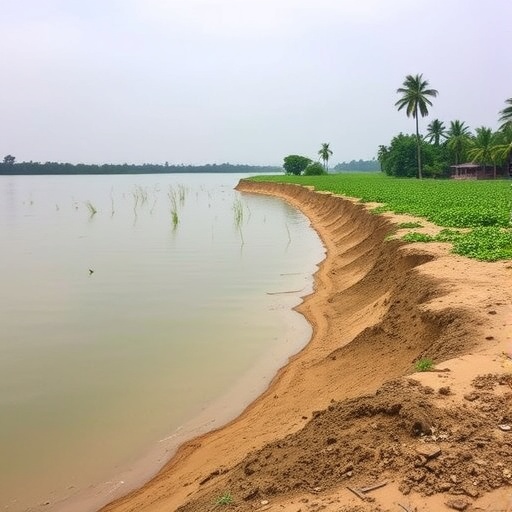
When the rivers of Bangladesh swallow a homestead, they take more than land. They take livelihoods, possessions, livestock and, according to striking new research, the psychological stability of the people left behind. A cross-sectional study published in the journal Natural Hazards has documented alarmingly high rates of anxiety and post-traumatic stress disorder among communities living along eroding riverbanks in southwestern Bangladesh, offering some of the most detailed evidence yet that one of climate change’s slowest-moving disasters is also among its most psychologically corrosive.
The research, conducted by Md. Zawadul Karim and Masuma Parvin of Gopalganj Science and Technology University and Md. Al-Mamun of the BRAC Institute of Governance and Development at BRAC University, focused on Gabura Union, a coastal settlement in the Shyamnagar sub-district of Satkhira District. This is a region that has endured a compounding series of catastrophes: tropical cyclones, tidal surges and the relentless, patient advance of riverbank erosion that gradually dissolves the very ground beneath people’s feet. Unlike a cyclone, which announces itself with wind and warning, erosion is a disaster measured in meters per monsoon season, a creeping loss that residents watch unfold over years while knowing they are largely powerless to stop it.
The study surveyed 385 residents aged 12 to 65, all of whom had lived in the area for more than 15 years and none of whom had a previously diagnosed mental disorder. Participants were selected through a multistage stratified sampling strategy, a design that divides the population into meaningful subgroups before sampling within each, ensuring that both severely affected and less affected residents were proportionally represented. Of the total, 280 participants had been directly exposed to severe riverbank erosion, while 105 had not, allowing the researchers to compare psychological outcomes across exposure levels.
Mental health was measured using two of the most widely validated screening instruments in psychiatric epidemiology. Anxiety symptoms were assessed with the seven-item Generalized Anxiety Disorder scale, known as the GAD-7, a brief questionnaire in which respondents rate how frequently they have been bothered by problems such as nervousness, uncontrollable worry and irritability over the preceding two weeks; higher cumulative scores indicate greater severity. Post-traumatic stress was screened with the PTSD Checklist for DSM-5, or PCL-5, a twenty-item instrument aligned with the current diagnostic criteria for PTSD that probes intrusive memories, avoidance behaviors, negative alterations in mood and cognition, and hyperarousal. Both instruments had previously been validated in Bangla translation for Bangladeshi populations, and the researchers also collected data on known risk factors, including loss of livestock, displacement experiences and levels of social support.
The results are sobering. Across the sample, 63.63 percent of participants produced positive scores on the anxiety screen, and 69.87 percent screened positive for PTSD. Prevalence was significantly higher among those directly affected by erosion, confirming that the psychological burden is not evenly distributed but concentrated among those whose lives the river has physically remade. The demographics of vulnerability followed recognizable patterns: middle-aged adults between 30 and 49 years old, members of joint multigenerational households, and illiterate individuals were disproportionately at risk. These are precisely the people who carry the heaviest economic and caregiving responsibilities in rural Bangladeshi society, and who possess the fewest resources for interpreting, expressing or treating psychological suffering.
The material devastation documented in the study helps explain these numbers. Erosion-induced losses were nearly universal among the worst-affected: 63.57 percent of respondents had lost livestock, and 64.65 percent had experienced displacement. In an economy where a family’s goats, chickens and cattle function simultaneously as savings accounts, food sources and income generators, losing them overnight to a collapsing riverbank is equivalent to financial ruin. Displacement compounds the damage, severing people from neighbors, kin networks and the social fabric that ordinarily absorbs shocks. The researchers found that this cascade of loss was associated with elevated risks not only of PTSD and anxiety, but also of insomnia and passive suicidal thoughts, a spectrum of harm that extends well beyond what conventional disaster assessments typically capture.
Yet the study also identified a powerful protective factor. Social support, the web of practical and emotional assistance that families, friends and communities provide, played a crucial role in mitigating psychological distress. This finding is consistent with a substantial international literature showing that social connection buffers the mental health impacts of disasters; research following Hurricane Katrina, the Fukushima disaster and flooding in the United Kingdom has repeatedly found that displaced individuals with strong support networks fare markedly better than those who face displacement alone. In Gabura Union, the implication is that the very communities the river is eroding are also the most important resource their members have for psychological survival.
The comparison with other natural disasters is instructive. Riverbank erosion differs from sudden-onset hazards in ways that may be uniquely damaging to mental health. A cyclone arrives, destroys and departs; the recovery phase, however painful, has a defined beginning. Erosion, by contrast, is chronic and anticipatory. Families live for years with the knowledge that their land may be next, watching neighboring plots crumble into the water, a form of sustained uncertainty that trauma researchers associate with prolonged stress activation. Moreover, because erosion displaces people gradually and often repeatedly, some families move multiple times in a decade, never reestablishing the stability needed for psychological recovery. The new study adds quantitative weight to earlier qualitative and small-scale findings from Bangladesh, including a 2021 PLOS ONE analysis of riverbank erosion’s mental health effects and a 2024 systematic review by some of the same authors documenting broad post-disaster mental health challenges across the country.
The authors argue that their findings demand a policy response that currently does not exist at scale. Bangladesh’s disaster management apparatus is largely built around sudden-onset events: cyclone shelters, early warning systems and emergency relief. Mental health care in rural coastal areas remains scarce, and psychological suffering is often stigmatized or attributed to spiritual causes rather than recognized as a treatable consequence of environmental loss. The researchers call for targeted mental health interventions and social assistance programs explicitly designed for erosion-affected populations, with an emphasis on community-based mental health care, which trains local workers to identify and support individuals in distress, and on sustainable social protection strategies that address the economic precarity underlying much of the psychological harm.
The broader significance of the work lies in what it suggests about the hidden costs of climate change. As sea levels rise, rainfall patterns intensify and Himalayan runoff shifts the hydrology of the Ganges-Brahmaputra delta, riverbank erosion in Bangladesh is expected to worsen, potentially displacing millions more people in the coming decades. Studies like this one make clear that the ledger of climate impacts must include anxiety disorders, PTSD, sleeplessness and suicidal ideation alongside the more easily counted metrics of hectares lost and homes destroyed. For the residents of Gabura Union who have watched the river take their fields, their animals and their front doors, the research offers something resembling validation: scientific confirmation that what has happened to their minds is a direct, measurable consequence of what has happened to their land, and that treating it will require more than rebuilding embankments. It will require rebuilding the conditions, social and material, under which psychological recovery becomes possible.
Cite Scienmag News
Glenn Wilkins. (September 4, 2026). Riverbank erosion drives anxiety and PTSD in southwestern Bangladesh communities. Scienmag. https://scienmag.com/riverbank-erosion-drives-anxiety-and-ptsd-in-southwestern-bangladesh-communities/
Glenn Wilkins. "Riverbank erosion drives anxiety and PTSD in southwestern Bangladesh communities." Scienmag, 4 September 2026, https://scienmag.com/riverbank-erosion-drives-anxiety-and-ptsd-in-southwestern-bangladesh-communities/. Accessed 4 September 2026.
Glenn Wilkins. "Riverbank erosion drives anxiety and PTSD in southwestern Bangladesh communities." Scienmag. September 4, 2026. https://scienmag.com/riverbank-erosion-drives-anxiety-and-ptsd-in-southwestern-bangladesh-communities/


