


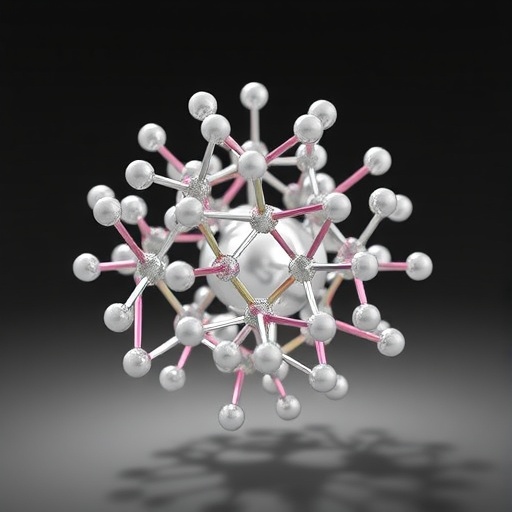
Molecular dynamics simulations have revealed how nickel–palladium core–shell nanoparticles melt, fuse, and—crucially—emerge from the process stronger and more ductile than either of their pure-metal building blocks. The study, published in the Journal of Nanoparticle Research by Taslima Hossain Sanjana, Sadia Afrin, and Mohammad Nasim Hasan of the Department of Mechanical Engineering at Bangladesh University of Engineering and Technology, offers an atomic-scale blueprint for engineers seeking to co-optimize thermal resilience, strength, and ductility in next-generation nanomaterials.
Core–shell nanoparticles, in which one material forms an inner core and a second material encapsulates it as an outer shell, have become a cornerstone of modern nanotechnology. By controlling which element sits at the center and which forms the surface, researchers can engineer structure–property relationships that neither material could achieve alone. Nickel–palladium combinations are particularly attractive because they merge nickel’s high strength and low cost with palladium’s superior thermal stability and chemical inertness. Such particles are already relevant to catalysis, printed flexible electronics, nanoparticle sintering for power electronics packaging, and nanojoining processes in microfabrication. Yet the coupled thermal and mechanical behavior that governs their structural integrity—especially during the melting and fusion events that occur in real processing—had remained poorly understood.
To close that gap, the team performed classical molecular dynamics simulations, a technique that tracks the motion of every atom by integrating Newton’s equations of motion with interatomic forces derived from a potential energy function. The accuracy of such simulations hinges on the quality of that potential, and here the researchers employed a second-nearest-neighbor modified embedded-atom method (2NN MEAM) potential specifically parameterized for the Pd–Ni binary system. This formalism captures not only pair interactions but also the directional bonding and many-body effects characteristic of transition metals, making it well suited to describe the complex physics at the interface between two dissimilar metals.
The simulations subjected nickel–palladium core–shell nanoparticles—nickel cores wrapped in palladium shells—to a systematic set of thermal histories. The team varied two key parameters: the core-volume fraction, which describes how much of the particle’s interior is nickel, at values of 33, 50, and 67 percent; and the heating rate, which controls how quickly the particles are brought to high temperature, at 1, 1.6, and 2 kelvin per picosecond. The segmental heating protocol allowed the researchers to dissect how these variables interact to determine when and how the particles melt and coalesce.
The central finding is that thermal stability is governed primarily by composition rather than by heating rate. No matter how fast or slow the particles were heated, the arrangement of elements inside them set the melting behavior. All of the core–shell configurations melted at lower temperatures than pure nickel or pure palladium nanoparticles of comparable size, a consequence of the excess energy stored at the core–shell interface and the enhanced surface-to-volume ratio that dominates at the nanoscale, where melting points famously drop well below their bulk values. Among the three compositions, the 33 percent core-volume fraction configuration showed the highest thermal stability, while the 67 percent configuration melted and coalesced earliest. Increasing the nickel core fraction promotes atomic disorder, accelerates interdiffusion across the interface, and drives densification during fusion, meaning that a larger nickel core destabilizes the particle against thermal attack even as it enriches the final fused structure in alloying activity.
Structural analysis of the melting and fusion process revealed these dynamics in atomic detail. As temperature rises, disorder propagates through the particle, atoms migrate across the nickel–palladium boundary, and the initially distinct core and shell progressively intermix. When two particles fuse, the neck between them grows, voids collapse, and the resolidified structure densifies—a sequence directly relevant to sintering processes used to join nanoparticles in electronic packaging, where the microstructure of the final joint determines its reliability.
The mechanical consequences of this fusion process proved to be the study’s most striking result. Materials science has long grappled with the strength–ductility trade-off: metals that resist deformation tend to be brittle, while ductile metals tend to be soft. Pure nickel nanoparticles are strong but suffer from limited ductility; pure palladium nanoparticles show the opposite tendency. Remarkably, the resolidified core–shell particles broke this trade-off. After melting and resolidification, the nickel–palladium particles simultaneously achieved tensile strengths of 14.7 to 15.0 gigapascals—enormous values, reflecting the near-absence of dislocations and defects at the nanoscale—and substantial ductility of up to 11.7 percent strain. The 50 percent core-volume fraction configuration provided the most favorable balance between the two properties, suggesting that a roughly even split of nickel and palladium maximizes the interfacial area available to deflect cracks, accommodate strain, and arrest deformation events during tensile loading.
Equally significant was the comparison against the rule of mixtures, a classical composite-mechanics benchmark that predicts the properties of a mixture as a volume-weighted average of its constituents. Every core–shell configuration exceeded that prediction, with tensile strength enhancements of up to 6.6 percent above the rule-of-mixtures value. This excess strength is the signature of interface-induced strengthening: the nickel–palladium boundary is not a passive dividing line but an active mechanical element that obstructs dislocation motion, redistributes stress, and toughens the particle. In other words, the interface itself behaves as a designable feature, and tuning the core fraction amounts to tuning how much of this strengthening mechanism is engaged.
The implications extend across several technological domains. In sintering-based joining, where nanoparticles are heated to fuse into conductive joints for power electronics, knowing that the 33 percent nickel configuration resists early melting while the 67 percent configuration fuses earliest gives process engineers a direct lever: choose the composition to match the desired sintering temperature and processing window. In catalyst design, where nickel-core palladium-shell particles are already exploited for reactions such as nitrite reduction, the demonstration that thermal history reshapes the degree of alloying and disorder provides a route to tailoring surface chemistry through processing. And for structural nanomaterials, the simultaneous achievement of high strength and ductility in the resolidified particles points toward composites and coatings that exploit the interface-toughening effect.
The study also contributes to a growing body of atomistic work on bimetallic nanoparticle fusion. Previous simulations have explored two-stage melting in core–shell systems, sintering behavior in copper–silver and copper–aluminum pairs, and coalescence-induced shape transformations in palladium and gold–palladium clusters. By combining composition sweep, heating-rate sweep, and post-fusion mechanical testing in a single framework, the BUET team adds a quantitative map of how composition and process conditions jointly determine both the fusion kinetics and the final mechanical performance of nickel–palladium systems.
From a methods standpoint, the work exemplifies how modern computational materials science can guide experimental design. Molecular dynamics with a validated 2NN MEAM potential can resolve phenomena—interfacial diffusion, atomic disorder, neck growth, densification, dislocation nucleation during tensile loading—that are difficult or impossible to observe directly in experiments on particles only a few nanometers across. The authors note that the identified interface-toughening mechanism establishes the nickel–palladium interface as an active design element capable of co-optimizing thermal resilience, strength, and ductility simultaneously.
As demand grows for multifunctional nanomaterials that must survive harsh thermal environments while bearing mechanical loads, studies of this kind translate the abstract idea of “interface engineering” into concrete, quantitative design rules. For nickel–palladium core–shell nanoparticles, the message is now clear: composition dictates thermal fate, and the interface dictates mechanical destiny—with the 50 percent nickel configuration standing out as the sweet spot where strength and ductility meet.
Cite Scienmag News
Denise Maddox. (September 3, 2026). Molecular dynamics reveals fusion behavior of Ni–Pd core–shell nanoparticles. Scienmag. https://scienmag.com/molecular-dynamics-reveals-fusion-behavior-of-ni-pd-core-shell-nanoparticles/
Denise Maddox. "Molecular dynamics reveals fusion behavior of Ni–Pd core–shell nanoparticles." Scienmag, 3 September 2026, https://scienmag.com/molecular-dynamics-reveals-fusion-behavior-of-ni-pd-core-shell-nanoparticles/. Accessed 3 September 2026.
Denise Maddox. "Molecular dynamics reveals fusion behavior of Ni–Pd core–shell nanoparticles." Scienmag. September 3, 2026. https://scienmag.com/molecular-dynamics-reveals-fusion-behavior-of-ni-pd-core-shell-nanoparticles/


