


None
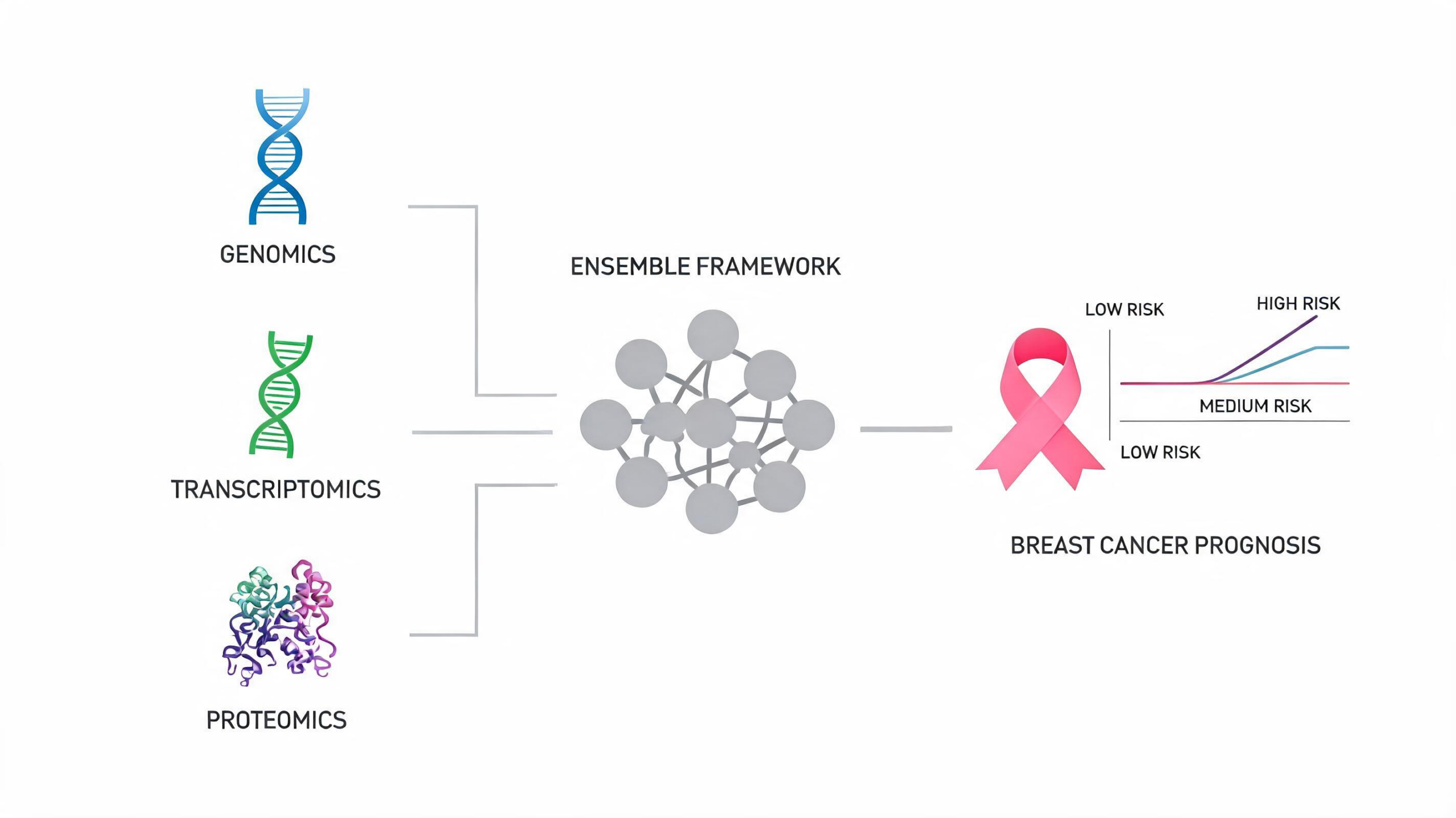
The distinction between stacking and bagging, the two ensemble paradigms combined in this framework, helps explain why assigning them complementary roles can be effective. Stacking, or stacked generalization, trains multiple base learners on the available data and then uses a meta-learner to weigh and combine their predictions, allowing the model to learn which underlying algorithms are most trustworthy for particular patterns in the data. Bagging, short for bootstrap aggregation, instead trains copies of a learner on resampled subsets of the training data and averages their outputs, which reduces variance and guards against the instability that arises when a small change in the training sample produces a large change in the fitted model. Because high-dimensional, low-sample-size biomedical datasets are precisely the setting in which variance dominates bias, the theoretical rationale for pairing the two strategies is well grounded in statistical learning theory.
The METABRIC cohort, used for evaluation in this study, has become one of the most widely cited resources in breast cancer computational research. It was originally assembled through the Molecular Taxonomy of Breast Cancer International Consortium, which profiled tumor specimens with gene expression microarrays and single-nucleotide polymorphism arrays while collecting detailed clinical annotations, including survival time, vital status, tumor stage, grade, and treatment information. The availability of matched clinical, transcriptomic, and copy number data for the same patients makes it unusually well suited for multimodal modeling, since many cohorts provide only one molecular layer. Its public release through cBioPortal has enabled reproducible benchmarking, and numerous prognostic modeling studies have used it, which facilitates direct comparison of new methods against previously reported performance levels.
Copy number variation, one of the three data modalities integrated by the framework, captures gains and losses of chromosomal regions that occur frequently in breast tumors and can influence prognosis by altering gene dosage. Amplification of loci such as 17q12, which contains the ERBB2 gene, and loss of regions on chromosome 17p involving TP53 are well-characterized examples with direct clinical relevance. Unlike gene expression, which reflects dynamic transcriptional activity and is sensitive to sampling and processing conditions, copy number profiles are comparatively stable measurements of genomic alteration. Including this modality alongside transcriptomic and clinical data therefore supplies the model with information about the underlying genomic architecture of the tumor, complementing the more variable expression layer and the demographic and pathological detail in the clinical record.
The reported performance gap between the hybrid framework and the conventional stacking ensemble, 0.936 versus 0.898 ROC-AUC, is meaningful in the context of prognostic modeling, where incremental gains become progressively harder to achieve as models approach the ceiling imposed by noise in the outcome labels themselves. Survival endpoints in observational cohorts are affected by treatment heterogeneity, censoring, and variation in follow-up, all of which place an upper bound on achievable predictive accuracy. Gains of this magnitude, achieved while also improving recall and reducing false negatives, suggest that the stabilization provided by the bagging branch recovers predictive signal that a single stacking pass leaves buried in prediction variance rather than merely fitting noise more aggressively.
The emphasis on reducing false-negative predictions deserves particular attention from a clinical standpoint. In prognostic stratification, a false negative means a patient at genuinely elevated risk of poor outcome is classified as low risk and may be undertreated or monitored less intensively. The consequences of missing a high-risk patient are generally considered more severe than the consequences of flagging a low-risk patient for additional surveillance, which is why sensitivity and recall are weighted heavily in clinical risk model evaluation. The observation that the hybrid framework increased sensitivity relative to the stacking ensemble on the independent test set, without sacrificing overall discrimination, indicates that the improvement is concentrated where it matters most for patient management rather than distributed evenly across easy and difficult cases.
The use of stratified tenfold cross-validation alongside an independent test set reflects a methodological practice that strengthens confidence in the reported results. Cross-validation with stratification preserves the class balance of the outcome variable in each fold, which is important because survival outcomes in breast cancer cohorts are often imbalanced, with fewer events than censored observations. Evaluating across ten folds provides an estimate of how much performance fluctuates when the training composition changes, and the reported consistency in mean ROC-AUC, F1-score, balanced accuracy, and the Matthews correlation coefficient across folds suggests that the framework’s advantage is not an artifact of a single favorable data split. The Matthews correlation coefficient is especially informative in this setting because it summarizes all four cells of the confusion matrix and remains reliable under class imbalance, unlike raw accuracy.
The challenge of integrating heterogeneous data modalities is compounded by differences in dimensionality and scale across the layers involved. Clinical variables typically number in the dozens, while gene expression panels contribute thousands of features and copy number profiles span tens of thousands of genomic loci. Naive concatenation of such matrices allows the high-dimensional molecular layers to dominate the learned representation, potentially drowning out the compact but highly informative clinical signals such as tumor stage and nodal status. Meta-learning within a stacking architecture offers a partial solution, because the meta-learner operates on base model outputs rather than raw features, effectively giving each modality a chance to be distilled into a prediction before integration and reducing the risk that one data layer overwhelms the others.
The overfitting risk inherent in high-dimensional, low-sample-size settings, often described as the large p, small n problem, is a persistent obstacle in omics research. When the number of features approaches or exceeds the number of patients, models can achieve perfect fits to training data by exploiting spurious correlations that do not generalize. This is a central reason why many published prognostic models perform well in internal validation but fail in external cohorts. The design choice of using bagging to stabilize the meta-learning stage directly targets this failure mode, since averaging over bootstrap resamples dampens the influence of any particular subset of patients or features on the final prediction, producing decision boundaries that are less sensitive to sampling idiosyncrasies.
The broader trend toward multimodal artificial intelligence in oncology, noted in the study’s positioning of its contribution, has been driven largely by imaging applications, where deep learning on histopathology slides and radiological images has attracted the most investment and clinical validation effort. Structured multi-omics prognostic modeling has progressed more quietly, in part because the data are tabular and high-dimensional rather than spatially structured, making them less amenable to the convolutional and transformer architectures that have transformed image analysis. Ensemble methods built on tree-based and classical learners remain highly competitive for tabular biomedical data, and the finding that a carefully designed ensemble of such models outperforms more elaborate alternatives reinforces the point that architectural novelty is not always the limiting factor in predictive performance.
Weighted probability fusion, the final combination step in the framework, represents a simple but principled alternative to hard voting or unweighted averaging. By assigning different weights to the stacking and bagging branches, the framework can express the relative reliability of integrated multimodal inference versus stabilized prediction, and these weights can be tuned on validation data. Soft fusion over probability outputs also preserves more information than voting on discrete class labels, since the confidence of each branch contributes to the final decision. This granularity matters at the decision thresholds used clinically, where patients near the boundary between risk strata are precisely those for whom well-calibrated probabilities, rather than binary labels, are most useful.
From the perspective of clinical translation, several considerations follow from these results. Any prognostic model intended for prospective use must demonstrate generalization beyond the cohort on which it was developed, and while the independent test set used here provides an initial check, validation in external cohorts with different patient demographics, treatment protocols, and assay platforms remains the decisive test. The reliance on gene expression and copy number data also implies that deployment requires molecular profiling infrastructure, which is increasingly routine in oncology but still unevenly distributed. The stability of performance across validation folds, together with the open availability of the underlying cohort, positions this framework as a reproducible baseline against which future multimodal prognostic methods for structured omics data can be measured, and the demonstration that complementary ensemble roles improve robustness offers a design principle likely to extend to other cancer types where matched clinical and molecular data are available.
Subject of Research: A heterogeneous multimodal ensemble framework for multi-omics breast cancer prognosis
Article Title: A heterogeneous multimodal ensemble framework for multi-omics breast cancer prognosis
Article References: Bozorgpour, R., & Sadrabadi, M. S. (2026). A heterogeneous multimodal ensemble framework for multi-omics breast cancer prognosis. Clinical Cancer Bulletin, 5(1), Article 16. https://doi.org/10.1007/s44272-026-00068-0
Image Credits: AI Generated
DOI: 10.1007/s44272-026-00068-0
Keywords: heterogeneous, multimodal, ensemble, framework, multi-omics, breast, cancer, prognosis, scientific research
Cite Scienmag News
Nathaniel Bowman. (September 3, 2026). A heterogeneous multimodal ensemble framework for multi-omics breast cancer prognosis. Scienmag. https://scienmag.com/a-heterogeneous-multimodal-ensemble-framework-for-multi-omics-breast-cancer-prognosis/
Nathaniel Bowman. "A heterogeneous multimodal ensemble framework for multi-omics breast cancer prognosis." Scienmag, 3 September 2026, https://scienmag.com/a-heterogeneous-multimodal-ensemble-framework-for-multi-omics-breast-cancer-prognosis/. Accessed 4 October 2026.
Nathaniel Bowman. "A heterogeneous multimodal ensemble framework for multi-omics breast cancer prognosis." Scienmag. September 3, 2026. https://scienmag.com/a-heterogeneous-multimodal-ensemble-framework-for-multi-omics-breast-cancer-prognosis/


