


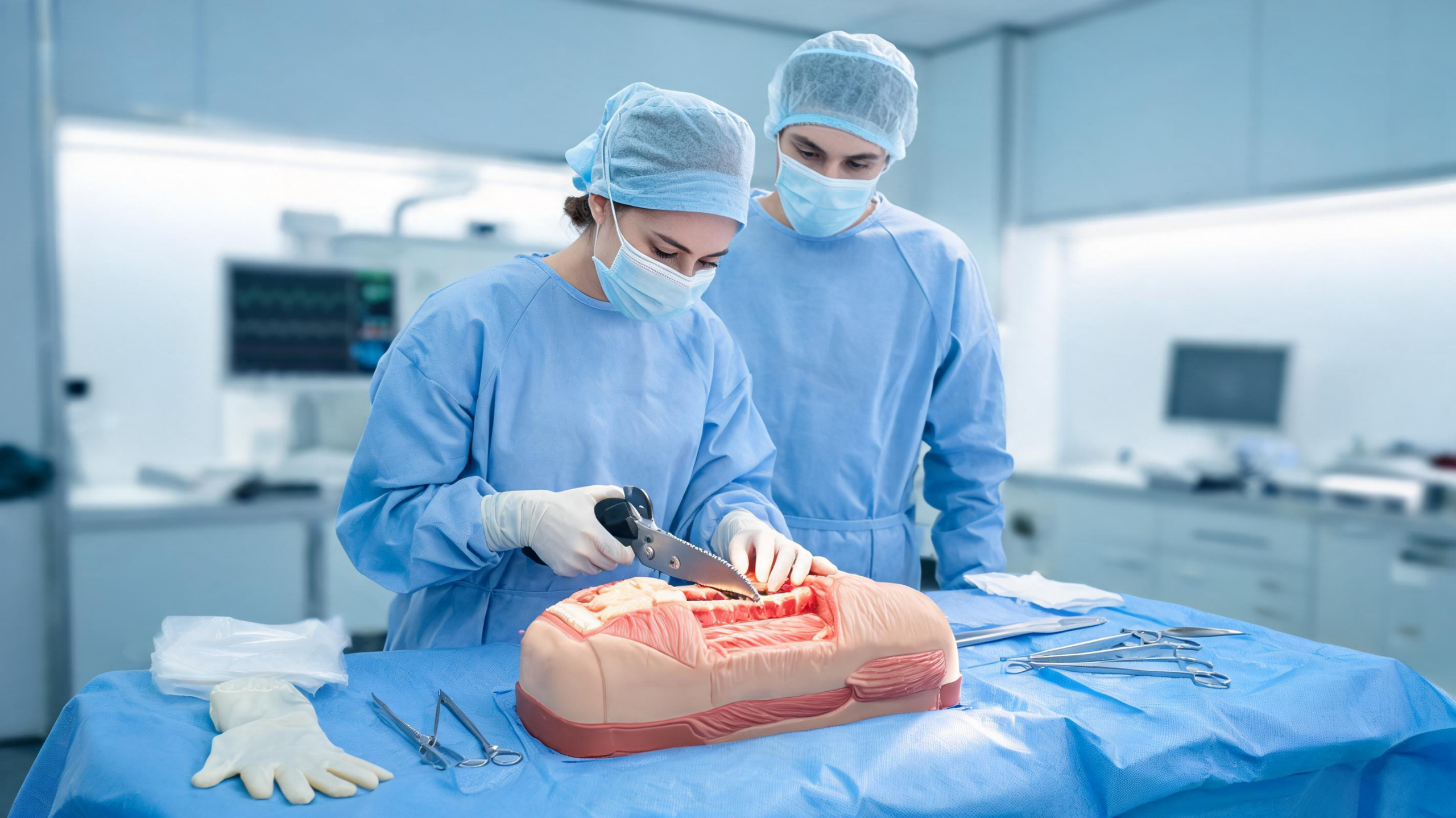
A median sternotomy — the deliberate division of the breastbone to expose the heart — is one of the most consequential incisions in surgery, and one of the rarest that general surgery trainees actually get to perform. A new pilot study from the University of Oklahoma Health Sciences Center suggests that a novel, reproducible sternotomy simulator, paired with directed instruction, can dramatically improve trainees’ technical performance, preparedness and confidence before they ever face the real thing.
The research, led by Kaitlin Pardue and colleagues in the Department of Surgery, was published in Global Surgical Education, the Journal of the Association for Surgical Education. The team set out to test a simple but urgent premise: because sternotomy is a high-risk procedure that general surgery residents encounter infrequently, simulation may be the most practical way to close the experience gap without compromising patient safety.
The procedural stakes are considerable. Opening the sternum requires precise midline division of the bone with a sternal saw, and deviations can damage underlying structures, complicate closure and increase the risk of postoperative wound complications. Prior surveys of general surgery residency program directors have documented limited cardiac surgery exposure during training, and many trainees report low comfort levels with the procedure — a pattern the Oklahoma group sought to address directly.
In the study, 25 learners consented and completed a baseline sternotomy on the training model before receiving any instruction. The majority of participants were resident trainees, making up 72 percent of the cohort, and 60 percent were male. Notably, none of the participants had ever performed a sternotomy prior to the simulation, and the group reported strikingly low baseline preparedness, averaging just 1.2 on a 5-point scale.
The training protocol was deliberately straightforward. After the baseline attempt, participants viewed a standardized instructional video demonstrating proper technique, then repeated the procedure on the simulator. Surveys administered before and after the initial sternotomy, and again at the completion of the simulation, measured self-assessed preparedness and anxiety using a 5-point Likert scale.
Objective scoring was built into the simulator itself. Artificial sternums were marked with a colored grading scale that allowed a 30-point accuracy assessment, capturing how closely trainees adhered to the ideal midline path. In addition, de-identified video recordings of each attempt were scored by blinded faculty reviewers on a 4-point technique scale, adding an independent, human evaluation of procedural skill alongside the anatomical accuracy measure.
The results were unambiguous. Accuracy scores on the sternum model rose from an average of 15.64 at baseline to 22.36 after training on the 30-point scale, a statistically significant improvement (p=0.006). Blinded faculty technique scores climbed from 2.08 to 3.48 on the 4-point scale (p<0.0001), indicating that the gains were visible not just in the cut itself but in the overall quality of the trainees’ operative technique.
The psychological benefits were just as striking. Ninety-six percent of participants reported improvement in preparedness following the simulation exercise, with an average increase of 1.3 points on the preparedness scale. Self-reported anxiety scores also fell significantly, dropping from 3.72 before the exercise to 2.76 afterward (p=0.001). The authors note that reducing anxiety in a controlled, nonthreatening environment may be a key mechanism by which simulation prepares trainees for real clinical scenarios.
The research was supported in part by a grant from the OUHSC College of Medicine’s Jerry Vannatta, MD Academy of Teaching Scholars, and the authors report no financial conflicts of interest. The study received ethical approval from the Human Investigation Committee of the University of Oklahoma (IRB# 15961), and informed consent was obtained from all participants.
The investigators conclude that, given the rare and high-risk nature of sternotomy, simulation offers an excellent opportunity to build both skill and confidence in surgical trainees — and may serve as a metric for assessing competence. While this was a pilot study and further work is needed to determine whether simulator gains translate into durable clinical competency, the findings suggest that a relatively simple, reproducible model combined with directed teaching could become a standard part of preparing the next generation of surgeons for one of the most demanding openings in the operating room.
The educational challenge at the heart of this study reflects a broader shift in how surgical training is conceived. Traditional apprenticeship models, in which residents learn by graduated exposure to real operations, assume that trainees will encounter each critical procedure often enough to progress from observation to supervised performance to independence. For procedures like median sternotomy, that assumption increasingly fails. Cardiac surgery volumes are concentrated in specialized centers, general surgery residents rotate through cardiothoracic services for limited periods, and the operation itself is often reserved for the most experienced members of the team because of the stakes involved. The result is a structural gap between what trainees are expected to be ready for and what they have actually practiced.
Simulation has emerged as the most widely endorsed response to this kind of exposure gap, and the evidence base supporting it has matured considerably over the past two decades. Systematic reviews of skills transfer after simulation-based surgical training have concluded that simulator-acquired skills do carry over to clinical settings, particularly when the training model reproduces the key perceptual and motor demands of the real procedure. For sternotomy, those demands include stabilizing the saw against a rigid, unforgiving structure; maintaining a strictly midline trajectory along the sternal symphysis; adjusting force as the saw traverses the denser manubrium and body of the bone; and halting the division at exactly the right moment to avoid plunging into the mediastinum. A model that lets trainees rehearse these elements repeatedly, without any risk to a patient, addresses precisely the components of the procedure where error is most costly.
The Oklahoma team’s simulator was not developed in a vacuum. Prior work in cardiac surgery education, including published efforts to build median sternotomy simulation models specifically for surgical training, has demonstrated growing interest in reproducing this single high-stakes step outside the operating room. What distinguishes the present study is its pairing of a physical, reproducible model with a structured instructional sequence and a dual scoring system. The combination matters because simulation alone, without deliberate instruction and objective feedback, tends to reinforce whatever habits a trainee brings to the task. The standardized video shown between the baseline and post-training attempts ensured that improvement reflected learning of correct technique rather than mere familiarity with the model.
The colored grading scale embedded in the artificial sternums deserves particular attention as a methodological feature. By scoring accuracy on a 30-point scale directly on the bone itself, the investigators created an assessment that is objective, inexpensive, and immediately interpretable. A deviated cut is visible in the artifact it leaves behind, which mirrors the clinical reality that a non-midline sternotomy is apparent to the operative team the moment the bone is divided. This kind of built-in assessment also points toward competency-based approaches to surgical education, in which progression is tied to demonstrated performance on defined tasks rather than to time served or case counts alone. A program director could, in principle, use a sternotomy simulator score as one element of a broader portfolio of procedural readiness.
The anxiety findings add a dimension that is often underemphasized in technical skills research. Self-reported anxiety fell from 3.72 to 2.76 on the five-point scale, a statistically significant decrease that accompanied the objective performance gains. The relationship between anxiety and surgical performance is well recognized: elevated stress degrades fine motor control, narrows attention, and impairs decision-making, particularly in trainees who are performing a procedure for the first time. Allowing a first attempt to occur in a low-stakes setting, where an imperfect cut has no consequence, may interrupt that cycle. By the time a trainee holds a sternal saw over a patient, the procedure is no longer a first exposure, and the psychological load of the moment is correspondingly reduced.
The clinical consequences of a poorly executed sternotomy help explain why this particular step merits dedicated training. Deviations from the midline can leave asymmetric bone edges that complicate wire closure and sternal reapproximation, and sternal wound complications, including dehiscence and mediastinitis, are among the most serious morbidities following cardiac operations. Off-midline cuts may also lacerate underlying pleura or vascular structures. Because these complications carry substantial morbidity and cost, investments in preclinical rehearsal of the incision are consistent with broader quality and safety priorities in cardiothoracic care.
As a pilot study, the work has limitations that the authors themselves acknowledge and that frame the agenda for future research. The cohort of 25 learners was small and drawn from a single institution, and the absence of any prior sternotomy experience among participants, while ideal for measuring learning curves, means the simulator’s value for more advanced trainees remains untested. The study measured immediate post-training performance rather than retention, leaving open the question of how durable the gains are over weeks or months. Most importantly, demonstrating improved simulator performance is not the same as demonstrating improved clinical competency, and translational studies linking simulator scores to supervised performance in actual operations would strengthen the case for widespread adoption.
Nevertheless, the pattern of results across three independent measures — anatomical accuracy, blinded technique scoring, and self-reported preparedness — converges on a consistent conclusion. The magnitude of the improvements, achieved with a single instructional session and a reproducible model, suggests an efficient educational intervention that could be implemented without elaborate resources. For a procedure that most general surgery residents will rarely, if ever, perform before being expected to assist with or perform it, that efficiency is the central argument for making sternotomy simulation a routine component of surgical preparation.
Subject of Research: A sternotomy simulation program to improve surgical trainees' performance and preparedness
Article Title: Splitting hairs: improving sternotomy performance and preparedness among trainees using a novel simulation program
Article References: Pardue, K., Davis, R., Trimble, J., Harter, M., Wood, F., Scott, R., & Lees, J. (2026). Splitting hairs: improving sternotomy performance and preparedness among trainees using a novel simulation program. Global Surgical Education – Journal of the Association for Surgical Education, 5(1), Article 174. https://doi.org/10.1007/s44186-026-00581-9
Image Credits: AI Generated
DOI: 10.1007/s44186-026-00581-9
Keywords: sternotomy, surgical simulation, surgical education, general surgery residency, trainee preparedness, technical skills, cardiothoracic surgery, pilot study, competency assessment, medical training, anxiety reduction, patient safety
Cite Scienmag News
Courtney Benton. (September 3, 2026). Simulation Program Sharpens Surgical Trainees’ Sternotomy Skills. Scienmag. https://scienmag.com/simulation-program-sharpens-surgical-trainees-sternotomy-skills/
Courtney Benton. "Simulation Program Sharpens Surgical Trainees’ Sternotomy Skills." Scienmag, 3 September 2026, https://scienmag.com/simulation-program-sharpens-surgical-trainees-sternotomy-skills/. Accessed 3 September 2026.
Courtney Benton. "Simulation Program Sharpens Surgical Trainees’ Sternotomy Skills." Scienmag. September 3, 2026. https://scienmag.com/simulation-program-sharpens-surgical-trainees-sternotomy-skills/


