


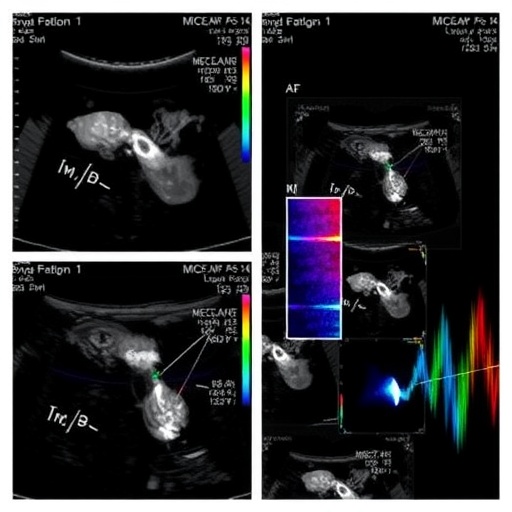
For decades, one of the most important muscles in the human body has been flying under the radar of modern medicine. The diaphragm, the dome-shaped muscle that powers every breath we take, can weaken or become paralyzed without most doctors ever detecting the problem, leaving patients struggling for air while their complaints are attributed to asthma, heart disease, or anxiety. Now, a team of researchers has unveiled a strikingly simple solution: a technique that combines lightning-fast ultrasound imaging with magnetic stimulation of the nerves that drive the diaphragm, allowing clinicians to measure the muscle’s strength without inserting a single tube into a patient’s body. The study, published in the Journal of Cachexia, Sarcopenia and Muscle, offers the first formal evaluation of this noninvasive approach and could reshape how breathlessness is diagnosed around the world.
Diaphragm dysfunction is far more common than most people realize. It spans a continuum from partial loss of function to complete paralysis, can affect one or both halves of the muscle, and arises from a daunting range of causes: direct trauma, thoracic and cardiac surgery, neuromuscular diseases, injury to the phrenic nerve, disuse during prolonged mechanical ventilation, and the chronic hyperinflation seen in diseases like chronic obstructive pulmonary disease. Because the diaphragm shares responsibility for breathing with accessory muscles, patients often compensate for years, and clinicians rarely think to look for the root cause. The consequences of missing the diagnosis can be severe, ranging from unexplained breathlessness on exertion to failure to wean from a ventilator in intensive care.
The problem, until now, has been that the definitive test is anything but simple. The current gold standard, known as twitch transdiaphragmatic pressure, requires patients to swallow balloon catheters positioned in the esophagus and stomach so that pressures on either side of the diaphragm can be recorded while the phrenic nerves are electrically stimulated. Because the stimulation does the work rather than the patient’s own effort, the test is objective and reliable — but the placement of the catheters is uncomfortable, technically demanding, and time-consuming. As a result, the procedure is performed so rarely in routine clinical practice that many hospitals never offer it at all, and the diagnosis of diaphragm dysfunction continues to slip through the cracks. Standard alternatives such as chest radiography, lung function testing, and conventional ultrasound of diaphragm thickening and movement are all effort-dependent or plagued by interobserver variability, and an elevated diaphragm on a chest X-ray can just as easily reflect obesity, atelectasis, or abdominal distension as true paralysis.
The new study set out to determine whether a radically faster form of ultrasound could do the job without any tubes at all. Conventional ultrasound machines capture images at a few dozen frames per second, far too slow to follow the explosive contraction of a diaphragm that has just been jolted by nerve stimulation. Ultrafast ultrasound, by contrast, relies on plane wave imaging — transmitting unfocused ultrasound beams at rates that can exceed a thousand frames per second — enabling researchers to track the motion of living tissue with extraordinary temporal resolution. Applying this technology to the costal diaphragm during stimulation of the phrenic nerves, the researchers could extract not just how far the muscle moved, but how fast it moved, how rapidly it accelerated, and the derivative of that acceleration, a quantity known in engineering as jerk. In essence, the technique converts the diaphragm’s twitch into a high-speed movie, and the movie into numbers.
Thirty patients referred for suspected diaphragm dysfunction — nineteen men and eleven women, with a median age of 57 years — enrolled in the study. Each underwent bilateral anterolateral magnetic stimulation of the phrenic nerves, a technique in which a magnetic coil held near the neck induces painless electrical currents that fire both nerves simultaneously. Crucially, while the magnetic pulses triggered the diaphragm to contract, the researchers recorded ultrafast ultrasound images of the muscle’s motion and, at the same time, measured esophageal and gastric pressures to compute the conventional gold-standard twitch transdiaphragmatic pressure. This head-to-head design meant that every noninvasive measurement could be directly compared with the invasive benchmark in the same patient, on the same breath.
The results were compelling. Twenty-four of the thirty patients — eighty percent — turned out to have abnormally low twitch transdiaphragmatic pressure, underscoring just how often this condition lurks beneath unexplained respiratory symptoms. The ultrafast ultrasound descriptors tracked the gold-standard pressure measurements closely: peak diaphragm tissue velocity correlated with a Spearman coefficient of 0.77, acceleration with 0.70, and jerk with 0.67, all statistically significant. To turn these motion descriptors into a diagnostic tool, the team used ridge regression, a statistical technique that combines multiple correlated predictors into a single robust model while guarding against overfitting. The model’s predicted pressures agreed well with the measured values, assessed using Lin’s concordance correlation coefficient and Passing-Bablok regression, two methods designed to test whether two measurements agree closely enough to be used interchangeably.
To determine how well the technique could actually flag disease, the researchers turned to Bayesian receiver operating characteristic analysis, a method that estimates not just a single diagnostic accuracy figure but a full probability distribution reflecting the uncertainty in a modest sample size. When the model-predicted twitch pressure was used to identify patients with abnormal diaphragm contractility, it achieved a sensitivity of seventy-five percent and a specificity of one hundred percent — meaning it never wrongly labeled a healthy diaphragm as diseased, though it missed roughly a quarter of true cases. The analysis also yielded concrete decision thresholds that other clinicians can test: peak diaphragm velocity below 10.25 millimeters per millisecond signaled dysfunction, with corresponding cutoffs of 408.6 millimeters per millisecond squared for acceleration and 3073 millimeters per millisecond cubed for jerk. The wide Bayesian credible intervals around these thresholds, spanning values several-fold above and below the point estimates, are an honest reminder that the numbers must be refined in larger cohorts before becoming universal standards.
What makes the advance so attractive clinically is that it is nonvolitional, meaning it does not depend on the patient’s own effort or cooperation. That matters enormously in medicine, because effort-dependent tests — maximal inspiratory pressure, sniff nasal inspiratory pressure, voluntary ultrasound maneuvers — can be faked or suppressed, whether by fatigue, poor technique, or unconscious compensation. A magnetic pulse, by contrast, bypasses the patient’s will entirely and directly tests the diaphragm’s intrinsic contractility. Coupling that objective trigger with ultrafast imaging means a clinician can, in principle, obtain a valid assessment of diaphragm strength at the bedside in minutes, without catheters, without discomfort, and without the specialized training currently required for esophageal pressure recording. In an era when millions of patients survive prolonged mechanical ventilation and critical illness only to face mysterious, disabling breathlessness, a rapid test for the muscle that breathes could be transformative.
The technique also opens a window on physiology that has been difficult to observe before. Because ultrafast ultrasound captures the diaphragm’s motion at sub-millisecond resolution, it records the earliest phase of contraction — the acceleration phase that conventional imaging simply cannot see — and may eventually reveal subtle changes in muscle dynamics before frank weakness appears. The researchers suggest this could prove valuable not only for diagnosis but also for monitoring disease progression and response to therapy in conditions such as muscular dystrophy, amyotrophic lateral sclerosis, and intensive care unit-acquired weakness, where the diaphragm is silently wasting away. In sarcopenia and cachexia research more broadly, the ability to quantify the contractile performance of a deep, inaccessible respiratory muscle noninvasively adds a genuinely new instrument to the toolkit.
As with any first evaluation, caution is warranted. The study involved thirty patients at a single center, all of whom were already suspected of having diaphragm dysfunction, and the diagnostic thresholds carry wide uncertainty ranges. The authors themselves emphasize that the findings support further clinical evaluation and warrant larger, multicenter validation studies before the technique can be recommended for widespread use. Questions also remain about how the measurements perform in patients with severe obesity, hyperinflated lungs, or anatomical variants that complicate ultrasound windows, and whether the magnetic stimulation coils can be standardized across manufacturers and operators. Still, the core proof of principle stands: diaphragm motion, filmed at ultrafast speeds during magnetic nerve stimulation, reliably predicts the pressure-based gold standard.
If those validation efforts succeed, the implications for clinical practice could be sweeping. A test that once required uncomfortable catheters and rarefied expertise might become as routine as the ultrasound scans performed in every emergency department and intensive care unit, finally giving breathless patients an answer that has been hiding in plain sight — in the muscle that keeps them alive with every breath they take. For the millions living with unexplained dyspnea, and for the clinicians who have long lacked the tools to help them, that would be news worth breathing deeply about.
Cite Scienmag News
Ophelia Keating. (September 3, 2026). Ultrafast Ultrasound With Phrenic Stimulation Diagnoses Diaphragm Dysfunction Noninvasively. Scienmag. https://scienmag.com/ultrafast-ultrasound-with-phrenic-stimulation-diagnoses-diaphragm-dysfunction-noninvasively/
Ophelia Keating. "Ultrafast Ultrasound With Phrenic Stimulation Diagnoses Diaphragm Dysfunction Noninvasively." Scienmag, 3 September 2026, https://scienmag.com/ultrafast-ultrasound-with-phrenic-stimulation-diagnoses-diaphragm-dysfunction-noninvasively/. Accessed 3 September 2026.
Ophelia Keating. "Ultrafast Ultrasound With Phrenic Stimulation Diagnoses Diaphragm Dysfunction Noninvasively." Scienmag. September 3, 2026. https://scienmag.com/ultrafast-ultrasound-with-phrenic-stimulation-diagnoses-diaphragm-dysfunction-noninvasively/


