


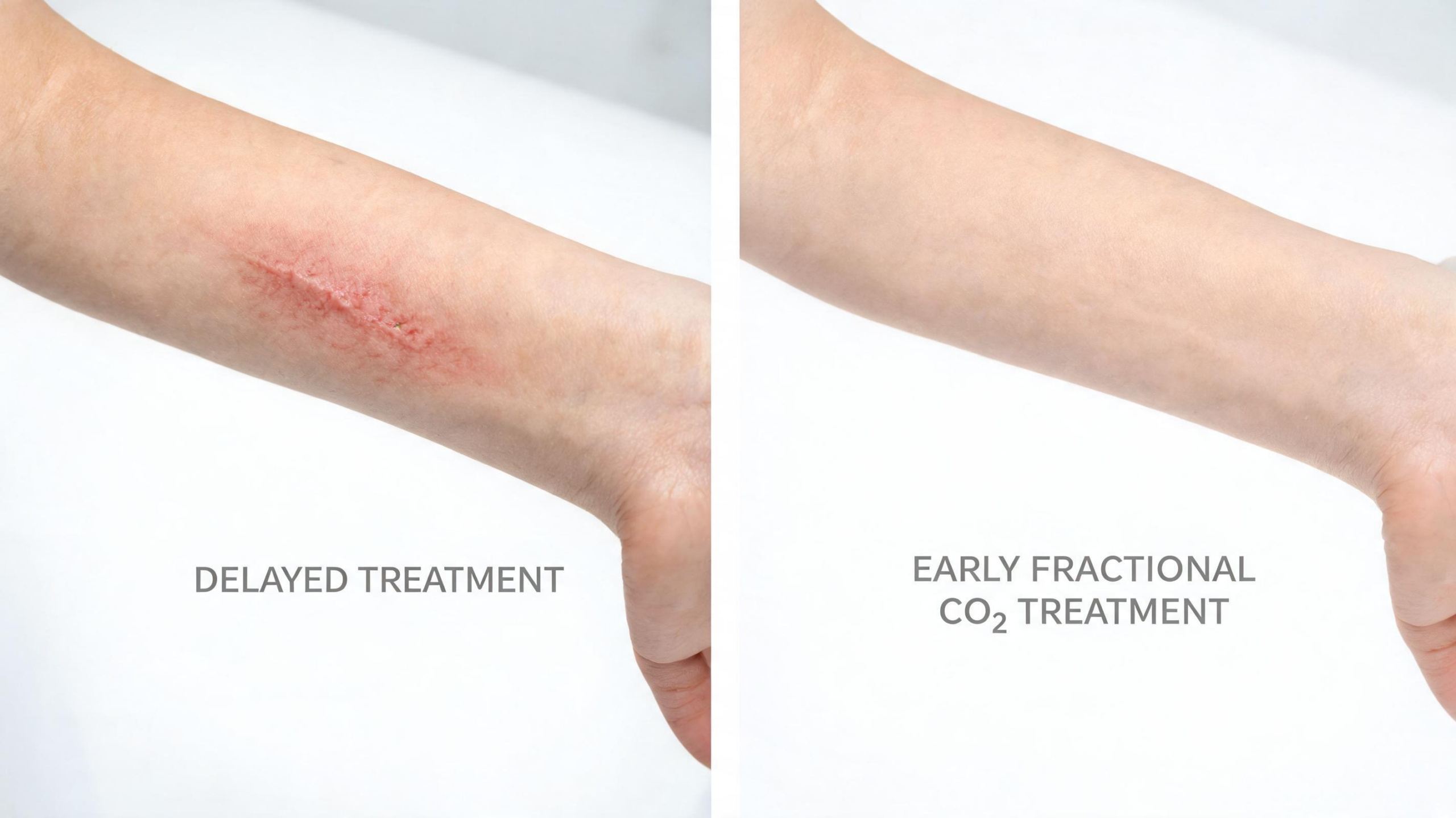
For millions of people who survive burns, accidents, and surgical emergencies, the wound is only the beginning of the story. What often remains, sometimes for a lifetime, is the scar: a permanent, visible marker of trauma that can erode self-esteem, trigger depression, and serve as a daily physical reminder of the worst moment of a person’s life. Now, a pilot study from Cairo University suggests that one of the most powerful tools in scar revision, the fractional carbon dioxide laser, may work dramatically better if clinicians simply pick up the device sooner. The research, published in BMC Plastic and Reconstructive Surgery, compared patients who began laser treatment within the first three months after wound healing with those who waited more than a year, and the early group came out ahead on nearly every measure, from clinical scoring to the microscopic architecture of the skin itself.
The fractional CO2 laser has become the most widely used ablative laser modality in scar management, and its mechanism is elegantly counterintuitive. Rather than removing the entire surface of the skin, the device emits a 10,600-nanometer wavelength through a grid of microscopic beams, vaporizing tiny columns of tissue while leaving surrounding skin intact. Each micro-column acts as its own miniature wound, triggering the body’s innate healing cascade: heat and vaporization of damaged skin layers stimulate the generation of new skin and fresh collagen synthesis. The result is a controlled remodeling response that nudges pathological scar tissue, with its dense, disorganized collagen, toward a more normotrophic state, improving texture, pigmentation, and overall appearance without any surgical intervention.
What has remained genuinely uncertain, however, is when to deploy this technology. Wound healing unfolds across four overlapping stages: hemostasis, inflammation, granulation, and remodeling. Scars arise from either inadequate or excessive collagen production during this process, and the maturation phase, in which collagen bundles become tightly cross-linked and disorganized, has long been considered the window in which intervention might either rescue or merely palliate the tissue. Recent research has increasingly hinted that ablative fractional lasers applied early may not only reduce scar formation but also decrease scar thickness and improve function, yet high-quality clinical data on optimal timing for post-traumatic scars specifically has been scarce.
To address that gap, researchers at the National Institute of Laser Enhanced Sciences at Cairo University enrolled forty patients with previously untreated post-traumatic scars. The participants were divided into two equal groups based on when they presented at the outpatient clinic: Group 1 began laser sessions within the first three months after their wounds had healed, while Group 2 did not start treatment until more than a year after healing. Importantly, the allocation reflected the natural history of patient presentation rather than randomization, a point the authors themselves flag as a limitation. Each patient received four sessions of fractional CO2 laser at four-week intervals, using energies of 45 to 60 millijoules and pulse durations of 1.9 to 2.5 milliseconds, with pulses placed adjacent to one another without overlap. A topical anesthetic cream was applied for an hour before each session, and patients followed a strict aftercare regimen involving mild steroid cream, sun protection, and avoidance of all other scar treatments.
The evaluation was deliberately two-pronged, combining subjective clinical scales with objective tissue analysis. Clinically, the team used the Vancouver Scar Scale, a four-point assessment covering vascularity, thickness, pliability, and pigmentation, with a maximum score of thirteen, alongside a patient satisfaction grading from dissatisfied to highly satisfied. Objectively, punch biopsies were taken from each scar before treatment began and again three months after the final session, then processed, stained with hematoxylin and eosin, and scored by a dermatopathologist who was blinded to group allocation, based on collagen fiber density and orientation in both the papillary and reticular dermis. This combination of tools is what distinguishes the study from much of the earlier timing literature, which often relied on clinical scores alone.
The clinical results were striking. Both groups showed highly statistically significant improvement in Vancouver Scar Scale scores after laser treatment compared with their own baselines, confirming that the therapy works. But when the two groups were compared head to head, the early-intervention group achieved a highly statistically significant greater reduction in scar scores than the late group, with a P value below 0.001. Illustrative cases captured the effect vividly: a 39-year-old man with a two-month-old atrophic facial scar saw his score fall from 8 to 3, a 62.5 percent improvement, while a 21-year-old with a three-year-old normotrophic facial scar improved from 7 to 3, or 57.1 percent. Patient satisfaction trended higher in the early group, with 40 percent of those patients reporting they were highly satisfied, though this difference did not reach statistical significance.
It was under the microscope, however, that the difference became most compelling. Histopathological analysis revealed a highly significant difference between the groups, with a P value of 0.006. Baseline biopsies from both groups showed the hallmark of pathological scarring: dense, haphazardly arranged collagen fibers. After treatment, the early group demonstrated a mean collagen density reduction of 66.5 percent, compared with 43.9 percent in the late group, and a mean improvement in parallel fiber arrangement of 67.0 percent versus 44.9 percent, both differences statistically significant. In plain terms, scars treated early shifted much further toward the physiology of normal skin, with collagen becoming less abundant and more neatly aligned. The authors attribute this to the biology of the maturation phase: targeting the disorganized collagen production early allows reorganization of the skin structure before tight cross-linking becomes entrenched.
The findings align with a growing body of international evidence. A retrospective study of 106 children with traumatic facial scars found that those treated one month after injury fared significantly better than those treated at three or six months. A randomized controlled cohort study of cleft lip scars similarly showed the best outcomes in patients who started laser sessions just one month after surgery. Research comparing immature scars, less than a year old, with mature scars found significantly greater score reductions in the immature group, and a large study of 221 patients with hypertrophic burn scars identified the first month post-injury as the ideal window for laser use. Notably, the Cairo team’s histopathological confirmation addresses a weakness in several of these predecessors, which lacked objective tissue-level assessment to corroborate their clinical scores.
The authors are candid about the study’s constraints. It was a single-center pilot with a small sample, powered by feasibility rather than formal calculation, and the findings are framed as hypothesis-generating. A crucial confound is that scar type distribution differed sharply between groups: half of the early group had atrophic scars, while 60 percent of the late group had hypertrophic scars, a pattern that reflects the natural biology of scar maturation and is inherently tied to the timing variable itself. The lack of randomization, variability in anatomical locations, short follow-up, and absence of formal inter-rater reliability testing for the histopathological scoring all temper the conclusions. Still, all patients tolerated the therapy well, with no significant side effects and no scar recurrence during follow-up, reinforcing the safety profile of the modality.
The takeaway for clinicians and patients alike is a message about momentum. Scar remodeling is a biological race against time, and the collagen architecture of a healing wound appears far more malleable in its first months than after a year of consolidation. Early fractional CO2 laser intervention, delivered in a series of brief, well-tolerated sessions, may intercept the scarring process while it is still reversible, preventing the hypertrophic and keloid transformations that are so difficult to reverse later. Larger, randomized controlled trials with stratification by scar type are now needed to convert these preliminary signals into clinical guidelines. But for the millions living with the psychological weight of traumatic scars, the study offers something concrete: a reason not to wait, and a growing scientific case that when it comes to laser scar revision, the earliest appointment may be the best one.
The 10,600-nanometer wavelength used in the study is strongly absorbed by water within the skin, which is precisely what allows it to vaporize targeted tissue columns with such spatial precision. By spacing these microscopic treatment zones apart, the fractional approach preserves bridges of untouched epidermis that serve as reservoirs of keratinocytes, permitting rapid re-epithelialization within days and sharply reducing risks such as prolonged open wounds and infection compared with fully ablative resurfacing.
The Vancouver Scar Scale, though subjective, remains the most widely validated tool in scar research, and its four domains map directly onto the biological processes that fractional lasers target: vascularity reflects angiogenic activity, pliability reflects collagen organization, and pigmentation reflects melanocyte disturbance during healing. Pairing it with blinded histopathology strengthens the study because collagen density and orientation can change before visible surface improvements appear.
Timing matters biologically because the remodeling phase involves a dynamic balance between collagen deposition and matrix metalloproteinase-mediated degradation. In the first months after epithelialization, collagen turnover is high and fibroblast activity remains responsive to mechanical and thermal signals; once cross-linking matures, the same stimulus produces far less structural change. The post-treatment regimen used in the study, including hydrocortisone cream to limit inflammation and diligent sun protection to reduce post-inflammatory hyperpigmentation, reflects standard practice for ablative laser care and likely contributed to the favorable tolerability observed.
Subject of Research: Optimal timing of fractional CO2 laser intervention for post-traumatic scar treatment
Article Title: Time of fractional CO2 laser intervention in post-traumatic scars: a pilot study
Article References: Tawfik, A. A., Hadhoud, A. O., & Abdallah, N. (2026). Time of fractional CO2 laser intervention in post-traumatic scars: a pilot study. BMC Plastic and Reconstructive Surgery, 2(1), Article 22. https://doi.org/10.1186/s44452-026-00034-8
Image Credits: AI Generated
DOI: 10.1186/s44452-026-00034-8
Keywords: fractional CO2 laser, post-traumatic scars, scar revision, Vancouver Scar Scale, collagen remodeling, wound healing, laser dermatology, histopathology, hypertrophic scars, atrophic scars, early intervention, pilot study
Cite Scienmag News
Ophelia Keating. (September 3, 2026). Timing Is Everything: Early Fractional CO2 Laser Treatment Shows Clear Edge for Traumatic Scars. Scienmag. https://scienmag.com/timing-is-everything-early-fractional-co2-laser-treatment-shows-clear-edge-for-traumatic-scars/
Ophelia Keating. "Timing Is Everything: Early Fractional CO2 Laser Treatment Shows Clear Edge for Traumatic Scars." Scienmag, 3 September 2026, https://scienmag.com/timing-is-everything-early-fractional-co2-laser-treatment-shows-clear-edge-for-traumatic-scars/. Accessed 5 October 2026.
Ophelia Keating. "Timing Is Everything: Early Fractional CO2 Laser Treatment Shows Clear Edge for Traumatic Scars." Scienmag. September 3, 2026. https://scienmag.com/timing-is-everything-early-fractional-co2-laser-treatment-shows-clear-edge-for-traumatic-scars/


