


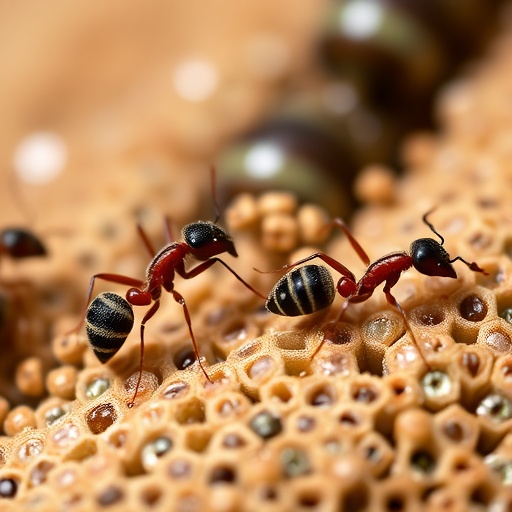
Beneath the permanent grasslands of Belgium lives one of Europe’s palest insects, and a new study shows it is far harder to kill than its ghostly appearance suggests. Researchers Romain Willeput and Claire Detrain of the Université Libre de Bruxelles report in The Science of Nature that the yellow meadow ant Lasius flavus — an almost unpigmented species that spends its entire life underground — survives exposure to the lethal entomopathogenic fungus Beauveria bassiana about as well as its darker, surface-dwelling relatives. The result overturns a long-standing expectation in insect immunology: that a thin, weakly hardened, depigmented cuticle should leave soil-dwelling ants unusually vulnerable to contact-transmitted pathogens. Just as striking, the study shows that the capacity to survive fungal attack varies sharply not only between species but between colonies of the same species and between workers holding different jobs inside one nest — differences the researchers connect to aging, division of labor, and a peculiar hygiene ritual in which ants coat their own bodies with formic acid.
Ant societies are, from a pathogen’s perspective, nearly perfect targets. A colony packs thousands of genetically similar individuals into a warm, humid, food-rich nest where workers groom one another, exchange regurgitated food, and tend dense piles of brood — ideal conditions for explosive disease transmission. That genetic similarity is a double-edged sword: it cements cooperation, but it also means a pathogen adapted to one worker can, in principle, exploit them all. Yet ants thrive, and decades of research on social immunity explain why. Colonies erect collective barriers such as allogrooming, the disposal of corpses, the disinfection or even destruction of infected brood, and the release of antimicrobial secretions from specialized glands. At the individual level, the first line of defense is the cuticle itself, a composite of chitin and cross-linked proteins whose degree of sclerotization and melanin-based darkening can physically block and chemically inhibit invading microbes. Behind it operate cellular and humoral defenses, including the prophenoloxidase cascade that seals wounds and melanizes intruders. Entomopathogenic fungi such as Beauveria bassiana and Metarhizium rank among the most abundant insect killers in soil, and for a strictly subterranean ant they are the ever-present neighbor.
That ecology made Lasius flavus an ideal test case. The yellow meadow ant builds long-lived nests in permanent grassland, cultivates root aphids for their sugary honeydew, and almost never comes to the surface. Because it lives in permanent darkness, its exoskeleton is weakly sclerotized — its structural proteins are only lightly cross-linked — and nearly devoid of the dark melanin pigments that toughen and protect the cuticles of epigeous, or surface-active, ants. A substantial body of research, from studies of density-dependent prophylaxis in mealworm beetles to experiments tying cuticular color to immune performance, holds that melanized, well-sclerotized integuments are physically tougher and more hostile to pathogens. Soil surveys across temperate regions likewise show that Beauveria and Metarhizium propagules are widespread and often abundant, making encounters routine rather than exceptional for insects that dig and tunnel. By that combined logic, L. flavus should have been an easy victim: a soft-shelled ant dwelling in a spore-saturated world. The predicted compensation, if any, was behavioral — an intensified grooming repertoire capable of stripping spores from the body before they germinate and breach the cuticle.
To test the prediction, the team collected colonies of L. flavus and five closely related, pigmented Lasius species that forage above ground, at several sites across Belgium. In the laboratory, workers were individually contaminated with dry spores of Beauveria bassiana, a generalist fungus that kills insects through a well-characterized sequence: conidia adhere to the cuticle, germinate, and penetrate the body wall with the help of cuticle-degrading enzymes, after which fungal cells multiply in the hemolymph until the host dies and the cadaver sprouts new infectious spores. Handle-only control groups allowed the researchers to separate infection deaths from background mortality. Survival was then tracked over time and analyzed with models that yield hazard ratios — estimates of the relative instantaneous risk of dying — complete with confidence intervals and p-values corrected for multiple comparisons. In parallel, each worker’s first ten minutes after contamination were scrutinized: the team measured how long an ant spent self-grooming and whether it made at least one contact between its mouthparts and its acidopore, the nozzle-like opening at the abdominal tip through which formicine ants discharge formic acid. For the focal species, grooming was analyzed across eight colonies, with fourteen workers per colony.
The outcome split into two stories told at different scales. Between species, susceptibility and grooming both differed, exactly as expected — but not in the direction the pale-cuticle hypothesis anticipated. Far from collapsing under fungal pressure, workers of Lasius flavus survived at rates comparable to those of most of their pigmented relatives, and their grooming effort sat squarely within the range displayed by surface species. More revealing still, across the genus the two behaviors tracked survival: species whose workers groomed themselves longer and engaged their acidopore more frequently suffered less mortality. That positive interspecific correlation, the authors argue, marks grooming as a genuine functional component of pathogen resistance rather than a mere reflex — a behavioral barrier that, together with cuticular chemistry and internal immunity, helps determine how firmly a given ant lineage withstands fungal disease.
The chemistry underlying the acidopore gesture is remarkable. Formicine ants store concentrated formic acid, a corrosive compound with a pH approaching 2, in a dedicated reservoir at the base of the abdomen and can spray it in jets at aggressors. They also turn the weapon inward: an ant will lick its acidopore and then spread the acid over its own cuticle with its legs and antennae, effectively sterilizing its body surface. Earlier experiments have shown that this behavior destroys fungal conidia on contact, and that formicine ants even swallow their own acid, using it to filter which microbes may inhabit their gut. Because spores must germinate on the integument before they can invade, anything that reduces their number or viability in those first minutes carries enormous survival value. Combined with self-grooming, in which an ant draws its legs and antennae through the mouthparts to strip off — and often ingest or discard — spores, the acidopore contact amounts to a mobile hygiene station: mechanical removal and chemical disinfection fused into a single sweeping motion.
Inside Lasius flavus, however, the picture grew more layered — and more surprising. Mortality after infection differed significantly among the eight colonies tested, with some losing workers at rates that clearly stood apart even under identical contamination protocols. Grooming, too, proved to be a colony-level trait: statistical models of self-grooming duration (χ² = 17.82, p = 0.013) and of acidopore contact (χ² = 25.11, p < 0.001) both detected significant differences between colonies, meaning each colony expresses its own hygiene profile. The sharpest internal divide, though, separated functional groups. Foragers — the workers that venture out of the nest core to collect food — died in markedly higher proportions than intranidal workers that remain inside tending brood and the queen. The researchers attribute this gap to immunosenescence, the age-related decay of immune performance documented in bumblebees, honeybees, and leaf-cutting ants. Foragers are generally the oldest workers in a colony, so their elevated death rate suggests that a colony’s defense budget is distributed across an age-structured workforce, with the most pathogen-exposed individuals also being the most physiologically fragile.
The deeper lesson concerns scale. At the species level, grooming and survival moved together. But when the analysis was confined to colonies and worker groups within Lasius flavus, the link weakened and dissolved into statistical noise: colonies whose workers groomed longer, or used their acidopore more often, did not reliably lose fewer workers, with rank correlations of roughly −0.6 that fell short of significance. In other words, behavior alone could not predict which colonies endured. The authors conclude that at these finer biological levels, other immune traits — cuticular chemistry, antimicrobial symbionts, individual physiological condition — likely take precedence. Lasius flavus, for example, is known to host antifungal actinobacteria: Streptomyces lasii, a bacterium with potent antifungal activity, was first isolated from the head of this very species. Defense, the study implies, is a shifting portfolio: widen the lens to whole species and hygiene behavior explains survival; narrow it to colonies and castes, and physiology may hold the decisive cards.
Why does this multilevel variation matter beyond myrmecology? First, it sharpens how scientists model epidemics in social animals: a colony’s fate is not set by one average susceptibility but by the composition of its workforce, the hygiene behavior of its members, and colony-specific traits that remain to be identified. That framework echoes urgent questions in honeybee health, where colony losses emerge from interactions among individual immunity, social behavior, and pathogens. Second, the findings speak to evolution: if selection can act independently on cuticular armor, grooming propensity, and acid use, ant lineages possess several partly separable routes to disease resistance — one reason subterranean life, despite its microbial hazards, has evolved repeatedly in ants and termites alike. Third, there is an applied edge: Beauveria bassiana is widely deployed as a biological insecticide, and understanding why certain ants shrug it off while others falter informs both the ecological safety of such products and the biology of the countless insects that share the soil with this fungus.
The study, carried out in the Unit of Social Ecology at the Université Libre de Bruxelles with support from the Belgian National Fund for Scientific Research (F.R.S.-FNRS), was published in The Science of Nature on 14 April 2026, with the complete datasets deposited openly in the Zenodo repository. The colonies were collected with minimal disturbance and the survivors were kept in captivity until their natural deaths. What remains to be uncovered is the nature of the hidden armor that lets a pale, soft-shelled insect endure what should be a microbial gauntlet: the precise composition of its cuticle, the contribution of its bacterial partners, and the physiological divide separating veteran foragers from their younger nestmates. For now, the yellow meadow ant has taught immunology a lesson in humility — protection, in ants as elsewhere, can be woven from behavior, chemistry, and the quiet arithmetic of an aging workforce rather than from a dark, hardened shell.
Cite Scienmag News
Kristina Jarvis. (August 31, 2026). Ant colonies show varied disease susceptibility and grooming across social levels. Scienmag. https://scienmag.com/ant-colonies-show-varied-disease-susceptibility-and-grooming-across-social-levels/
Kristina Jarvis. "Ant colonies show varied disease susceptibility and grooming across social levels." Scienmag, 31 August 2026, https://scienmag.com/ant-colonies-show-varied-disease-susceptibility-and-grooming-across-social-levels/. Accessed 31 August 2026.
Kristina Jarvis. "Ant colonies show varied disease susceptibility and grooming across social levels." Scienmag. August 31, 2026. https://scienmag.com/ant-colonies-show-varied-disease-susceptibility-and-grooming-across-social-levels/


