


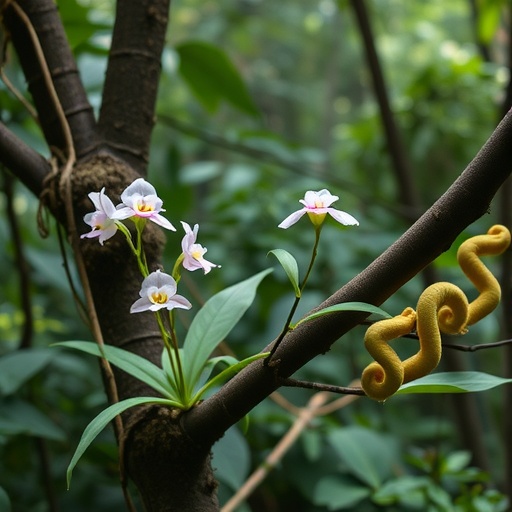
Deep within the semi-evergreen forests of northeastern Bangladesh, some of the country’s most threatened plants cling to life on the trunks and branches of towering trees. Now, following survey campaigns stretching from mid-2023 to late 2024 across four protected areas, researchers have produced the most complete portrait yet of these hidden canopy dwellers: 21 species of wild epiphytic orchids across 12 genera, each dependent on a specific combination of host trees and micro-environmental conditions. The study, led by Khatun Rabeya and Kazi Mohammad Masum of the Department of Forestry and Environmental Science at Shahjalal University of Science and Technology and published in the journal Discover Forests, shows that the fate of these orchids is written not merely in the forest as a whole, but in the height, bark, and crown architecture of the individual trees they colonize. With Bangladesh losing forest cover at roughly 2.6 percent each year—double the global average—the findings arrive at a pivotal moment for one of Asia’s most intriguing orchid frontiers.
Epiphytic orchids, which account for roughly 75 percent of the orchid family Orchidaceae—one of the most species-rich groups of flowering plants on Earth, with about 25,000 known species—are unusually honest messengers about forest health. Because they draw water and nutrients directly from the air, rainfall, and debris trapped on bark rather than from soil, they respond quickly to air pollution, climate variability, and moisture stress, making them valued ecological indicators. That sensitivity also makes them fragile. In Bangladesh, a national checklist once tallied 160 orchid species, 106 of them epiphytic, yet later surveys found that 54 species could no longer be located in their previously recorded habitats, and 32 are now considered possibly extinct in the country. Forest degradation, illegal collection for the ornamental trade, agricultural encroachment, invasive species, and the spread of monoculture plantations are all squeezing wild orchids into ever-smaller refuges. The economic pull is powerful too: during peak season, a single orchid vendor in neighboring Nepal can earn about 2,450 US dollars from wild-harvested flowers.
The new research zeroed in on four protected areas in the Sylhet region: Rema-Kalenga Wildlife Sanctuary, a roughly 1,796-hectare mosaic of primary and secondary semi-evergreen forest established in 1982 in Habiganj district; Lawachara National Park, a 1,250-hectare reserve in Moulovibazar district with dense canopy cover and scattered hillocks; Satchari National Park, a compact 243-hectare park within the Raghunandan Hill Reserve Forest; and Khadimnagar National Park, 678.8 hectares of hilly secondary forest near Sylhet, ringed by tea estates. Between mid-June 2023 and October 2024, the team surveyed route-based walking trails spaced at least 500 meters apart, using a modified arbitrary sampling design and establishing circular plots of 100 square meters—each with a radius of 5.461 meters—wherever an epiphytic orchid was encountered. Around every orchid-bearing tree, researchers recorded eight variables: phorophyte height, diameter at breast height, bark thickness, crown height, orchid attachment height, distance to the nearest forest edge, canopy coverage, and elevation. Specimens that could not be identified in the field were verified with the Bangladesh National Herbarium and Botanical Garden.
The diversity results split the four forests into a clear hierarchy. Rema-Kalenga and Lawachara each harbored 20 orchid species, while Satchari supported 15 and Khadimnagar just 9; across all sites, the orchids were found growing on 74 tree species from 31 families. The Shannon Diversity Index, which blends species richness with relative abundance, peaked at 2.84 in Rema-Kalenga—the upper end of the moderate diversity range and close to the high-diversity threshold—followed by 2.63 in Lawachara, 2.22 in Satchari, and 1.94 in Khadimnagar. Rema-Kalenga also recorded the highest evenness value, 0.95, meaning orchid individuals were spread almost uniformly across species, a signature of a balanced, thriving community. Pairwise comparisons using the Sørensen Dissimilarity Index revealed that Rema-Kalenga and Lawachara were nearly ecological twins, with a beta diversity of just 0.05, whereas Khadimnagar differed substantially from both, at 0.45. That pattern, the authors argue, reflects Khadimnagar’s fragmented patches and the tea plantations pressing against its borders, which appear to have eroded habitat heterogeneity and left a few dominant species in charge of an impoverished community.
Rank–abundance curves, which order species from most to least numerous, identified the community heavyweights at each site. Cymbidium finalaysonianum dominated Rema-Kalenga with a peak rank value of 1.362, while Dendrobium lindleyi topped Lawachara at 1.415. Aerides odorata led Satchari at 1.322, and Rhynchostylis retusa, the foxtail orchid, ranked first in Khadimnagar at 1.230. Rema-Kalenga and Lawachara both showed gradual declines in abundance across ranks, the classic profile of a species-rich community with a few strong dominants, whereas Satchari and especially Khadimnagar fell away sharply. The same analysis applied to host trees placed Artocarpus chaplasha, a large canopy member of the mulberry family, at the top in both Rema-Kalenga and Lawachara, with Chukrasia tabularis leading in Satchari and Khadimnagar. The steep drops in the curves for the latter two parks indicated more fragmented phorophyte communities—fewer abundant host trees and, by extension, fewer stable platforms on which orchid populations can establish and persist.
Perhaps the study’s richest findings concern host specificity—the question of whether orchids are picky landlords. The answer is a spectrum. At one end, the genera Aerides and Cymbidium proved consummate generalists, each recorded on 26 different phorophyte species, with Dendrobium close behind on 25 and Rhynchostylis on 19. At the opposite end, Camarotis and Phalaenopsis—the genus behind the familiar moth orchid of windowsills—were found on only three host species each, marking them as specialists with narrow ecological niches and acute sensitivity to the loss of particular trees. Pelatantheria and Pomatocalpa fell in between, restricted to 8 and 5 hosts respectively. Among the hosts themselves, Artocarpus emerged as the standout supporter, harboring 11 orchid species, while Chukrasia, Diospyros, Ficus, Lagerstroemia, Syzygium, and Tectona each hosted between 8 and 10. At the bottom of the table, Gynocardia, Hymenodictyon, and the introduced mahogany Swietenia supported only two species apiece, possibly because of smoother bark, limited canopy structure, or less favorable microclimates. The authors caution that such patterns may partly mirror the sheer abundance of certain trees in the forest rather than strict host preference.
To untangle what draws orchids to particular trees, the team ran Pearson correlation analyses across the full dataset. Four traits emerged as significant, if individually modest, predictors of orchid abundance: phorophyte height (r = 0.20, p < 0.001), crown height (r = 0.19, p < 0.001), bark thickness (r = 0.13, p < 0.01), and orchid attachment height (r = 0.13, p < 0.01). Diameter at breast height, a staple predictor in epiphyte studies elsewhere, showed no significant correlation here (r = 0.07), hinting that its influence is indirect and depends on forest type and age structure. Distance to the forest edge produced a weak negative trend, and canopy coverage and elevation were statistically insignificant on their own. The mechanisms behind the significant traits rest on solid epiphyte biology: taller trees intersect more light gradients and moisture bands within the canopy, creating a vertical patchwork of microhabitats, while thicker, rougher bark holds water longer and supports the mosses and lichens that orchid seeds require for germination and that young roots exploit for anchorage. Big, textured trees, in short, function as floating islands of opportunity in the canopy.
Two complementary statistical tools sharpened the picture further. Mantel tests, which compare distance matrices built from species composition and from environmental variables, revealed species-specific signatures: Aerides correlated positively with canopy coverage (r = 0.067, p < 0.01), consistent with the moisture-dependent physiology of a genus that favors dense, humid crowns, while Phalaenopsis tracked host diameter (r = 0.121, p = 0.023) and Bulbophyllum showed a near-significant association with attachment height. Other genera, including Cymbidium, Rhynchostylis, Dendrobium, Coelogyne, and Camarotis, showed no statistically significant correlations, though weak trends were visible. Principal component analysis then delivered the study’s most striking number: the first principal component alone explained 99.7 percent of the variance in orchid distribution and was dominated almost entirely by edge distance, with a loading of 0.99996, while the second component—contributing just 0.2 percent—was driven by altitude. Later components emphasized canopy coverage, crown height, and attachment height as the primary drivers of where orchids actually settle, with bark thickness and tree diameter playing secondary roles. Forest interiors, the analysis implies, offer the stable humidity, milder temperature swings, and diverse hosts that edges simply cannot.
The conservation implications are concrete. Because orchid diversity tracked phorophyte diversity and structural complexity, the authors argue that protecting individual host trees—especially supportive genera such as Artocarpus, Ficus, and Chukrasia—is as important as protecting forest land in the abstract. Maintaining habitat continuity matters equally: the dominance of edge distance in the PCA suggests that clearing and fragmentation degrade orchid habitat even where trees remain standing, by destabilizing the humidity and temperature regimes these plants depend on. Altitude adds a further dimension, shaping the temperature, light, and air moisture conditions that govern orchid survival and reproduction. Rema-Kalenga and Lawachara, with their mature, stratified canopies and lower levels of human disturbance, emerge as the region’s strongest refuges and natural priorities for protection; Khadimnagar stands as a warning of what fragmentation delivers—reduced richness, lower diversity, and communities skewed toward a handful of hardy generalists. The study also supplies something the region has long lacked: a comprehensive baseline against which future monitoring, habitat restoration, and reintroduction programs can be measured.
For a country that has already lost dozens of orchid species and whose forests are vanishing at twice the global pace, the message from the canopy is quietly urgent. Epiphytic orchids are not decorative extras in these ecosystems: they contribute to nutrient cycling, canopy water retention, and the food webs of countless canopy-dwelling animals, and their interactions with host trees, mycorrhizal fungi, and pollinators weave them deep into the forest’s ecological fabric. What this study demonstrates is that saving them demands a finer lens than simply drawing park boundaries on a map. The trees must be the right species, the right size, and the right distance from the forest edge; the canopy must hold its moisture and its mosses. As climate change shifts rainfall patterns and pressure on land intensifies across South Asia, the researchers’ conclusion doubles as a challenge to foresters, policymakers, and local communities alike: the survival of Bangladesh’s wild orchids now depends on preserving not just forests, but the intricate three-dimensional architecture within them.
Cite Scienmag News
Margaret Porter. (August 31, 2026). Epiphytic orchids reveal microhabitat and host tree preferences in Bangladesh forests. Scienmag. https://scienmag.com/epiphytic-orchids-reveal-microhabitat-and-host-tree-preferences-in-bangladesh-forests/
Margaret Porter. "Epiphytic orchids reveal microhabitat and host tree preferences in Bangladesh forests." Scienmag, 31 August 2026, https://scienmag.com/epiphytic-orchids-reveal-microhabitat-and-host-tree-preferences-in-bangladesh-forests/. Accessed 31 August 2026.
Margaret Porter. "Epiphytic orchids reveal microhabitat and host tree preferences in Bangladesh forests." Scienmag. August 31, 2026. https://scienmag.com/epiphytic-orchids-reveal-microhabitat-and-host-tree-preferences-in-bangladesh-forests/


