


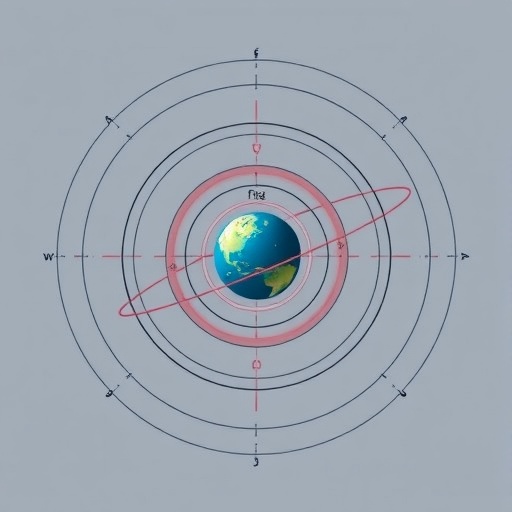
Some of the most trusted long-range forecasts in celestial mechanics rest on a deceptively simple maneuver: average away the rapid orbital cycles and follow only the slow drift that remains. A new study now pinpoints precisely where that shortcut collapses, and the culprit is not a planet tumbling into resonance but the external clockwork of the system drifting out of step. In research published in the journal Celestial Mechanics and Dynamical Astronomy as volume 138, article 47, Mohamed R. Amin of Qassim University in Buraydah, Saudi Arabia, and the National Research Centre in Dokki, Giza, Egypt, examines a hierarchical four-body model in which a massless test particle is shaped by the combined gravity of a tight inner binary and a distant third body. The analysis shows that when the imposed frequencies of the inner and outer orbits approach an integer ratio, the standard first-order averaging procedure loses its mathematical grip, and a more careful one-harmonic reduction must take over to keep predictions faithful to the true dynamics.
Averaging is among the oldest and most successful instruments in the celestial mechanic’s toolkit, and its logic is straightforward whenever timescales separate cleanly. A weak perturbation that oscillates rapidly produces only bounded jitter in the slow quantities that matter over long intervals, such as the eccentricity and orientation of an orbit, so replacing the perturbation with its average over the fast cycles yields an approximation that remains accurate far longer than anyone could integrate by hand. The technique underpins landmark results across the field, from Jacques Laskar’s estimates of the size of the chaotic zones of the solar system to the resonant repulsion observed in pairs of Kepler exoplanets and analyzed by Yoram Lithwick and Yanqin Wu, and to the analytical treatments of planetary resonances developed by Konstantin Batygin and Alessandro Morbidelli. Formally, first-order averaging is a near-identity transformation that removes the non-resonant Fourier harmonics of a perturbation, and its error control rests on a single geometric fact: the frequencies multiplying the deleted harmonics stay bounded away from zero, so each discarded term contributes only a small, controlled correction. In this study, that fact is precisely what fails.
To locate the failure, Amin constructed a test bed that captures the architecture of many real systems while keeping the mathematics tractable. The configuration is hierarchical and restricted: two massive bodies form a compact inner binary, a third massive body orbits far away, and a massless particle feels both fields, playing the role that a small moon, a planetesimal, or a spacecraft would play. Because the length scales are widely separated, the distant primary contributes only a tidal perturbation whose acceleration scales with the outer mass times the inner separation cubed over the outer distance cubed; measured against the inner binary’s own gravity, its relative strength is the parameter the study calls ε_f, the mass of the outer body divided by the total mass of the inner binary, multiplied by the cube of the ratio of the two separations. The analysis unfolds in the rotating barycentric frame of the inner binary, whose angular velocity fluctuates because the binary’s orbit is itself being driven, so the equations of motion acquire Coriolis and Euler terms alongside an effective potential built from the binary’s gravity, the particle’s tidal encounter with the outer body, and a linear term that removes the uniform acceleration of the translating frame so that the distant primary enters only through its tidal part. The framework is deliberately planar and restricted to weak particle eccentricity, isolating the mechanism under investigation from competing effects.
A crucial modeling choice separates this work from a conventional four-body integration. The phases of the inner binary and the outer body are prescribed rather than self-consistently evolved, advancing at fixed mean motions that the study denotes n_in and n_out. The particle therefore moves through a quasi-periodically forced environment driven by two external clocks, and the problem becomes a Hamiltonian system in an extended phase space. To treat the explicit time dependence canonically, the formulation adjoins auxiliary angle variables for the imposed phases together with dummy momentum variables, so that the total Hamiltonian consists of an unperturbed piece for the particle, a term linear in the dummy actions at the forcing frequencies, and the small tidal forcing weighted by ε_f. Because the forcing is periodic in each phase, it expands into a double Fourier series of harmonics of the combination k times the outer phase minus l times the inner phase, where k and l run over the integers, each harmonic carrying a state-dependent amplitude and a phase offset. Every harmonic rotates at a rate set by its detuning, k times n_out minus l times n_in, and averaging, in this language, is the systematic deletion of every harmonic whose detuning is not small. The transformation removes oscillating terms, not the fast variables themselves, and its price is a first-order correction proportional to the forcing strength times the harmonic amplitude over the detuning.
The failure mechanism is the classic small-divisor problem in contemporary dress. When the ratio of the two mean motions approaches the integer ratio l over k, the detuning of the corresponding harmonic approaches zero, and the first-order correction generated by the averaging transformation is amplified without bound. The study shows that once the ratio of forcing strength times amplitude divided by detuning approaches unity, the first-order averaged approximation loses what mathematicians call uniform control with respect to detuning: no matter how weak the forcing is made, some neighborhood of the commensurability always exists within which first-order averaging cannot be certified. The small denominators that complicate rigorous perturbation theory, from the foundations of Kolmogorov-Arnold-Moser theory to Anatoly Neishtadt’s analysis of passage through resonances, here arise from externally imposed frequencies rather than from the particle’s own orbital frequencies. That distinction carries the paper’s central conceptual message. The slow angle whose sluggish motion destabilizes the approximation is a combination of prescribed forcing phases, not an intrinsic angle of the massless particle, so the breakdown of the averaged model need not correspond to the particle being captured into any resonance of its own.
Rather than abandoning averaging altogether, the study builds a repair kit in the form of a one-harmonic reduced model. The construction begins with a selection rule, because amplitude alone is a poor guide to dynamical importance: a large harmonic oscillating rapidly averages away harmlessly, while a weaker harmonic with a nearly vanishing detuning can dominate the error. Each mode is therefore scored by its amplitude divided by the absolute value of its detuning, with Fourier coefficients extracted either symbolically when an analytic form of the forcing is available or numerically on a finite grid when it is not, and the single harmonic with the largest score within a truncated mode set is retained while everything else is averaged out. The reduced Hamiltonian keeps the averaged part of the perturbation and adds back one term, a single cosine of the slow phase combination formed from the winning indices. This surviving term organizes the slow dynamics into what the paper calls a pendulum-like auxiliary structure, the familiar architecture of resonance theory, but the study is explicit that this pendulum is a device for capturing slow forcing, not evidence that the physical particle has been trapped in a resonant island of its own phase space.
The claim is then subjected to a battery of numerical experiments comparing three systems side by side: the full forced model, the fully averaged model, and the one-harmonic reduction. To make the comparisons meaningful, the study employs filtered slow observables that strip away rapid oscillations and expose the secular behavior, dimensionless detuning scans that sweep the frequency ratio of the two clocks across the commensurability, and phase-ensemble tests that sample many initial values of the imposed phases to ensure that the conclusions are not artifacts of a privileged starting configuration. The pattern that emerges is consistent across all three diagnostics. Near the commensurability, the fully averaged model loses accuracy and drifts away from the full dynamics, while the one-harmonic model remains substantially closer throughout the transition region, tracking the secular evolution that the averaged approximation misplaces. The degradation is broad rather than sharply localized, spanning a measurable band of detunings instead of collapsing onto a single critical value, yet its width and scaling remain consistent with the predicted small-divisor law, supporting the interpretation that slow near-commensurate forcing, rather than hidden resonant capture, drives the breakdown of the averaged description.
The result lands in the middle of an active debate over the limits of averaged descriptions. Hierarchical triples, compact planetary systems, and small-body environments all involve layered orbital frequencies, and researchers routinely average over more than one fast angle to obtain tractable secular equations. Earlier work by Liberato Luo, Boaz Katz, and Subo Dong demonstrated that double averaging can fail to characterize the long-term evolution of Lidov-Kozai cycles, while studies of precession resonances in hierarchical triples and of pendulum approximations at high orbital eccentricity have probed adjacent territory. What the new analysis contributes is a clean attribution in the forced setting: the failure of first-order averaging is explained quantitatively by a slow, near-commensurate forcing harmonic, accompanied by a criterion that practitioners can evaluate before trusting an averaged model. The same mathematics bears on quasi-bicircular models, in which motion around the collinear libration points unfolds in an environment driven by two independent orbital frequencies, and it complements the symplectic integrators that handle fast orbital timescales numerically while analytic secular theories must decide when averaging is legitimate at all. Averaged dynamics, the study insists, must be audited against the clocks that drive it.
For everyday practice, the paper offers something close to a checklist. Fourier-analyze the forcing, tabulate the detunings of its harmonics, rank them by amplitude over detuning, retain the dominant one, and test whether the forcing strength times amplitude divided by detuning approaches unity; if it does, set the fully averaged model aside in favor of the partially averaged one. The framework also flags its own boundaries: the selection rule is deliberately first-order and local, and if several harmonics carry comparable scores, a multimode reduction may be required rather than a single retained term. None of this dethrones averaging, which remains the workhorse that rendered the solar system’s chaotic seas navigable and the exoplanet archive interpretable, and the century-long machinery of near-identity transformations, Hamiltonian normal forms, and resonance passage still supplies the vocabulary in which the results are stated. What the study clarifies is where the workhorse must be relieved by a more careful partner. Wherever two external clocks tick in near-coincidence, the denominators of perturbation theory shrink, the deleted harmonics push back, and the averaged sky can quietly stop matching the real one.
The breakdown of first-order non-resonant averaging near frequency commensurabilities in a prescribed-phase, quasi-periodically forced hierarchical four-body Hamiltonian model.
Failure of averaging near-commensurability in a forced hierarchical four-body model
Amin, M. R. (2026). Failure of averaging near-commensurability in a forced hierarchical four-body model. Celestial Mechanics and Dynamical Astronomy, 138, Article 47. https://doi.org/10.1007/s10569-026-10323-0
AI Generated
10.1007/s10569-026-10323-0
First-order averaging, Hamiltonian systems, Small divisors, Quasiperiodic forcing, Near-commensurability, Hierarchical celestial mechanics
Cite Scienmag News
Grant Pearson. (August 30, 2026). Averaging breaks down near orbital resonances in hierarchical four-body systems. Scienmag. https://scienmag.com/averaging-breaks-down-near-orbital-resonances-in-hierarchical-four-body-systems/
Grant Pearson. "Averaging breaks down near orbital resonances in hierarchical four-body systems." Scienmag, 30 August 2026, https://scienmag.com/averaging-breaks-down-near-orbital-resonances-in-hierarchical-four-body-systems/. Accessed 30 August 2026.
Grant Pearson. "Averaging breaks down near orbital resonances in hierarchical four-body systems." Scienmag. August 30, 2026. https://scienmag.com/averaging-breaks-down-near-orbital-resonances-in-hierarchical-four-body-systems/


