


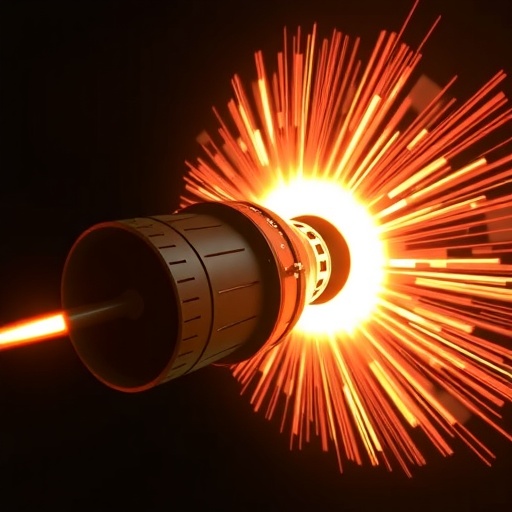
A Force Field Against the Fire: Magnetic Shields for Spacecraft Take a Major Leap in the Lab
Every spacecraft coming home from orbit survives a descent that is, in essence, a controlled catastrophe. Plowing into the upper atmosphere at several kilometers per second, the vehicle rams air molecules so violently that the gas ahead of it transforms almost instantly into a glowing shroud of plasma heated to several thousand degrees. For the entire history of spaceflight, engineers have endured that punishment the same way: wrap the craft in heat-resistant tiles, or bury it beneath sacrificial material that burns away on purpose and carries the heat off with it. Now researchers at Tokyo Metropolitan University have moved a strikingly different strategy — shielding and slowing a spacecraft with magnetism — a significant step closer to reality. In a study published in the Journal of Spacecraft and Rockets, a team led by Associate Professor Kohei Shimamura unveiled a laboratory platform that blasts a miniature test vessel with shockwaves traveling at more than seven kilometers per second while a powerful electromagnet wraps the model in magnetic fields far stronger than anything achieved in earlier experiments that relied on permanent magnets.
The physics of atmospheric entry is brutally simple. A returning spacecraft arrives carrying an enormous quantity of kinetic energy, and when it meets the atmosphere, that energy has to go somewhere. Nearly all of it is dumped into the air. As the vehicle plunges forward at hypersonic speed, it drives a shockwave ahead of itself, and gas crossing that shock is compressed and heated almost instantaneously to temperatures of several thousand degrees — hot enough to strip electrons from atoms and to melt or vaporize most engineering materials. Current thermal protection systems are essentially elaborate ways of standing between that inferno and the vehicle’s structure. Ceramic heat-resistant tiles of the kind that once shielded the Space Shuttle insulate the airframe while radiating heat away. Ablative heat shields go further, deliberately charring, melting, and vaporizing layer by layer, carrying thermal energy out of the system as material is consumed. Both approaches have flown reliably for decades. Both also carry stubborn penalties: they add weight that crowds out payload, their surfaces wear with every flight, they are expensive to produce, and they impose lengthy inspection and refurbishment campaigns between missions. In an era when the space industry is pushing hard toward rapidly reusable vessels, that trade-off is becoming ever harder to accept.
The alternative being pursued in Tokyo is called magnetohydrodynamic aerobraking, or MHD aerobraking, and its raw material is supplied free of charge by reentry itself. At hypersonic speeds the shock layer enveloping a vehicle is not merely hot; it is hot enough to be weakly ionized, seeded with free electrons and ions that render the gas electrically conductive. And a conductive fluid moving through a magnetic field is acted upon by electromagnetic forces. Switch on a sufficiently strong field around a reentering craft, and the ionized gas in the shock layer feels a body force — the same Lorentz-force principle at work in electric motors — pushing it outward, away from the hull. The ultra-hot shock layer expands and stands off farther from the craft’s surface, so substantially less heat flows into the vehicle. The benefits do not stop at thermal protection. Because the magnetic field thickens the cushion of plasma the craft must push through the surrounding flow, it can also increase aerodynamic drag, actively slowing the vehicle during descent. One technology, two payoffs: a cooler skin and a stronger brake. Previous theoretical and experimental studies have resoundingly supported the concept. The stubborn problem has been testing it rigorously.
That problem is subtler than it sounds. Studying MHD aerobraking on the ground means recreating, in a laboratory, flow conditions that otherwise exist only around hypersonically entering spacecraft — and then superimposing a strong magnetic field on top of them, all within fleeting experimental windows. In earlier experiments, researchers typically embedded a permanent magnet, usually a neodymium one, inside a small test model and fired a shockwave over it. Permanent magnets are compact and dependable, but they are inflexible in every way that matters for systematic science. The field strength is fixed at manufacture, the field’s shape is baked into the magnet’s geometry, and the field cannot be switched on or off, tuned, or reconfigured. Engineers therefore could not cleanly vary field strength to see how the shock layer responds, or trial different field shapes against different vessel designs; each model effectively came locked to a single magnetic configuration. What the field needed was a way to dial magnetism up, down, and into different shapes on demand — and to do so within test windows lasting only tens of microseconds.
Shimamura’s team engineered exactly that capability. At the heart of the new platform sits a small test model carrying a powerful electromagnet built from a customizable set of coils, allowing the geometry of the magnetic field to be designed rather than inherited from a lump of permanent magnet material. The coils are driven by a pulse-forming network, or PFN — an electrical system that stores energy and then releases it as a single, intense, precisely timed surge of current. That surge floods the coils and generates a strong magnetic field for a short, well-defined period: long enough to act on the flow around the model, brief enough to fit inside a ground-based hypersonic experiment. The model is mounted in a hypersonic expansion tube, a ground-based facility built to test aircraft and spacecraft in extreme environments by accelerating gas to flight-representative velocities. When the tube fires, a shockwave sweeps over the model at more than seven kilometers per second, and the entire interaction unfolds in tens of microseconds. The field strengths generated by the pulsed electromagnet substantially exceed what is possible with a permanent neodymium magnet, opening experimental territory that earlier campaigns simply could not reach.
Orchestrating such an experiment is a feat of timing as much as physics. Nothing in a hypersonic expansion tube waits around: the shockwave arrives, engulfs the model, and passes within tens of microseconds, so every subsystem must fire in coordination. The team’s system tracks the arrival of the shockwave and synchronizes the magnetic pulse to that exact duration, ensuring the field is at full strength precisely while the plasma layer forms around the vessel — the condition a real reentering spacecraft would experience continuously. A high-speed camera, synchronized to the same shockwave, records the light given off by the heated shock layer, a glow researchers call self-emission. In an environment where any physical probe would melt, or would itself disturb the flow it is meant to measure, the plasma’s own light becomes the diagnostic instrument. The brightness and spatial extent of the self-emission layer serve as a real-time map of where the hottest gas sits relative to the model’s surface. If a magnetic field is doing its job, the glowing layer should visibly swell outward — a thicker cushion standing between the inferno and the wall.
To demonstrate the platform’s flexibility, the researchers built two different models, each fitted with a coil configuration tailored specifically to its shape — an early signal that magnetic field geometry can be engineered to serve the vessel, rather than the vessel being designed around whatever magnet happens to fit inside it. When the system fired, the electromagnets delivered fields of 1.24 and 1.58 tesla. For context, the stronger of the two is more than double the field strength of conventional neodymium magnets, the workhorse of previous MHD aerobraking experiments. And the hot plasma responded as theory predicts: with the magnetic field switched on, the self-emission layer was observed to be more than 15 percent thicker than with the field off, the unmistakable footprint of a shock layer being pushed outward by magnetic forces.
A 15 percent thicker glowing layer may sound incremental, but in this discipline it is a meaningful and legible signal. The thickness of the shock layer governs how much of the plasma’s punishing thermal load actually reaches the vehicle: push the hottest gas farther from the surface and the heat flowing into the structure falls. Observing the shock layer expand in direct response to a switched, tunable magnetic field — at strengths beyond the permanent-magnet ceiling — confirms that the platform is not merely producing strong fields but reproducing the underlying magnetohydrodynamic physics that makes aerobraking attractive. Just as important, the two coil configurations showed that field shape can be matched to model geometry, giving engineers a genuine design variable instead of a fixed constraint. That transformability is precisely what the field has lacked: a way to ask systematic questions about how field strength and topology shape the protective effect, rather than accepting whatever a permanent magnet can offer.
The work is a vital stepping stone toward the team’s stated goal: planned tests of real reentry experiments, in which the technology would be evaluated on actual vessels descending through an actual atmosphere rather than on miniature models in a tube. The road from laboratory to flight is long, but the platform supplies the missing middle rung — a way to characterize electromagnetic aerobraking across a wide parameter space before anything is committed to orbit. If the technology matures, the implications stretch across spaceflight. Reusable vehicles could return with less sacrificed material and shorter turnarounds between flights. Missions to Mars, where a thin but real atmosphere must do the braking, could shed velocity magnetically while sparing their payloads. Probes bound for Venus or the outer planets — any destination with an atmosphere — could in principle trade some of their bulky heat shields for fields. As the team frames it, MHD aerobraking is a candidate core technology for any future space mission that involves reentry into any atmosphere, and every kilogram saved on thermal protection is a kilogram returned to science, cargo, or crew.
The study, published on 23 July 2026 in the Journal of Spacecraft and Rockets, was supported by JSPS KAKENHI grant numbers 21KK0078 and 26KJ1885. For now, each experiment lives and dies in a flash lasting tens of microseconds — a shockwave at seven kilometers per second, a surge of current through hand-tailored coils, and a camera catching the instant a magnetic field visibly bends a wall of plasma. But those flashes are accumulating into something larger: the experimental foundation for spacecraft that survive the fireball of reentry not with tiles that crack and shields that burn away, but with magnetic fields switched on at precisely the right moment. The force field, long a staple of science fiction, is being quietly assembled in a Tokyo laboratory — one microsecond at a time.
Cite Scienmag News
Katie Riggs. (August 29, 2026). Magnetic brakes tested in lab to slow high-speed spacecraft reentry. Scienmag. https://scienmag.com/magnetic-brakes-tested-in-lab-to-slow-high-speed-spacecraft-reentry/
Katie Riggs. "Magnetic brakes tested in lab to slow high-speed spacecraft reentry." Scienmag, 29 August 2026, https://scienmag.com/magnetic-brakes-tested-in-lab-to-slow-high-speed-spacecraft-reentry/. Accessed 29 August 2026.
Katie Riggs. "Magnetic brakes tested in lab to slow high-speed spacecraft reentry." Scienmag. August 29, 2026. https://scienmag.com/magnetic-brakes-tested-in-lab-to-slow-high-speed-spacecraft-reentry/


