


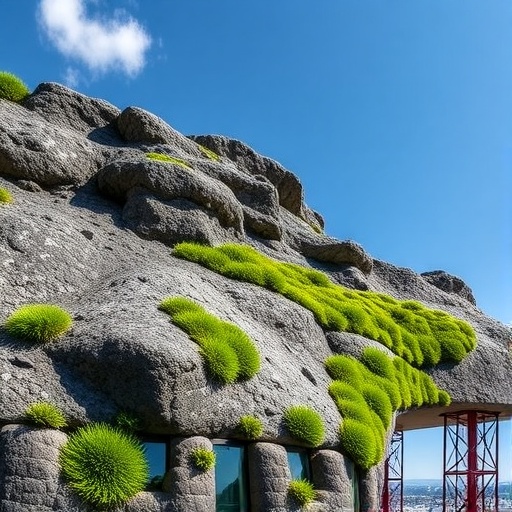
Gabbro, the Rock That Builds Cities, Could Now Lock Away Carbon Dioxide and Clean Polluted Water
Gabbro rarely gets the spotlight. It is the dark, dense, coarse-grained rock that crystallizes deep beneath mid-ocean ridges, forms the lowest layer of the oceanic crust, and is crushed by the millions of tonnes into roadbeds, rail ballast, and the foundations of skyscrapers. Yet a sweeping new review argues that this unglamorous construction staple may be one of the most underutilized tools in the race to decarbonize industry and repair damaged environments. Writing in the open-access journal Environmental Earth Sciences on 29 August 2026, a team led by Mostafa R. Abukhadra of the United Arab Emirates University, together with Hassan A. Rudayni and Ahmed A. Allam of Imam Mohammad Ibn Saud Islamic University and Bahaa Eldin Mahmoud Amin of the United Arab Emirates University, weaves decades of petrology, aggregate engineering, cement chemistry, and carbon-capture research into a single conclusion: gabbro can serve as a platform geomaterial whose performance is engineered from the mineral up, provided the right rock fraction meets the right application.
At the mineralogical level, gabbro is the plutonic twin of basalt: a coarse-grained mafic intrusive rock built mainly from calcic plagioclase and clinopyroxene, with variable amounts of olivine, orthopyroxene, amphibole, and iron–titanium oxides. Because its parent magma cools slowly at depth, crystals grow large enough to interlock into a tight, low-porosity fabric. Most of the planet’s gabbro lies hidden in the lower oceanic crust, where mantle-derived basaltic melts crystallize beneath mid-ocean spreading centers, but slivers of oceanic lithosphere thrust onto continents — ophiolites such as the Semail ophiolite spanning Oman and the United Arab Emirates, or the Troodos complex in Cyprus — expose it in mountain belts. Continental layered intrusions, including South Africa’s Bushveld Complex, North America’s Stillwater Complex, and Greenland’s Skaergaard Intrusion, add further vast reserves. The review emphasizes that these occurrences span troctolite, olivine gabbro, gabbronorite, and hydrothermally altered uralitized variants, and that this diversity, far from being a nuisance, is precisely what allows different gabbro fractions to be matched to different technological roles.
The review’s intellectual core is a structure–property–function framework: modal mineralogy, texture, alteration state, and particle size jointly decide whether a given batch of gabbro will resist abrasion on a highway, dissolve productively inside a carbonation reactor, or bind metals in a water filter. Fresh plagioclase–pyroxene gabbro, with its interlocking crystals and negligible primary porosity, delivers high compressive strength and outstanding abrasion resistance — qualities that have made ophiolite-derived gabbro the backbone of hard-rock aggregate supply across rapidly developing arid regions. Crush or mill the same rock, however, and cleavage planes, grain boundaries, and fresh fracture surfaces multiply its reactive area in contact with fluids. Hydrothermal alteration cuts both ways: it degrades aggregate quality by raising water absorption and promoting microcracking, yet moderate alteration can be an asset for reactive applications, because secondary iron oxides, hydrous silicates, and microfracture networks amplify surface heterogeneity, sorption capacity, and fluid access. Even accessory Fe–Ti oxides and their weathering products punch above their modal weight, supplying redox-active and sorptive surfaces that shape contaminant transformation and catalytic behavior.
In its conventional role, gabbro’s credentials are formidable. Angular crushed particles interlock tightly, improving rutting resistance in asphalt, and gabbro dust incorporated into foamed-bitumen cold-recycled mixtures has been shown to raise stiffness while lowering temperature susceptibility. In high-strength concrete, dense gabbro aggregate supports compressive strength and wear resistance, which helps explain why Fujairah’s quarries in the UAE’s Northern Emirates feed highways, ports, and coastal defenses. Cut and polished, dark gabbro is sold commercially as “black granite” dimension stone, though the review cautions that façade designers must account for surface temperatures approaching 80 degrees Celsius on solar-loaded cladding and for salt-fog attack in coastal atmospheres. Durability carries caveats, too: gabbro is not automatically immune to alkali–silica reaction, the deleterious swelling that occurs when reactive silica — often carried in late-stage veins, strained quartz, or microcrystalline phases — meets the high-pH pore solution of concrete. Standards such as ASTM C295 and RILEM AAR-1 therefore demand quarry-specific petrographic screening and, where warranted, laboratory expansion testing rather than blind trust in the rock’s name.
The first upgrade pathway is cementitious. UAE-based studies show that gabbro stone powder works as a microfiller when it replaces part of Portland cement: it refines particle packing, densifies the hardened matrix, moderates hydration kinetics, and reduces cumulative heat release. These are filler effects rather than true pozzolanic reactivity, but they are valuable all the same for cutting clinker content and valorizing stone-processing fines. In alkali-activated and hybrid binder systems, gabbro cannot rival slag, fly ash, or metakaolin as a reactive precursor, yet it earns a role as a semi-reactive component: its calcium- and magnesium-rich chemistry nudges the formation of C-(A)-S-H-type binding gels, while its crystalline surfaces act as nucleation substrates that accelerate precipitation and microstructural densification. Recent work on quarry-waste geopolymers shows that high proportions of metagabbro waste can perform in hybrid alkali-activated concretes provided the overall chemistry and activator dosage are properly engineered, rather than assuming that a fully crystalline rock will geopolymerize on its own.
The most consequential application, however, is carbon. Mineral carbonation exploits a neat piece of geochemistry: when CO₂ dissolves in water it forms carbonic acid, which drives proton-promoted dissolution of calcium- and magnesium-bearing silicates; the liberated Ca²⁺ and Mg²⁺ ions then combine with dissolved carbonate species to precipitate stable minerals such as dolomite and magnesite — in effect, turning a greenhouse gas into stone. Laboratory experiments in which a gabbro–anorthosite system reacted with seawater and supercritical CO₂ documented exactly this sequence, mobilizing calcium, magnesium, iron, silicon, and aluminum before carbonate phases appeared. The field benchmark remains Iceland’s CarbFix project, where more than 95 percent of CO₂ dissolved in water and injected into basaltic rock mineralized within less than two years. Gabbro is denser, more crystalline, and slower-reacting than glass-rich basalt, so the review treats it as a conditional feedstock whose kinetics hinge on comminution, fracture connectivity, permeability, and fluid residence time. Crucially, quarries already grind gabbro into fines, meaning the most energy-intensive step for ex situ carbonation is partly pre-paid — a strong argument for co-locating reactors with cement plants, power stations, and other concentrated industrial CO₂ sources.
A sister strategy, enhanced rock weathering, spreads finely ground silicate rock on farmland so that natural carbonic-acid weathering generates bicarbonate alkalinity that rivers ultimately carry to the ocean as durable dissolved inorganic carbon. Gabbro fines fit this logic as a slow-release soil remineralizer: weathering of plagioclase, pyroxene, and accessory mafic minerals gradually delivers calcium, magnesium, iron, and silicon while buffering soil acidity — a long-term fertility tool rather than a fast fertilizer. Early agronomic evidence is encouraging but limited: a Colombian study tested a gabbro by-product as a bulk amendment for yellow maize, and a gabbro–dacite rock-powder blend improved soil and plant responses. The review is candid about the obstacles. A soil-core investigation in dry United Kingdom croplands found only limited CO₂ removal by enhanced weathering, a warning for arid regions where low rainfall and high evapotranspiration throttle alkalinity export, and where monitoring must distinguish genuine dissolved-carbon export from carbonate re-precipitation inside the soil profile. Any deployment also demands trace-element screening for nickel and chromium, particularly in olivine-bearing and oxide-rich gabbroic variants.
Water treatment is where gabbro’s polymineral character turns from complication into advantage. Rather than acting as a single-phase adsorbent, gabbro behaves as a natural composite: hydroxylated iron-oxide coatings and iron-bearing secondary phases supply high-affinity binding sites that capture dissolved metals through surface complexation and ligand exchange, while gradual dissolution of calcium–magnesium silicates consumes acidity, raises pH, and pushes dissolved metals toward immobilization as hydroxides and carbonates. That combination suits packed beds, granular filters, and permeable reactive barriers for contaminated groundwater and wastewater. The most eye-catching result comes from the UAE itself: unmodified gabbro quarry residues behaved as solar-responsive catalytic surfaces, degrading 4-nitrophenol and 2-propanol under irradiation, reducing nitrogen dioxide, and oxidizing carbon monoxide — despite only modest measured surface area. The review attributes this to mineralogical complexity, surface acidity, and Fe-, Mn-, and Ti-bearing phases rather than any single mineral. Compared with basalt, which reacts faster, or serpentinite, which neutralizes acid more aggressively but raises nickel and chromium concerns, gabbro emerges as a balanced medium: moderate buffering, robust hydraulics, mechanical durability, and existing industrial supply chains.
The review also catalogs higher-value industrial conversions. Gabbro’s bulk chemistry sits inside the CaO–MgO–FeO–Al₂O₃–SiO₂ compositional window prized in mineral-wool manufacture; blended with dolomite, bauxite, slag, or recycled briquettes, it can be melted and fiberized into thermal and acoustic insulation, and a Polish study of Braszowice gabbro reported favorable glass-forming behavior with a low crystallization tendency that may even outperform basalt in fiber formation. The same melt chemistry underpins gabbro-derived glass–ceramics, whose wear resistance has been demonstrated experimentally, and packed-bed thermal energy storage, where dense, iron-bearing mafic rocks excel at storing sensible heat for renewable-heavy grids. Oxide-rich layered gabbros open a beneficiation route: stratiform titanomagnetite and ilmenite can be concentrated, and since more than 95 percent of titanium mineral concentrates feed TiO₂ pigment production, while magnetite commands its own market as a durable black pigment, quarry streams can be split into silicate construction fractions and oxide revenue streams. Gabbro even matters underground as a hot dry rock geothermal reservoir, where fracture-controlled permeability and temperature-dependent electrical resistivity — measured experimentally up to 350 degrees Celsius — govern heat extraction, and fault experiments show that the physical state of water controls gabbro friction, informing induced-seismicity risk.
None of this happens automatically, and the review is unusually blunt about what remains unknown. Gabbro reacts more slowly than glassy basalt or olivine-rich peridotite; grinding consumes energy that life-cycle assessments must count; natural heterogeneity forbids generalizing from rock name alone; and long-term questions of passivation, clogging, leaching, and durability under repeated wetting, heating, and chemical cycling remain open. The authors call for quantitative, mineral-specific reactivity data, standardized petrographic and geochemical screening, leaching and environmental-risk assessment, life-cycle and techno-economic analysis, and field-scale validation with rigorous monitoring, reporting, and verification, especially for carbon-removal schemes. Their vision is a cascading quarry in which fresh coarse stone serves aggregate and dimension-stone markets, selected fines feed binders, enhanced weathering, and soil remineralization, altered or oxide-rich fractions become remediation media, and Fe–Ti-rich streams supply pigment and titanium markets. The United Arab Emirates — with its Semail ophiolite gabbro, mature quarrying sector, concentrated industrial CO₂ sources, and Net Zero 2050 agenda — serves as the illustrative case study, but the argument travels wherever ophiolitic gabbro meets infrastructure demand and decarbonization pressure. The humble ocean-floor rock, the authors conclude, has earned promotion from commodity to platform.
Cite Scienmag News
Hazel L. (August 29, 2026). Gabbro emerges as sustainable platform for carbon mineralization and green applications. Scienmag. https://scienmag.com/gabbro-emerges-as-sustainable-platform-for-carbon-mineralization-and-green-applications/
Hazel L. "Gabbro emerges as sustainable platform for carbon mineralization and green applications." Scienmag, 29 August 2026, https://scienmag.com/gabbro-emerges-as-sustainable-platform-for-carbon-mineralization-and-green-applications/. Accessed 29 August 2026.
Hazel L. "Gabbro emerges as sustainable platform for carbon mineralization and green applications." Scienmag. August 29, 2026. https://scienmag.com/gabbro-emerges-as-sustainable-platform-for-carbon-mineralization-and-green-applications/


