


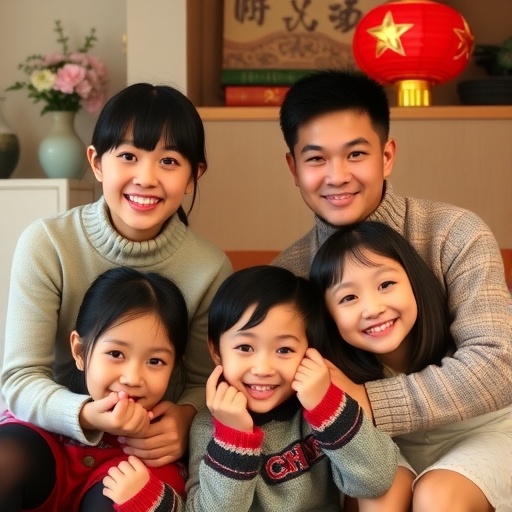
The Quiet Shield: How Bookshelves, Diplomas, and Warm Expectations Protect Chinese Teenagers’ Mental Health
Families pass down more than money. They pass down shelves of books, framed diplomas, and a dinner-table certainty that education matters — an inheritance sociologists call cultural capital. A new longitudinal study from China suggests that this inheritance may do something far more intimate than shaping grades or careers: it appears to help protect adolescents from the emotional and behavioral problems that increasingly burden a generation. Analyzing nationally representative panel data that followed children aged 10 to 15 across a four-year span, Hao Song of Shandong Normal University, Yang Hong of Guizhou University of Finance and Economics, and Lin Zhang of Zhengzhou University found that teenagers whose families hold richer stores of cultural resources display fewer psychological and behavioral difficulties — and that the benefit travels largely through one deceptively simple channel: what parents expect of their children’s education. Crucially, those expectations become protective only when the parent–adolescent relationship is warm enough to carry them. The study, published in Applied Research in Quality of Life on 29 August 2026, arrives amid mounting concern about adolescent mental health in China.
The stakes are considerable. Emotional and behavioral problems form a broad clinical category spanning internalizing difficulties — anxiety, depression, social withdrawal — and externalizing difficulties such as aggression, rule-breaking and hyperactivity. In China they are increasingly framed as a public health issue rather than a private family matter: a national survey of school children and adolescents aged 6 to 16, published in European Child & Adolescent Psychiatry, catalogued their prevalence across the country, and UNICEF now runs a dedicated initiative to standardize the measurement of adolescent mental health at the population level. The consequences do not stay confined to childhood. Research ties emotional disorder to school absenteeism, links adolescent distress to weaker academic performance that can echo into early adulthood, and shows that such problems undermine psychosocial adjustment and future well-being. Because adolescence is increasingly understood as a pivotal window in the developmental timeline — the period when socio-emotional patterns consolidate — identifying which family conditions blunt the emergence of these problems has become a central question for developmental science and health policy alike.
The concept at the center of the new study descends from the French sociologist Pierre Bourdieu, who in 1986 distinguished three forms of cultural capital: embodied capital, meaning dispositions, language habits and knowledge internalized through upbringing; objectified capital, meaning cultural goods such as books, artworks and educational materials; and institutionalized capital, meaning formally recognized credentials, above all educational qualifications. Song and colleagues focused on the objectified and institutionalized forms, which can be measured in the home and in parents’ schooling histories. Decades of research have shown these resources to be potent engines of advantage: they enrich children’s vocabulary and learning routines, equip parents to navigate school systems, and even shape how young people recognize and seek mental health care. Cultural capital has been tied to children’s reading motivation and behavior, to junior high school achievement in China, and to adolescents’ digital skills. What remained poorly understood was whether the same resources influence not just what children learn but how they feel and behave — and, if so, through what relational machinery.
To find out, the team turned to the China Family Panel Studies, or CFPS, a nationally representative, biennial survey administered by Peking University that tracks thousands of households across economic, educational and health domains. The researchers harnessed two waves — 2018 and 2022 — focusing on adolescents aged 10 to 15, which allowed them to measure family conditions years before the outcomes they might influence. That longitudinal architecture matters: if cultural capital were measured at the same moment as emotional problems, one could not tell whether bookshelves breed calm or whether distressed families abandon bookshelves. Within a moderated mediation framework in the regression-based conditional process tradition of methodologist Andrew Hayes, the team modeled the two dimensions of cultural capital as predictors, parental educational expectations as the mediator, parent–adolescent relationship quality as the moderator, and emotional and behavioral problems as the outcome. The underlying survey data were collected with written informed consent under ethical approval from Peking University’s Biomedical Ethics Review Committee.
The headline result is deceptively clean: higher family cultural capital predicted fewer emotional and behavioral problems over the four-year window. More revealing was the pathway. In the language of mediation analysis, the association flowed partly through the tendency of culturally rich families to hold higher educational expectations — the so-called a-path — and the tendency of adolescents whose parents expect more of their schooling to show fewer difficulties — the b-path. The product of those two paths, the indirect effect, carried a meaningful share of the overall association, though not all of it, leaving room for other channels the model did not capture. The finding resonates with meta-analytic evidence that parental educational expectations robustly predict academic achievement in children and adolescents. What the new study adds is an extension into the socio-emotional domain: expectations, it seems, are not merely academic fuel but daily signals of parental belief — messages that a child is capable of, invested in, and worth anticipating a future for.
The result also enters a contested arena. In China’s high-stakes educational culture, which culminates in the gaokao college entrance examination that shadows years of schooling, parental educational expectations are a double-edged instrument. Analyses of the China Education Panel Survey have associated expectations paired with heavy academic pressure with poorer adolescent mental health, and studies of parental involvement trace chains in which expectations feed educational anxiety. Yet other work finds expectations nourishing: higher expectations predict greater self-efficacy and learning engagement, which in turn lift adolescents’ subjective well-being, and longitudinal Chinese evidence links higher expectations to better well-being when perceived academic pressure is low. Against this ambivalent backdrop, the new findings propose a resolution: the variable that separates helpful expectations from harmful ones may be relational rather than quantitative — how much warmth surrounds the expectation, not how high it flies.
The study’s most striking twist confirms that suspicion. The protective association between parental educational expectations and adolescents’ emotional and behavioral adjustment was not uniform: it depended on the quality of the parent–adolescent relationship. In technical terms, relationship quality moderated the b-path of the mediation model, producing what methodologists call a conditional indirect effect — an indirect effect whose strength varies across levels of a third variable. Where relationships were supportive and emotionally close, higher expectations translated more strongly into fewer emotional and behavioral problems; where ties were strained or distant, the protective signal weakened. The metaphor is almost agricultural: identical seeds of expectation yield different harvests depending on the relational soil in which they are planted. An expectation delivered inside a warm bond lands as belief; the same expectation delivered across a cold one risks landing as pressure.
That interpretation gains force from adjacent literatures. Attachment and family systems perspectives hold that warm parent–child bonds operate as a secure base from which adolescents can absorb demands without feeling threatened; in their absence, identical demands are more likely to be read as surveillance or control. Chinese adolescent studies supply corroborating detail: academic stress is associated with depression through school burnout and self-esteem, and parental expectation has been linked to psychological distress via eroded core self-worth and elevated perceived stress. The stakes of framing are amplified in the Chinese cultural context, where parental expectations are entangled with filial piety and the interlocking semantics of “face” — mianzi and lian — so that the same aspirational message can be heard as devotion or as debt. The pattern converges with international evidence that parent–child relationship quality in adolescence predicts higher subjective well-being in adulthood across a diverse group of countries. Together these strands suggest a general principle: expectations protect only when embedded in connection.
The authors and careful readers alike would urge caution in causal readings. The design is observational: even with years between measurement waves, cultural capital co-travels with family income, parental education, urban residence and inherited endowments, any of which could partly drive the associations. Two waves cannot capture the full developmental choreography of adolescence, and self- and parent-reported measures introduce blind spots, since parents and adolescents sometimes disagree about the very problems being measured. Partial mediation means much of the association between cultural capital and adolescent adjustment remains unexplained, plausibly flowing through parenting practices, school climates or peer networks the model did not include. Nor should the findings be read deterministically: cultural capital marks statistical tendencies across thousands of families, not guarantees for any single child. And the Chinese context — an exam-oriented system, large-scale rural-to-urban migration, and left-behind children — shapes both the distribution of family resources and the meaning of expectations, warranting care in generalizing to other settings even when the underlying mechanisms likely travel.
Still, the practical implications are difficult to ignore. If expectations are the delivery vehicle and warmth the condition of delivery, then family-based prevention of adolescent emotional and behavioral problems need not choose between academic encouragement and emotional connection — it must engineer both. Parenting programs could train caregivers to pair high expectations with explicit affirmations of support; school counselors could assess not only achievement pressure but the relational climate in which it lands; and policymakers concerned with child and family welfare could treat relationship quality as a form of infrastructure rather than a private afterthought. The study also joins a growing body of work in its own journal on how family capital shapes positive youth development among rural Chinese adolescents and on reconceptualizing family resilience in the Chinese context. As China confronts a rising tide of adolescent distress, the message emerging from four years of national data is quietly radical: the most protective thing a family may own is not the bookshelf itself, but the warmth with which its ambitions are handed down.
Cite Scienmag News
Celia A. (August 29, 2026). Family Cultural Capital Boosts Chinese Teens’ Well-Being Through Parental Expectations and Bonds. Scienmag. https://scienmag.com/family-cultural-capital-boosts-chinese-teens-well-being-through-parental-expectations-and-bonds/
Celia A. "Family Cultural Capital Boosts Chinese Teens’ Well-Being Through Parental Expectations and Bonds." Scienmag, 29 August 2026, https://scienmag.com/family-cultural-capital-boosts-chinese-teens-well-being-through-parental-expectations-and-bonds/. Accessed 29 August 2026.
Celia A. "Family Cultural Capital Boosts Chinese Teens’ Well-Being Through Parental Expectations and Bonds." Scienmag. August 29, 2026. https://scienmag.com/family-cultural-capital-boosts-chinese-teens-well-being-through-parental-expectations-and-bonds/


