

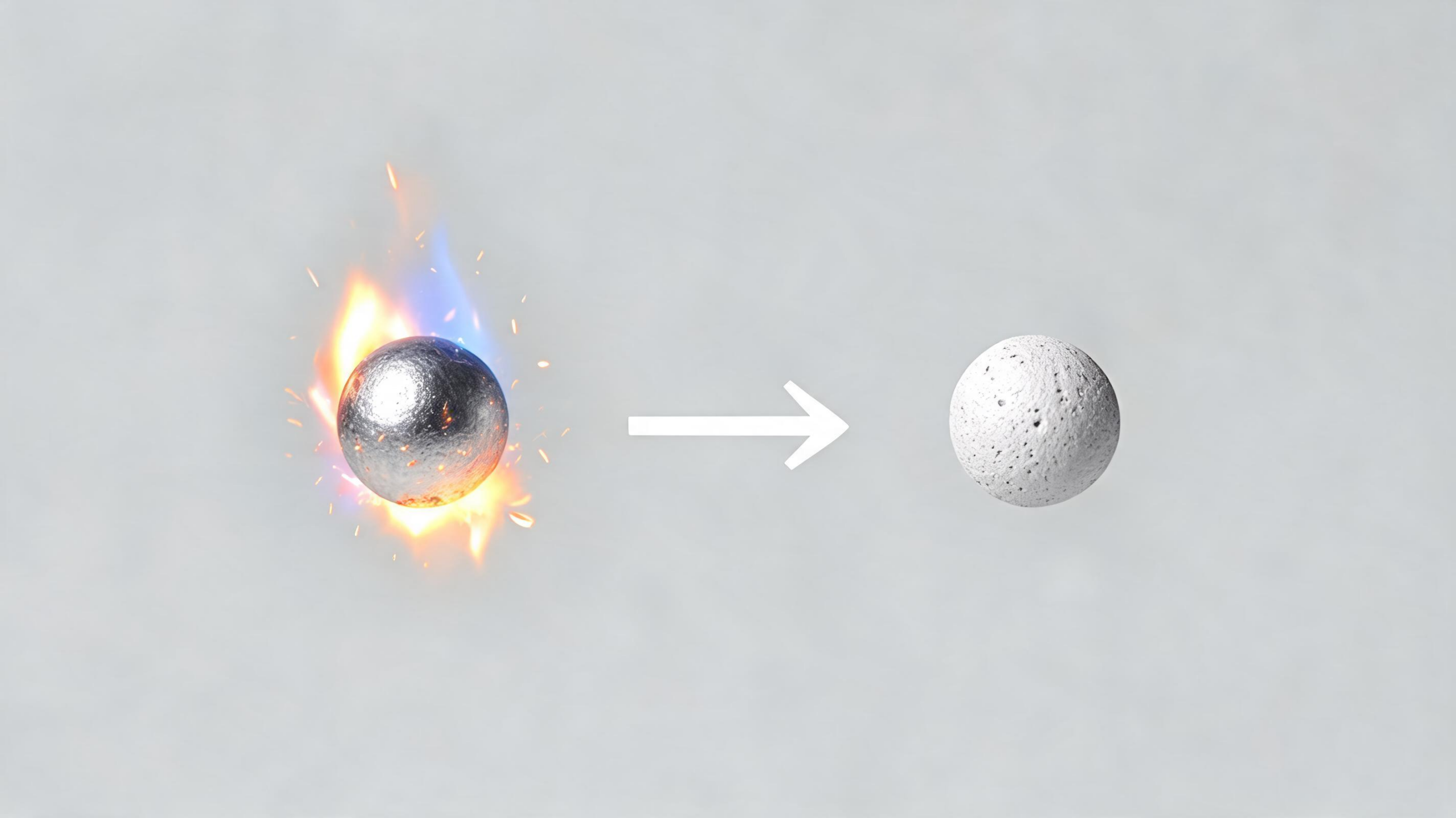
Aluminum is usually associated with lightweight structures, packaging, and aircraft, but in finely divided form it can also act as a highly energetic fuel. Its appeal extends to propulsion and energy systems because the metal stores substantial chemical energy and can potentially serve as a recyclable carrier for renewable power. Yet turning that promise into a practical technology is difficult. Every aluminum particle rapidly develops a thin, stable surface layer of alumina, or aluminum oxide, which shields the underlying metal from its surroundings. That protective coating makes ignition and sustained combustion more complicated, particularly when particles are only a few tens of micrometers across. A study by Hong-Gye Sung, Beom-Mo Kim, and Han-Young Choi presents a numerical model designed to follow those processes in detail. Published in the International Journal of Aeronautical and Space Sciences, the work examines how individual aluminum particles burn and how the resulting oxide vapor condenses, with special attention to a poorly understood size range between 10 and 100 micrometers.
The researchers focus on what combustion scientists call the transition regime, where the familiar assumptions of ordinary fluid mechanics begin to break down. In larger particles and conventional gas flows, heat and mass transfer can often be estimated using continuum descriptions: gases are treated as smooth fluids, and transport toward or away from a particle is represented through established correlations. At sufficiently small scales, however, the mean free path of gas molecules becomes significant compared with the particle diameter. Molecules no longer behave as though they are moving through a perfectly continuous medium, and the Knudsen number becomes important. The model therefore bridges continuum and transition-regime behavior rather than applying a single transport formula across all particle sizes. That distinction matters because burning time does not change smoothly as aluminum particles shrink. Experimental observations show an abrupt variation across the transition range, with a notable inflection near particles about 30 micrometers in diameter.
To represent the coupled physics, the study uses an Eulerian–Lagrangian framework. In this approach, the surrounding gas is described as a continuous field, while the aluminum particle is tracked individually as it moves, heats, reacts, loses mass, and changes composition. The two descriptions are fully coupled: the gas transfers heat and oxidizing species to the particle, while the particle returns energy and reaction products to the gas. The combustion formulation includes heat and mass transfer in both continuum and transition regimes, reactions at the particle surface, vaporization of aluminum, and chemical kinetics in the gas phase. The calculation also follows changes in the particle state, including the growth of condensed aluminum oxide. This level of detail is intended to capture processes that simpler single-stage or diffusion-limited models can miss, especially when vaporization and phase change compete with surface oxidation.
Aluminum combustion is not simply a matter of oxygen reaching a metal surface. As the particle heats, the oxide layer influences how readily the oxidizer can interact with the aluminum beneath it. Surface reactions can consume aluminum and oxidizer directly, while intense heating can vaporize aluminum from the particle. The vapor may then participate in gas-phase reactions before aluminum-containing products return to a condensed state. These pathways redistribute both energy and mass. Heat conducted through the particle, transferred from the surrounding gas, and emitted or absorbed by radiation all affect the temperature history. At the same time, the particle’s size and surface condition influence drag, relative motion, and the area available for reaction. By incorporating these effects into a single-particle simulation, the researchers sought to explain why apparently similar particles can display sharply different burning behavior as their diameter changes.
The calculations were compared with experimental data and published correlations to test whether the model could reproduce observed burning-duration trends and transport behavior. The results support the existence of a distinct change in combustion mode within the transition range. For particles larger than about 50 micrometers, boiling is the dominant stage in the modeled combustion sequence. Boiling contributes much less for particles smaller than 30 micrometers, and the model finds no contribution from boiling at 10 micrometers. This shift helps explain why the relationship between particle size and burn time contains an inflection rather than following one simple scaling law. A large particle can spend an important part of its combustion history in a state where vaporization governs the supply of reactive aluminum. A much smaller particle, by contrast, has a different balance between surface reaction, heat transfer, and mass loss, so the same boiling-driven description cannot be applied.
The transition has consequences beyond the time required for a particle to disappear. Aluminum combustion produces a substantial amount of condensed aluminum oxide, and that oxide can form slag or deposits inside engines and combustors. Deposits may reduce performance, obstruct passages, alter heat transfer, and complicate maintenance. For systems intended to burn aluminum as a fuel, predicting oxide production is therefore as important as predicting ignition or energy release. The model estimates a strong size dependence in the remaining oxide. For a 10-micrometer particle, the aluminum oxide is about 40 percent of the initial particle size, according to the study’s reported result, whereas the corresponding oxide is more than 50 percent for larger particles. These values describe the modeled size relationship rather than a universal constant, but they show why particle-size control could be central to managing condensed products.
The findings are relevant to several engineering concepts in which metal particles are burned individually or as part of a dispersed cloud. Aluminum powders have been investigated for propulsion, energetic materials, controllable power generation, and systems that might use metals to store energy produced elsewhere. In each case, the useful chemical energy must be weighed against ignition difficulty, incomplete reaction, and the behavior of solid or liquid products. A model that resolves the transition between transport regimes can help researchers evaluate how particle diameter changes flame behavior and residue formation before building a full combustor. It may also support calculations of two-phase flows, in which reacting particles move through a gas while exchanging momentum, heat, and chemical species. The study does not establish that aluminum is ready to replace existing fuels, nor does it demonstrate a complete engine design. Its contribution is a more detailed way to calculate the microscopic events that influence larger systems.
The work also clarifies why experiments on metal-particle combustion can be difficult to interpret. A measurement of burn time may combine several stages, including heating, oxide-layer evolution, surface oxidation, aluminum vaporization, gas-phase reaction, and condensation. The dominant stage can change with particle size, so data collected at one scale cannot automatically be extrapolated to another. The reported inflection near 30 micrometers and the changing role of boiling provide specific targets for future measurements. Further experimental tests could examine how pressure, oxidizer composition, gas flow, particle shape, and initial oxide thickness modify the predicted behavior. For now, the numerical results offer a framework for linking those variables to particle-scale physics. By treating combustion and condensation as connected parts of the same process, the study brings researchers closer to predicting not only how rapidly aluminum burns, but also what its combustion leaves behind.
A useful way to interpret the model is as a bridge between particle-scale chemistry and combustor-scale behavior. The calculation does not treat aluminum oxidation as a single reaction occurring at a fixed surface. Instead, it accounts for several routes by which energy and material move through the particle–gas system. Heat can arrive through the surrounding gas, conduction, and radiation, while aluminum can be consumed at the surface or enter the gas phase through vaporization. Gas-phase kinetics then determine how vaporized material reacts before products condense. This coupling is important because a change in one pathway can alter the others: faster heating may promote vaporization, but the resulting mass transfer also changes the surrounding composition and the surface available for reaction.
The transition regime is especially significant because transport coefficients are not merely smaller or larger versions of continuum values. When the molecular mean free path is comparable with the particle diameter, collisions between gas molecules and the particle surface influence momentum, heat, and species transfer. The study therefore includes transition-regime formulations alongside continuum descriptions and tracks the particle and gas simultaneously. In practical simulations, this approach can prevent a model calibrated for relatively large particles from being applied uncritically to smaller powders. It also provides a physical explanation for why particle-size effects may be discontinuous: the governing balance can change when a transport regime and a combustion stage become important at the same size scale.
The reported oxide results should be read as a geometric outcome of the modeled reaction history, not simply as the fraction of aluminum that failed to burn. Condensed alumina may form after aluminum has vaporized and reacted in the gas phase, as well as through processes associated with the particle surface. Its amount and distribution therefore depend on how the calculation represents surface reactions, evaporation, gas-phase chemistry, and condensation together. This distinction matters for engineering assessments. A system could achieve rapid consumption of metallic aluminum while still producing a considerable condensed oxide burden. Measurements of residue, deposit formation, and particle disappearance consequently provide different information and should not be treated as interchangeable indicators of combustion efficiency.
Because the work models an isolated aluminum particle, its results are most directly useful as a building block for larger multiphase calculations rather than as a complete prediction for an operating device. In a dense particle cloud, neighboring particles could modify temperature, oxidizer availability, radiation, and vapor concentration. The single-particle framework can nevertheless supply size-dependent reaction and mass-transfer behavior for such future simulations. Its validation against experimental observations and established correlations strengthens confidence in the identified burning-time trend, while the remaining sensitivity to operating conditions underscores the need for targeted measurements. Pressure, gas composition, flow, and initial surface condition can all affect which stage dominates, so extrapolating the reported size thresholds beyond the modeled conditions would require additional evidence.
Subject of Research: Micron-sized aluminum particle combustion and alumina condensation in the transition regime
Article Title: A Numerical Model for Combustion and Condensation of Micron-sized Aluminum Particle in Transition Regime
Article References: A Numerical Model for Combustion and Condensation of Micron-sized Aluminum Particle in Transition Regime. (n.d.). https://doi.org/10.1007/s42405-026-01279-4
Image Credits: AI Generated
DOI: 10.1007/s42405-026-01279-4
Keywords: aluminum combustion, micron-sized particles, alumina, condensation, burn time, transition regime, Eulerian–Lagrangian modeling, metal fuels, Numerical, Model, Combustion, Micron-sized
Cite Scienmag News
Scienmag. (August 29, 2026). A New Model Reveals How Micron-Sized Aluminum Burns and Forms Oxide. https://scienmag.com/a-new-model-reveals-how-micron-sized-aluminum-burns-and-forms-oxide/
Scienmag. "A New Model Reveals How Micron-Sized Aluminum Burns and Forms Oxide." Scienmag, 29 August 2026, https://scienmag.com/a-new-model-reveals-how-micron-sized-aluminum-burns-and-forms-oxide/. Accessed 29 August 2026.
Scienmag. "A New Model Reveals How Micron-Sized Aluminum Burns and Forms Oxide." Scienmag. August 29, 2026. https://scienmag.com/a-new-model-reveals-how-micron-sized-aluminum-burns-and-forms-oxide/


