


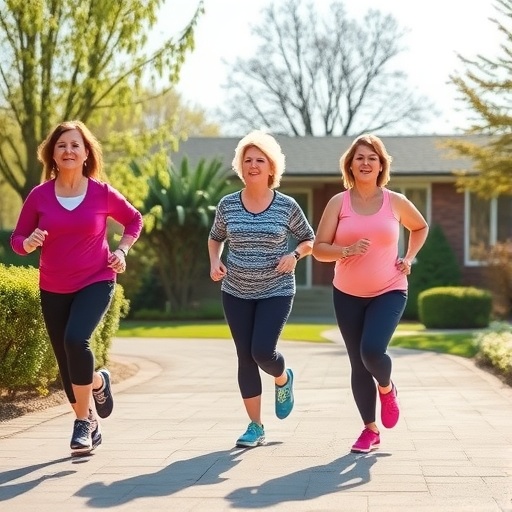
A Few Daily Movement Skills Could Add 550 Steps—and Help Women Navigate Cardiovascular Risk
For women in midlife who are at elevated risk of cardiovascular disease, becoming more physically active may depend less on an ambitious exercise plan than on having a flexible set of psychological and behavioral tools ready for ordinary life. A new study suggests that each additional physical-activity skill participants reported using on a given day was associated with about 550 extra steps that day. The finding emerged from an eight-week intervention in which 62 women aged 40 to 65 learned strategies for handling barriers such as limited time, low motivation, unpredictable schedules and lack of social support. Rather than prescribing a rigid workout routine, the program emphasized small, sustainable increases in movement, including walking more during daily tasks, taking the stairs and building activity into existing routines. The results, published in the Journal of Behavioral Medicine, offer a detailed glimpse into what happens between formal coaching sessions—where behavior-change techniques must ultimately become usable habits.
Midlife is a particularly important period for cardiovascular prevention. Biological aging and the menopausal transition can alter blood pressure, metabolism and other risk factors, while physical activity often declines. The researchers focused on women who were insufficiently active and had at least one cardiovascular risk condition, including hypertension or prehypertension, prediabetes or type 2 diabetes, metabolic syndrome, high cholesterol or current smoking. Before joining the study, participants reported less than 90 minutes of moderate-to-vigorous activity per week or fewer than 7,000 steps per day. The group had an average age of 52 and an average body-mass index of 31 kilograms per square meter; 40 percent identified with a racial or ethnic minority group. Although the sample was not designed to represent all women in midlife—many participants had relatively high education and household income—it included a population for whom modest, repeatable changes in daily movement could have meaningful health implications.
The intervention combined techniques drawn from cognitive-behavioral therapy, acceptance and commitment therapy and motivational interviewing. Across six active intervention weeks, coaches introduced nine distinct skills involving behavior, cognition and acceptance. Participants learned to manage time, set goals, solve problems, communicate effectively, draw on partner support, engage with personal values, show willingness to act despite uncomfortable thoughts or feelings, and refocus after a lapse rather than treating it as a relapse. The distinction between a lapse and a relapse was central to the program’s flexible philosophy: missing one walk was not supposed to erase previous progress or trigger all-or-nothing thinking. “Willingness,” in this context, meant choosing a valued behavior even when motivation was low or negative thoughts were present. The researchers paired participants with partners of similar age, baseline activity and availability, allowing them to exchange encouragement between remote meetings with coaches.
The study’s most distinctive feature was its day-by-day measurement. Participants wore either a study-issued pedometer or their own activity tracker and completed an end-of-day survey intended to take no more than five minutes. They recorded their step count, identified the main barrier to physical activity that day and indicated which skills they had used. This intensive approach differs from asking someone at the end of a month how often they exercised, a method vulnerable to imperfect recall and broad, impressionistic answers. Daily reports can connect a person’s experience on a particular day with an objectively recorded behavior, while multilevel statistical models can separate differences between people from fluctuations within the same person. In this analysis, the investigators treated each skill as either used or not used on a given day, then examined how the total number of skills related to steps, barriers and time in the program.
Compliance was high enough to show that this kind of close monitoring is practical. During the intervention and immediate post-intervention period, participants completed 2,186 of the expected 2,600 surveys on time, an 84 percent completion rate that exceeded the researchers’ predefined feasibility threshold of 80 percent. Participants rated the acceptability of reporting daily skill use at an average of 4 out of 5. They rated their confidence in using the skills even higher, at 4.5 out of 5, while the effort required for the program’s daily demands averaged 3.1 out of 5. All 62 women remained in the study through the end of the program, 97 percent of intervention sessions were completed and 92 percent of participants attended every session. These figures indicate that repeated self-reflection did not become an insurmountable burden for this group, although adherence could be different in populations facing greater financial, technological or caregiving constraints.
Participants did not use the skills uniformly. Willingness was reported on 44 percent of days with timely surveys, followed by time management on 31 percent and partner support on 30 percent. Engaging personal values appeared on 17 percent of days, while effective goal-setting was reported on only 3 percent during the main intervention period. The researchers suggest that willingness may have resonated because it matched the program’s rejection of an all-or-nothing approach and offered a direct response to low motivation. Time management and partner support addressed barriers commonly reported by women in midlife. Values-based strategies, by contrast, may have seemed more abstract and therefore less immediately actionable. Goal-setting may also have been understood as a weekly activity completed with a coach rather than a technique to use independently each day. By the three-month follow-up, however, goal-setting appeared on 22 percent of observed days, hinting that its role may shift as people move from adopting a behavior to maintaining it.
The data also revealed that skill use was highly dynamic, even within the same person. Depending on the skill, between 44 and 67 percent of the variation in daily reports reflected within-person fluctuation rather than stable differences between participants. In other words, a woman who used a strategy one day might not use it the next, likely because the circumstances she faced had changed. The average participant reported using 1.82 skills per day during the intervention and immediate follow-up, with daily totals ranging from zero to eight. The number of skills used increased as the program progressed, while the frequency of reported barriers declined by about 30 percent per week. Participants used slightly fewer skills on days when they attended intervention sessions than on days without sessions, perhaps because coaching days themselves structured activity or because participants had less time to apply additional strategies. The number of reported barriers, however, did not differ significantly between session and non-session days.
The strongest associations appeared when the researchers compared different days for the same participant. After controlling for each woman’s typical level of skill use and for the week of the intervention, every additional skill reported on a day corresponded to approximately 550 more steps. This was a within-person association, meaning the result compared a participant with herself across days rather than claiming that people who generally use more skills are inherently more active. Days without reported barriers were associated with about 2,000 more steps than days on which a barrier was reported. The relationship between skills and steps was even stronger on barrier days, suggesting that the strategies may have been most useful when movement was difficult. On days when barriers were present, participants used an average of 1.41 skills, compared with 2.23 on days without barriers, and they reported using no skills at all on 10 percent of barrier days. The study cannot establish that the skills caused the additional walking, but it identifies a plausible day-level pathway worth testing in controlled trials.
A smaller exploratory follow-up offered an early look at whether the tools survived beyond coaching. Of the 54 participants invited, 35 completed a seven-day assessment three months after the program, with surveys completed on time on 77 percent of expected days. Willingness and time management remained the most frequently reported skills. Goal-setting was more common than during the intervention, while problem-solving, cognitive defusion and communication were less frequent. Partner support fell from 30 percent of intervention days to 9 percent at follow-up, consistent with the loss of structured contact after the formal program ended. The researchers emphasize that this follow-up was optional and added after the study had begun, so participants who took part may have been especially engaged or may have benefited more from the intervention. Even so, the pattern suggests that some skills may become personally maintained practices, whereas others depend more heavily on coaching or social reinforcement.
The findings come with important limitations. This was a single-arm study without a control or attention-matched comparison group, so the investigators cannot determine whether the intervention itself caused the increase in skill use, the decline in barriers or the association with steps. The sample of 62 women limits the precision of between-person conclusions, and many participants had relatively high socioeconomic status and education. Step counts were obtained from different devices, including a study pedometer and personal Fitbit, Apple Watch, Garmin or Samsung monitors; participants also copied their step totals into the evening survey. Such measurement differences may introduce imprecision, although the researchers argue that consistent device-specific error within each participant would have less effect on within-person comparisons. The surveys measured whether a skill was used, not how skillfully or effectively it was applied. A higher number of skills might indicate a versatile toolkit, but it could also mean that participants had to try several strategies before one worked. Future studies should test specific skills and combinations, assess their quality and timing in real time, and include more diverse participants. For now, the study’s central message is less that everyone needs nine new techniques than that successful physical-activity programs may work best when they help people select practical responses to the barriers confronting them on a particular day.
Cite Scienmag News
Silas Everden. (August 28, 2026). Midlife Women at Cardiovascular Risk Apply Physical Activity Skills in Daily Life. Scienmag. https://scienmag.com/midlife-women-at-cardiovascular-risk-apply-physical-activity-skills-in-daily-life/
Silas Everden. "Midlife Women at Cardiovascular Risk Apply Physical Activity Skills in Daily Life." Scienmag, 28 August 2026, https://scienmag.com/midlife-women-at-cardiovascular-risk-apply-physical-activity-skills-in-daily-life/. Accessed 28 August 2026.
Silas Everden. "Midlife Women at Cardiovascular Risk Apply Physical Activity Skills in Daily Life." Scienmag. August 28, 2026. https://scienmag.com/midlife-women-at-cardiovascular-risk-apply-physical-activity-skills-in-daily-life/


