

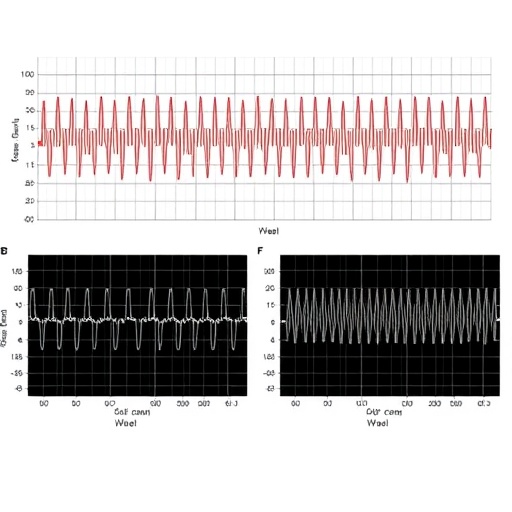
Wireless networks that stretch from satellites to aircraft and ground stations may soon have a sharper way to identify the signals moving through them. Researchers have developed a deep-learning system that recognizes the modulation patterns embedded in radio transmissions, reporting higher average accuracy than existing models on three widely used benchmark datasets. The proposed Multi-Scale Complex Convolution Fusion Network, or MCCFN, is designed for the difficult conditions of space-air-ground integrated networks, where signals can be weakened, distorted, delayed, or mixed with interference as they travel between very different platforms. The work, published in Mobile Networks and Applications, addresses a problem that is easy to overlook in everyday wireless communication: before a receiver can interpret a message, it must often determine how that message has been encoded onto a radio wave.
Modulation is the process of altering a carrier signal so it can convey information. Digital systems may vary a wave’s amplitude, phase, frequency, or a combination of these properties to represent symbols. Automatic modulation recognition, or AMR, attempts to infer the modulation scheme directly from a received signal, without relying on prior cooperation from the transmitter. That capability is important in non-cooperative communication, spectrum monitoring, interference detection, emergency response, and adaptive network management. In a SAGIN architecture, the challenge becomes especially severe because the same communication environment may include low-Earth-orbit satellites, unmanned or crewed aircraft, and terrestrial base stations. Each link can impose different propagation effects, while moving transmitters and receivers introduce rapidly changing channel conditions.
Radio receivers commonly represent a sampled signal using two components known as in-phase and quadrature, or I/Q, channels. Together, these components encode the instantaneous state of the carrier in a two-dimensional coordinate system: one axis describes the in-phase component and the other describes the quadrature component, which is shifted by 90 degrees. From this pair, engineers can derive amplitude and phase. A key argument behind MCCFN is that the I and Q channels should not be treated as unrelated real-valued data streams. Their relationship carries information about the signal’s geometry, and independently processing the two components can disrupt the joint phase-amplitude structure that distinguishes one modulation type from another. The researchers therefore use complex-valued convolutions, mathematical operations that preserve the interaction between the real and imaginary parts of a signal while extracting patterns from it.
Convolutional neural networks are especially effective at finding local structures in data. In an image, a convolutional filter might detect an edge; in a radio signal, it can learn recurring transitions, oscillations, symbol shapes, or temporal patterns. But a single filter scale may miss important information. Fine-scale features can reveal abrupt changes between symbols, whereas broader patterns may reflect longer signal structures, channel distortions, or relationships across multiple samples. MCCFN addresses this limitation with multi-scale complex convolution, applying feature extraction at different effective resolutions. The resulting representations are intended to be richer than those produced by a conventional network that examines the signal through only one scale or separates its I/Q channels at the outset.
The network then uses self-attention to combine the multi-scale features. Attention mechanisms assign different weights to elements of a representation according to their relevance to the task. In this setting, self-attention can help the model emphasize informative portions of a received waveform and reduce the influence of features that are less useful under a particular channel condition. This is valuable for air-to-ground and other mobile links, where the signal characteristics may change substantially from one example to the next. Rather than fusing all extracted features in a fixed way, the model dynamically determines which information should contribute most strongly to its modulation decision. The architecture consequently combines two strategies: complex-valued processing to preserve signal relationships and attention-based fusion to adapt the importance of features.
The researchers also introduce training controls intended to make the system more robust. One is dynamic dropout, a regularization method that temporarily removes selected neural-network activations during training. Dropout can reduce overfitting by preventing the network from depending too heavily on a narrow set of internal features. In MCCFN, the dropout behavior is adjusted dynamically rather than being treated as a fixed setting throughout training. The model also uses learning-rate adaptation rules, which alter the step size used to update its parameters. A learning rate that is too large can make optimization unstable, while one that is too small can slow learning or trap the model in an ineffective region of its parameter space. Together, these mechanisms are intended to prevent premature overfitting and improve recognition under varying signal conditions.
In comparative experiments, MCCFN achieved average recognition accuracies of 63.415 percent on RML2016.10A, 65.29 percent on RML2016.10b, and 69.66 percent on RML22. The authors report that these results outperformed the state-of-the-art models included in their comparisons. The three datasets differ in how they represent the wireless modulation problem, with RML22 specifically intended to support more realistic dataset generation for modulation classification. Testing across multiple benchmarks is important because a model can appear highly capable when evaluated only on data that resemble its training conditions. The reported results suggest that the combination of complex-valued feature extraction, multi-scale processing, attention-based fusion, and adaptive training contributed to the gains. However, the percentages are average benchmark accuracies, not a guarantee that the system will identify every signal reliably in a live network.
Ablation studies provided further evidence about the model’s design choices. In an ablation experiment, researchers remove or alter individual components and observe how performance changes. Such tests help determine whether a system’s improvement comes from a particular architectural idea or simply from adding more parameters. According to the study, the ablations validated the effectiveness of the proposed components in the SAGIN communication context, supporting the role of complex convolution, multi-scale feature extraction, self-attention, and the dynamic training rules. The authors include An Li, Yue Li, Qiang Zhang, and Ping Chen among the researchers responsible for the work, with contributions spanning model construction, theoretical derivation, code development, experiments, data analysis, and manuscript revision. The team reports no competing interests.
The new network does not replace the physical engineering of a communication system, and the study does not establish that MCCFN is ready for deployment on satellites, aircraft, or commercial base stations. Real-world recognition would have to contend with hardware imperfections, changing interference, unfamiliar modulation formats, limited onboard computing power, and signal conditions that may not be fully represented by public benchmarks. The article also states that no datasets were generated or analyzed during the current study, indicating that the work relies on existing resources rather than introducing a new corpus. Even with those boundaries, the approach highlights a growing direction in wireless intelligence: treating radio signals as inherently complex-valued objects instead of forcing them into simplified real-valued representations. As networks become more heterogeneous and increasingly autonomous, models that can interpret the hidden structure of signals may help communication systems decide what they are hearing before deciding how to respond.
Cite this news
SCIENMAG. (August 28, 2026). New Multiscale AI Network Improves Automatic Recognition of Complex Wireless Modulation Signals. https://scienmag.com/new-multiscale-ai-network-improves-automatic-recognition-of-complex-wireless-modulation-signals/
SCIENMAG. "New Multiscale AI Network Improves Automatic Recognition of Complex Wireless Modulation Signals." Scienmag, 28 August 2026, https://scienmag.com/new-multiscale-ai-network-improves-automatic-recognition-of-complex-wireless-modulation-signals/. Accessed 28 August 2026.
SCIENMAG. "New Multiscale AI Network Improves Automatic Recognition of Complex Wireless Modulation Signals." Scienmag. August 28, 2026. https://scienmag.com/new-multiscale-ai-network-improves-automatic-recognition-of-complex-wireless-modulation-signals/


