

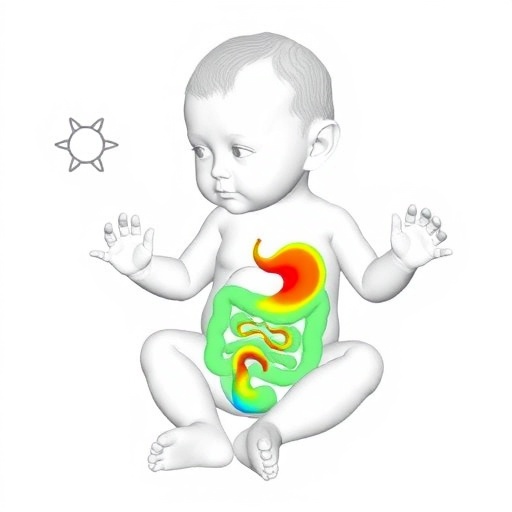
Phenylketonuria, or PKU, has long been understood as a disorder of a single missing enzymatic step. But a new study suggests that the condition’s biology may also depend on an ecosystem living inside the intestine. Using computer models that combine infant physiology with the metabolism of gut bacteria, researchers have found that microbes may alter the availability of L-tyrosine, an amino acid closely connected to the disease. The finding could help explain why children with PKU can show different biochemical and clinical profiles even when their primary genetic defect is the same. It also raises the possibility that future diagnostics and treatments may need to account for a patient’s individual microbiome.
PKU is caused by a deficiency in phenylalanine hydroxylase, or PAH, an enzyme that normally converts the amino acid L-phenylalanine into L-tyrosine. When PAH activity is impaired, phenylalanine accumulates in the blood and tissues. If the condition is not treated, excessive phenylalanine can interfere with brain development and cause severe neurological damage. Newborn screening programs therefore measure blood phenylalanine, allowing dietary treatment to begin early. People with PKU commonly restrict dietary protein and receive specially formulated nutritional products, while some may also receive pharmacological therapies. Yet the concentration of phenylalanine does not fully capture the variation in symptoms, treatment response or biochemical behavior observed among patients.
The new work, led by researchers at the University of Galway and collaborators in Germany, investigated whether the infant gut microbiome could be one source of that variation. The team used infant whole-body metabolic models, computational reconstructions that represent biochemical reactions across organs and tissues. These models were built to distinguish between female and male infant physiology and to track metabolic fluxes—the estimated rates at which molecules move through interconnected reaction pathways. The researchers first simulated a germ-free state, in which no microbial reactions were present, and then added gut microbiome models derived from metagenomic data obtained from 48 healthy female infants and 42 healthy male infants. In each virtual system, they compared normal metabolism with a simulated PAH deficiency resembling PKU.
This approach allowed the researchers to examine hundreds of possible biomarkers before focusing on nine molecules associated with phenylalanine and tyrosine metabolism. In the germ-free models, the predicted biochemical signature of PKU was clear. Phenylalanine and several of its derivatives rose, while flux toward L-tyrosine fell because the defective PAH reaction could no longer efficiently perform the conversion. That result reflects the conventional biochemical picture: a blocked pathway causes the substrate to build up and the product to become less available. L-tyrosine is not merely a passive by-product. It is used to make proteins and serves as a precursor for compounds including L-DOPA, dopamine, noradrenaline and adrenaline, as well as the pigment melanin. A persistent reduction in tyrosine production could therefore have consequences beyond the immediate phenylalanine imbalance.
The picture changed when microbial metabolism was incorporated into the virtual infants. Bacteria in the gut can consume, transform or produce amino acids, and some strains possess pathways capable of generating tyrosine independently of the host’s PAH reaction. The models predicted that microbial activity substantially increased the apparent availability of L-tyrosine in many PKU simulations. In computational terms, bacterial reactions supplied additional flux into the host tyrosine pool, partially compensating for the missing human enzyme. But that compensation also weakened L-tyrosine’s value as a universal biomarker. A blood or metabolic signal that appears low in one patient might remain near normal in another, not because the underlying PAH deficiency is absent, but because different bacteria are contributing to the same biochemical output.
The researchers estimated that in approximately 23 percent of the microbiome-containing PKU models, tyrosine flux remained low despite the presence of gut microbes. These virtual cases were associated with microbiome configurations enriched in Firmicutes and lacking particular strains of Bifidobacterium and Escherichia that the study linked to tyrosine production through the pretyrosine pathway. The pretyrosine route is an alternative biochemical mechanism used by some microorganisms to synthesize aromatic amino acids. It differs from the human PAH-dependent reaction and may allow bacteria to influence host amino-acid availability even when the host pathway is defective. The result suggests that two infants with comparable PAH impairment could receive different metabolic support from their intestinal bacteria, depending on which organisms are present and how abundant they are.
To identify the organisms most strongly connected to these effects, the team applied shadow price analysis, a method from constraint-based metabolic modelling. In such models, a shadow price estimates how much the system’s objective would change if the availability of a metabolite were altered. When applied to microbial reactions, it can highlight species whose metabolic capacity is especially important for satisfying a simulated host demand. The analysis identified organisms that could be critical for L-tyrosine production, but it also exposed a potential hazard in treating individual strains as universally beneficial. Bifidobacterium dentium, for example, was associated with tyrosine production but also contributed to L-phenylalanine synthesis in some model communities. For a person with PKU, increasing a bacterium that supplies tyrosine could theoretically be counterproductive if it simultaneously raises phenylalanine production. The finding emphasizes that microbiome interventions may need to target pathways and community context rather than simply adding a familiar “beneficial” species.
Not every biomarker was destabilized by microbial activity. Across the models, L-phenylalanine, phenylpyruvate and hydroxyphenylacetic acid remained reliably elevated under the simulated PKU condition. Their consistent behavior supports their continued diagnostic relevance and suggests that microbial metabolism does not erase every signature of PAH deficiency. Phenylpyruvate is produced when excess phenylalanine is diverted into an alternative reaction, while hydroxyphenylacetic acid is another downstream derivative of aromatic amino-acid metabolism. Because these compounds remained elevated across the tested microbiome configurations, they may be more robust indicators of the disorder than L-tyrosine alone. The modelling also examined other metabolites, including methoxytyrosine, L-DOPA, dopamine, tyramine and hydroxyphenylpyruvate, providing a broader map of how microbial and host reactions might interact.
The study does not show that gut bacteria cause differences in PKU symptoms, nor does it demonstrate that probiotics can safely correct tyrosine metabolism in children. Its conclusions arise from simulations rather than a clinical intervention, and the microbiome data came from healthy Swedish infants whose stool metagenomes were used to construct virtual communities. The models also represent biochemical capabilities and constraints; they do not reproduce every feature of a living infant, such as diet, medication exposure, intestinal transit, immune interactions or the complex regulation of gene expression. Nevertheless, the work illustrates why computational physiology may be valuable in rare metabolic diseases. By linking microbial genomes to organ-resolved human metabolism, researchers can test many possible biochemical scenarios before designing laboratory or clinical studies.
The broader implication is that PKU monitoring may eventually move beyond a single measurement of circulating phenylalanine. A patient-specific panel could combine established markers with secondary metabolites whose reliability has been assessed against the individual’s microbiome. The same modelling framework might also help identify patients for whom tyrosine deserves closer attention or indicate when a microbiome-directed treatment should be considered. Such treatments could involve carefully selected probiotics, dietary adjustments or other strategies designed to shift metabolic activity without increasing phenylalanine production. Any intervention would require rigorous testing, particularly in infants, where nutritional demands and neurological development are changing rapidly. For now, the study’s most striking message is that the metabolic consequences of PKU may be shaped not only by the enzyme a child lacks, but also by the microscopic partners that help determine which biochemical pathways remain available.
Cite this news
SCIENMAG. (August 28, 2026). Modeling Reveals How Infant Gut Microbes May Affect Tyrosine Availability in Phenylketonuria. https://scienmag.com/modeling-reveals-how-infant-gut-microbes-may-affect-tyrosine-availability-in-phenylketonuria/
SCIENMAG. "Modeling Reveals How Infant Gut Microbes May Affect Tyrosine Availability in Phenylketonuria." Scienmag, 28 August 2026, https://scienmag.com/modeling-reveals-how-infant-gut-microbes-may-affect-tyrosine-availability-in-phenylketonuria/. Accessed 28 August 2026.
SCIENMAG. "Modeling Reveals How Infant Gut Microbes May Affect Tyrosine Availability in Phenylketonuria." Scienmag. August 28, 2026. https://scienmag.com/modeling-reveals-how-infant-gut-microbes-may-affect-tyrosine-availability-in-phenylketonuria/


