


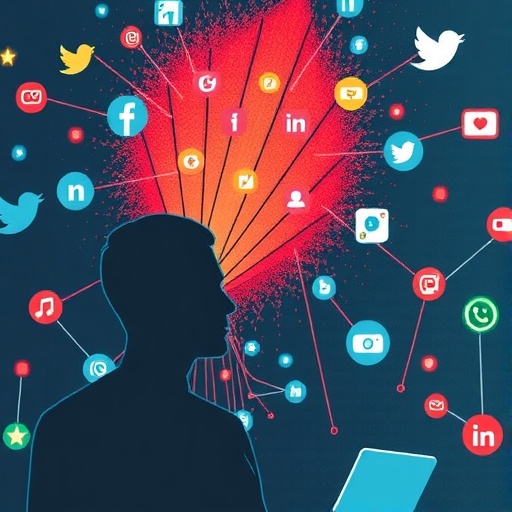
Social media algorithms may be doing more than deciding which videos appear next on a teenager’s or young adult’s screen. A proof-of-concept study from psychologists at The University of Texas at Dallas suggests that personalized short-video feeds may reflect and reinforce negative emotional states, creating a feedback loop that links algorithmic recommendations, real-time brain activity and symptoms of depression. The findings, published in Computers in Human Behavior, offer a more immediate view of the relationship between social media and mental health than studies based solely on questionnaires. Instead of asking participants to remember how they felt after using an app, researchers recorded their brain activity as they watched videos drawn from their own Instagram or TikTok accounts. The results indicate that the emotional character of recommended content may matter at least as much as the amount of time people spend online.
The study involved 60 young adults with an average age of 20. Before viewing the videos, participants completed validated assessments of anxiety and depression symptoms. They then watched two types of short-form content. The first consisted of videos personally recommended by the participants’ own social media accounts, reflecting the recommendations generated by the platforms’ algorithms. The second consisted of generally trending videos that were not selected specifically for each participant. Researchers categorized the videos according to their emotional and social content, while electroencephalography, or EEG, measured electrical activity across the brain. This design allowed the team to compare how the same viewers responded to content shaped by their individual digital histories with how they responded to material popular across a broader audience.
The researchers focused on frontal alpha asymmetry, an EEG measure associated with motivational direction and emotional processing. Alpha waves are relatively slow electrical oscillations that can be detected from the scalp, and differences in alpha activity between the left and right frontal regions have often been used as an indicator of approach- versus withdrawal-related responses. Greater relative activity on the left side is generally associated with more positive emotional processing and approach motivation, while stronger right-sided activity is commonly linked with negative processing, withdrawal and reduced engagement. The measure is not a diagnostic test for depression, but it can provide a real-time physiological signal of how the brain is responding while a person is encountering emotionally meaningful information. In this study, that signal was captured within milliseconds as participants watched their personalized feeds.
The use of EEG gave the study a different perspective from conventional social media research. Surveys can reveal how often people use an app or how they believe it affects their mood, but they typically rely on memory and self-interpretation after the experience has ended. The Texas researchers instead examined neural responses during exposure to algorithmically selected videos and compared those responses with participants’ reported depressive symptoms. Dr. Alva Tang, the study’s corresponding author, said the approach made it possible to observe what participants were viewing and how they were reacting while their feeds were actively serving the content. Dr. Stacie Warren, a co-author, described EEG as a measure of brain processing that operates within milliseconds, providing an objective complement to participants’ reports about their mental health.
The results pointed to a relationship between depressive symptoms and the emotional direction of personalized recommendations. Participants reporting more depressive symptoms tended to receive feeds containing more depressive or negatively toned material. Their frontal alpha asymmetry while watching these personalized videos also showed a pattern characteristic of more negative emotional processing, a response that was not observed in the same way when they watched generally trending videos. The findings do not establish that an algorithm directly causes depression, nor do they show that a single video can determine a person’s mood. Instead, they suggest that recommendation systems may learn from a user’s behavior and emotional signals in ways that repeatedly expose the person to content consistent with an existing negative state.
The most common type of recommended video in the study involved social relationships, including romance, friendship and interpersonal conflict. Within that broad category, videos could depict arguments, tension or rejection, but they could also show friends supporting one another or engaging in positive social interactions. Neutral videos contained little obvious emotional or social meaning. Researchers found that viewing fewer positive social-relationship videos was associated with relative right frontal alpha asymmetry, indicating a more negative or withdrawal-related response. The pattern is consistent with the possibility that people experiencing depression may pay greater attention to negative material, overlook positive content or interact with posts in ways that teach recommendation systems to supply more of the same. The resulting feed may then become increasingly narrow in emotional tone.
This possible feedback loop is central to the researchers’ interpretation. Modern recommendation systems are designed to predict what will hold a user’s attention. They draw on signals such as viewing duration, replays, likes, comments, follows and skips, then use those signals to rank future content. If a user lingers on emotionally intense or negative videos, the system may interpret that behavior as evidence of interest rather than distress. Continued exposure can produce more engagement, which in turn provides additional data for the algorithm. In a person already experiencing depressive symptoms, that cycle could repeatedly connect negative attention patterns with negative recommendations. The study’s authors emphasize that their findings concern this interaction between user behavior, algorithmic selection and emotional processing rather than an isolated effect of screen exposure.
The researchers also accounted for total screen time, a factor frequently examined in studies of digital media and mental health. Their argument is that time alone may be an incomplete measure because social media use is not uniformly harmful or beneficial. Ten minutes spent watching supportive, humorous or informative material may have a different psychological effect from ten minutes spent consuming conflict-driven content that intensifies rumination. By separating exposure to personalized recommendations from exposure to general trends, the study attempted to examine the content and selection process more closely. Because the participants used their own phones and accounts, the experiment preserved some of the conditions of ordinary social media use, although the relatively small sample and proof-of-concept design mean that the findings require replication in larger and more diverse groups.
The results point toward a different approach to digital well-being than simply imposing strict limits on phone use. The researchers argue that young people may benefit from learning how recommendation systems respond to their actions and how deliberately shaping those actions can alter a feed. Following creators who produce constructive or positive material, interacting with content that supports a desired mood and removing sources of repeated negativity may gradually change what an app recommends. Users can also reset some accounts to default recommendations and begin training the system around new interests. These strategies are not substitutes for professional treatment of depression, and they cannot eliminate the complex causes of mental illness, but they may give users more control over an environment that otherwise adapts continuously to their attention.
Parents and educators may also need to move beyond advice focused only on reducing screen time. For many teenagers, social media is woven into friendships, identity and everyday communication, making total avoidance difficult and sometimes socially isolating. Understanding how algorithms amplify patterns of attention could be more practical than treating every minute online as equivalent. The UT Dallas team is now collecting data from adolescents between 13 and 16 years old for a potential long-term study. Tracking participants over time could help determine whether algorithmically selected emotional content predicts later changes in mood, whether mood changes the content people receive, or whether both processes reinforce each other. Until such evidence is available, the current study provides an important warning: the most influential part of a social media feed may not be how long a person stays online, but the emotional world the algorithm keeps placing in front of them.
Cite Scienmag News
Glenn Wilkins. (August 28, 2026). Psychologists Investigate the Hidden Costs of Social Media Algorithms. Scienmag. https://scienmag.com/psychologists-investigate-the-hidden-costs-of-social-media-algorithms/
Glenn Wilkins. "Psychologists Investigate the Hidden Costs of Social Media Algorithms." Scienmag, 28 August 2026, https://scienmag.com/psychologists-investigate-the-hidden-costs-of-social-media-algorithms/. Accessed 28 October 2026.
Glenn Wilkins. "Psychologists Investigate the Hidden Costs of Social Media Algorithms." Scienmag. August 28, 2026. https://scienmag.com/psychologists-investigate-the-hidden-costs-of-social-media-algorithms/


