

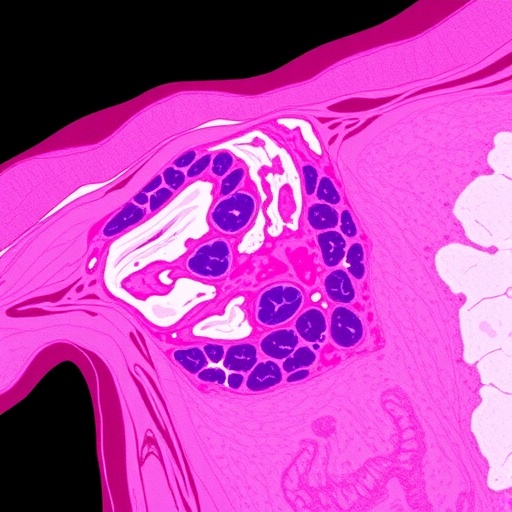
A simple change in how surgeons identify lymph nodes could offer a new route to reducing the extent of axillary surgery for some people with breast cancer, according to a prospective cohort study from researchers at The First Affiliated Hospital of Nanjing Medical University in China. The technique, called stained region lymph node biopsy, or SrLNB, accurately identified previously cancer-positive lymph nodes after patients had received neoadjuvant systemic therapy, the treatment given before surgery. In 159 patients, the method detected the marked nodes in every case and produced an overall false-negative rate of 5.3 percent, remaining below the 10 percent threshold commonly used to judge whether axillary restaging is sufficiently reliable. The findings suggest that directly retrieving the lymph nodes known to contain cancer before treatment might provide an alternative to sentinel lymph node biopsy in this clinically difficult setting.
The question is important because the lymph nodes in the armpit, known collectively as the axillary nodes, help determine how breast cancer has spread and influence decisions about chemotherapy, radiotherapy and surgery. Patients whose cancer is confirmed in these nodes have traditionally undergone axillary lymph node dissection, an operation that removes many nodes. Although effective for controlling disease, the procedure can damage lymphatic vessels and nerves, contributing to arm swelling, pain, numbness and restricted shoulder movement. Modern systemic treatments can eliminate detectable cancer from lymph nodes before breast surgery, creating an opportunity to avoid extensive dissection. But doctors must first establish, with high confidence, whether cancer remains. Missing residual disease could lead to undertreatment; removing every node unnecessarily can cause long-term harm.
Neoadjuvant systemic therapy, or NST, includes chemotherapy and, depending on the biology of the tumor, targeted or immune-based treatments administered before the primary breast operation. A complete disappearance of cancer from the axillary nodes at surgery is known as an axillary pathological complete response, or pCR. It is assessed by examining removed tissue under a microscope. In the new study, 65 of 159 patients—40.9 percent—had an axillary pCR after NST. That proportion illustrates why restaging matters: a substantial number of patients who initially had node-positive disease may no longer have detectable cancer in those nodes after treatment. Yet treatment can also alter lymphatic drainage patterns and shrink or destroy metastatic deposits, making it harder to rely on pre-treatment imaging or conventional sampling alone.
The researchers focused on a limitation of the sentinel lymph node biopsy approach. Sentinel nodes are the first lymph nodes expected to receive drainage from a tumor, and surgeons locate them using tracers such as radioactive substances or blue dye. In patients who were clinically node-negative before treatment, sentinel node biopsy can often provide a minimally invasive assessment. In patients who were known to have cancer in the axilla before NST, however, the originally involved node is not necessarily the same node identified as a sentinel node after treatment. A sentinel node may be technically found yet fail to represent the node that carried the metastasis. This mismatch can produce a false-negative result, in which the sampled node appears clear while cancer persists elsewhere in the axilla.
SrLNB addresses that problem by marking the suspicious node before therapy begins. Under ultrasound guidance, the investigators injected a suspension of carbon nanoparticles into the most suspicious axillary lymph node or nodes in each participant. The particles stain the targeted tissue black and can remain visible through the interval of systemic treatment. After NST was completed, surgeons located and removed the stained nodes directly. They then performed a completion axillary lymph node dissection, allowing the researchers to compare the pathology of the marked nodes with that of all remaining axillary tissue. This design made it possible to calculate both detection—the proportion of patients in whom the stained node was successfully retrieved—and the false-negative rate, the proportion of patients whose marked node tested negative even though another removed node still contained metastasis.
The technical appeal of the approach lies in its directness. Rather than infer which lymph node is most important from lymphatic flow after treatment, the procedure preserves a physical record of the node that was suspicious before treatment began. Carbon nanoparticle suspension is also relatively inexpensive and does not require the nuclear medicine infrastructure associated with radioactive tracers. Ultrasound guidance allows the injection to be performed using equipment already common in breast-imaging services. In the cohort, the detection rate was 100 percent: all 159 patients had their marked nodes successfully identified and removed. The result indicates that the stain remained sufficiently conspicuous during NST and that the method was practical in the hands of the treating team.
The study’s primary performance measure was the false-negative rate. Of the 159 participants, 94 had residual axillary disease identified in the complete dissection specimen, and SrLNB missed disease in five of those cases, yielding an overall FNR of 5.3 percent. The researchers reported that the rate stayed within the prespecified 10 percent safety threshold across the patient subgroups they examined. A false-negative rate is not the same as a failure rate for the entire group: it is calculated among patients who actually have residual disease, rather than among all participants. In clinical terms, the result means that the marked node generally reflected the disease status of the wider axilla, although it did not do so perfectly. The five missed cases also underscore why validation and careful patient selection remain essential before the technique can replace established surgery.
The findings are promising but do not yet establish that patients can routinely avoid axillary dissection on the basis of SrLNB alone. This was a single-arm prospective cohort study, meaning every participant underwent the experimental biopsy as well as completion dissection; there was no randomized comparison with sentinel node biopsy or another restaging strategy. The work was conducted at a single institution and included patients treated between September 2020 and December 2022, so outcomes may depend on local expertise, imaging quality, injection technique and the types of systemic therapy used. The study also primarily demonstrates diagnostic feasibility rather than long-term safety. Whether omitting further axillary surgery after a negative SrLNB produces equivalent rates of regional recurrence, disease-free survival and overall survival will require larger, preferably multicenter studies with prolonged follow-up.
Even with those caveats, the concept fits a broader shift in breast cancer care: replacing blanket operations with treatment tailored to each patient’s response. The goal is not simply to remove less tissue, but to preserve oncological safety while reducing complications. A reliable method for tracking a known metastatic node could be particularly valuable as modern therapies produce higher response rates in biologically defined breast cancers. If future trials confirm the study’s accuracy, SrLNB could become part of an individualized algorithm in which pre-treatment needle confirmation, ultrasound marking, systemic therapy and post-treatment pathology work together. For now, the study offers an intriguing piece of evidence that a node identified before therapy may be more informative than one selected only after therapy—and that a small, visible marker could help surgeons navigate the consequences of a major treatment response.


