

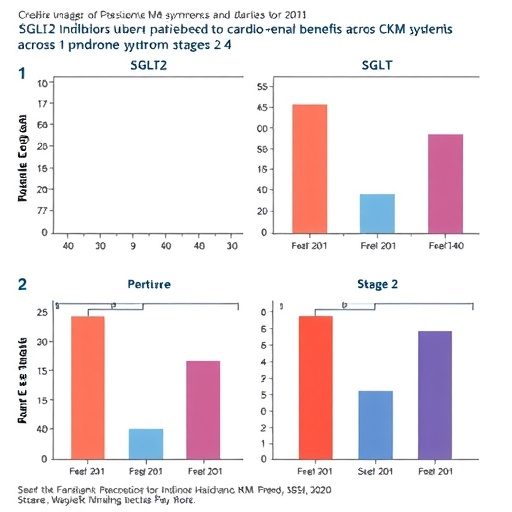
A large analysis of clinical-trial evidence suggests that sodium-glucose cotransporter 2 (SGLT2) inhibitors protect the heart and kidneys across multiple stages of cardiovascular-kidney-metabolic disease, including in people with advanced illness. The findings, published in BMC Endocrine Disorders, bring together data from 73,220 participants and indicate that the drugs consistently reduce composite heart-failure events, hospital admissions for heart failure and kidney outcomes in patients classified as having cardiovascular-kidney-metabolic, or CKM, syndrome. The analysis did not find a statistically significant difference in treatment effects between people in CKM stages 2–3 and those in stage 4. However, the researchers caution that the evidence for stages 2–3 came from relatively few estimates and was therefore less precise than the evidence for stage 4. The results support the idea that SGLT2 inhibitors may offer benefits across a broad disease continuum, but they do not prove that the drugs work equally well at every stage.
CKM syndrome is a framework developed to describe the biological links among obesity, diabetes, high blood pressure, cardiovascular disease and chronic kidney disease. Rather than treating these conditions as isolated problems, the framework views them as interconnected consequences of metabolic stress, vascular damage, inflammation and declining organ function. In the operational classification used by the researchers, stages 2–3 encompass people with metabolic risk factors, kidney abnormalities or subclinical cardiovascular disease, while stage 4 represents established cardiovascular disease, kidney disease or both in the presence of metabolic risk. This distinction matters because patients with advanced CKM syndrome often have a high risk of hospitalization, progressive loss of kidney function and death, while also being more difficult to include in conventional trials. By mapping existing trial populations onto CKM stages, the investigators sought to test whether the benefits of SGLT2 inhibition extended across this clinically connected spectrum.
SGLT2 inhibitors were first developed as glucose-lowering medicines for type 2 diabetes, but their effects extend beyond blood sugar control. The drugs block the SGLT2 protein in the proximal tubule of the kidney, where much of the glucose and sodium filtered from the blood is normally reclaimed. Inhibition increases urinary glucose excretion and causes a modest increase in sodium loss. That change alters signaling between the kidney’s filtration apparatus and the renin–angiotensin system, helping to reduce pressure inside the glomeruli, the microscopic structures that filter blood. The medicines also produce a mild diuretic and natriuretic effect, reducing fluid congestion that can strain the heart. Researchers believe these mechanisms, together with changes in renal oxygen demand, vascular function and cardiac metabolism, help explain why the drugs can benefit patients with or without diabetes.
Sun, Guo and their colleagues searched PubMed/MEDLINE, Web of Science, Embase and the Cochrane Central Register of Controlled Trials for randomized controlled trials available through 25 February 2026. They included trials comparing an SGLT2 inhibitor with placebo or usual care and grouped trial populations, or mutually exclusive subgroups reported within trials, according to the CKM stage framework. Nineteen reports derived from 11 parent randomized trials met the criteria. A total of 18,547 participants were assigned to the CKM stages 2–3 group, while 54,673 were classified as stage 4. The researchers pooled six time-to-event outcomes using restricted maximum likelihood random-effects models. This statistical approach allows for the possibility that the true treatment effect differs somewhat among studies rather than assuming that all trials are estimating one identical effect.
The clearest signals involved heart failure and kidney disease. For the composite heart-failure outcome, the hazard ratio was 0.80 in CKM stages 2–3, with a 95 percent confidence interval of 0.68 to 0.93, and 0.77 in stage 4, with a confidence interval of 0.73 to 0.81. A hazard ratio below 1 indicates fewer events in the SGLT2 inhibitor group; these estimates correspond roughly to relative reductions of 20 percent and 23 percent, respectively. For hospitalization for heart failure, the hazard ratio was 0.61 in stages 2–3 and 0.71 in stage 4, equivalent to approximate relative reductions of 39 percent and 29 percent. Kidney outcomes also favored treatment, with hazard ratios of 0.61 and 0.64 in the two groups. These findings are consistent with the drugs’ established ability to slow clinically important kidney deterioration and reduce heart-failure events in several different patient populations.
The statistical comparisons did not show that the apparent differences between groups were significant. The P value for the comparison of composite heart-failure outcomes between CKM stages 2–3 and stage 4 was 0.65. For heart-failure hospitalization it was 0.24, and for kidney outcomes it was 0.64. In practical terms, the available data did not demonstrate that one CKM group gained more or less benefit than the other. But a non-significant difference is not the same as proof of identical effects. The stages 2–3 analysis was based on only four estimates, creating wider confidence intervals and greater uncertainty. Stage 4 estimates were generally more precise because the group included more participants and more events. The researchers therefore describe the results as evidence of benefit in both groups, not as definitive evidence that the magnitude of benefit is equivalent.
The analysis also examined major adverse cardiovascular events, commonly known as MACE, and all-cause mortality. Estimates for MACE and mortality in CKM stage 4 were more precise, reflecting the larger evidence base in that category, but the source material does not report a single statistically significant stage-based difference for these outcomes. The researchers registered five main outcomes rather than designating one primary endpoint, while all-cause mortality was registered as a secondary outcome. That distinction is important because a study evaluating several outcomes can produce a complex pattern of results, and individual findings may vary in certainty. An exploratory Egger test for all-cause mortality produced a P value of 0.025, raising the possibility of small-study effects or publication bias. Such tests are difficult to interpret when the number of contributing estimates is limited, so the result is a warning signal rather than evidence that the overall mortality conclusion is invalid.
To test whether the findings depended on particular analytical decisions, the investigators performed prespecified sensitivity analyses. They examined alternative statistical models, removed the SOLOIST-WHF trial because a selected efficacy result was judged to have a high risk of bias, tested different definitions of kidney endpoints and assessed whether any single study disproportionately influenced the results. They also investigated possible small-study effects. The principal heart-failure and kidney findings remained stable across these checks, strengthening confidence that the observed pattern was not created by one trial or one endpoint definition. Nevertheless, meta-analysis inherits limitations from the studies it combines. Trial participants may differ in baseline kidney function, diabetes status, heart-failure phenotype, medication use and follow-up duration, while operationally assigning populations to CKM stages cannot fully reproduce the complexity of individual patients.
The findings arrive as SGLT2 inhibitors are increasingly used across cardiology, nephrology and endocrinology, including in patients with heart failure with reduced, mildly reduced or preserved ejection fraction and in people with chronic kidney disease. Their apparent benefits across these specialties have helped shift the drugs from narrowly targeted diabetes treatments to therapies with broader cardiorenal applications. The new review reinforces that cross-disciplinary picture: patients at different points along the CKM pathway experienced fewer heart-failure and kidney events when receiving an SGLT2 inhibitor than when receiving placebo or usual care. Still, treatment decisions must account for kidney function, volume status, genital and urinary infections, ketoacidosis risk and other individual factors. The authors’ central conclusion is appropriately cautious: SGLT2 inhibitors favored heart-failure and kidney outcomes in both CKM stage groups, but more evidence—especially in earlier-stage CKM disease—is needed to determine how treatment effects compare across the full continuum.


