


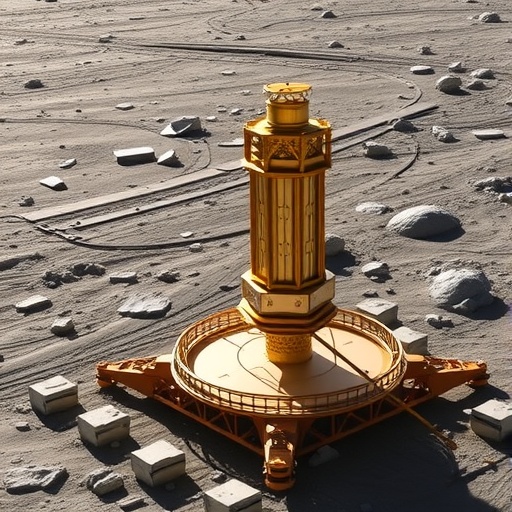
A new lunar drilling system used in China’s Chang’e-5 and Chang’e-6 missions has demonstrated how carefully engineered robotics can transform the way material is collected from the Moon. The technology, described in a new study published in Space Science Reviews, was designed to recover subsurface lunar regolith while preserving information about the layers through which the drill passed. Its most distinctive feature is a “double-tube single-bag non-slip” coring method, developed to prevent loose lunar soil from escaping, mixing, or losing its original structure during extraction. The system collected 260 grams of lunar material during Chang’e-5 and 320 grams during Chang’e-6, offering scientists samples from two geologically important locations. These results turn a demanding mechanical operation into a major scientific achievement: the drill did not merely gather dust, but helped return a more coherent record of the Moon’s shallow subsurface.
Lunar regolith is deceptively difficult to sample. It is composed of fragmented rock, mineral grains, impact debris, and layers formed by billions of years of bombardment. Its mechanical properties can change sharply with depth, and the material may behave as a loose granular soil in one region and as a compacted or rock-like layer in another. Under lunar conditions, there is no atmosphere to assist with cooling or dust removal, gravity is only about one-sixth that of Earth, and every operation must be completed by a machine operating millions of kilometers from direct human intervention. Conventional scooping can collect surface material efficiently, but it tends to disturb the natural arrangement of grains and provides little information about stratigraphy. Drilling and coring offer a better scientific return because they can access buried layers, yet they introduce their own problems: friction, vibration, impact forces, clogging, and the risk that extracted material will slide out of the tool before it can be sealed.
The Chang’e drilling approach addresses these risks by combining spiral drilling with a flexible containment system. The drill’s rotating structure penetrates the regolith and transports material upward, while an impact mechanism supplies additional force when the ground becomes difficult to cut. Rotation and impact are driven independently, allowing the machine to adjust the balance between cutting and hammering according to the resistance encountered underground. Inside the drilling assembly, a double-tube configuration helps guide and support the core. A flexible bag wraps around the recovered material as it enters the coring tube, shaping the sample and reducing slippage. Rather than relying solely on rigid walls to hold the core in place, the bag conforms to irregular fragments and granular soil. This is especially important for lunar regolith, which can break apart easily once the drill stops moving. By preserving the sample inside a flexible sleeve, the system improves recovery while reducing the chance that layers become scrambled.
The “non-slip” principle is central to the design. A lunar core is not necessarily a solid cylinder like a geological core extracted from Earth. It may consist of weakly bonded grains, fractured clasts, and discontinuous pieces that can shift under vibration or reverse motion. A rigid tube alone may allow the sample to slide downward, fracture, or spill when the drill is lifted. The flexible bag instead grips and encloses the material, helping maintain its shape during drilling, withdrawal, and handling. The researchers also developed a multistage elastic sealing device to close the recovered sample and limit material loss. Sealing is technically challenging because the device must operate within strict mass, volume, and power constraints while tolerating vibration and impact. It must also function without lubricants or maintenance in the harsh lunar environment. The resulting system is therefore not simply a drill bit, but an integrated chain of penetration, transport, containment, sealing, and sample preservation.
Another innovation is the system’s online identification and drilling-control method. A drill working below the lunar surface cannot rely on visual feedback to determine what it is encountering. Instead, the control system monitors multiple status variables, including drilling thrust and the mechanical response of the drive system, to estimate how difficult the ground is to penetrate. These measurements help distinguish changing drilling conditions and provide the basis for adaptive control. If the material becomes harder, the system can respond by modifying thrust, rotational behavior, or impact operation. If the load drops, the controller can avoid applying unnecessary force that might destabilize the core or waste energy. This type of real-time assessment is essential for autonomous or remotely supervised planetary machinery. A command sent from Earth cannot provide instant corrections because communication delays make continuous manual control impractical. The machine must recognize changes, remain within safe operating limits, and execute a sequence of actions with a high degree of independence.
The researchers tested the control architecture under simulated lunar soil and rock, focusing on how accurately the system could regulate drilling thrust. Their experiments showed that the controller could adaptively track different thrust requirements, indicating that it was capable of responding to changes in material resistance rather than following a fixed mechanical routine. The team also subjected the drilling and sampling system to impact loads, which can produce sudden changes in force and potentially damage the drill, disturb the lander, or disrupt the sample. In those tests, the control system responded effectively to the shocks generated during operation. Such performance matters because impact drilling is useful for breaking through resistant layers, but it also creates a complex dynamic environment involving repeated acceleration, vibration, and transient loads. A successful lunar drill must manage both slow, controlled penetration and rapid mechanical events without losing stability or compromising the sample.
Core-sampling experiments in simulated lunar soil produced another important finding: constant-thrust control generated better sampling results than approaches that allowed thrust to vary more widely. A constant thrust does not mean that the drill encounters constant resistance. Instead, it maintains a steady penetration force while the drilling mechanism adapts to the changing response of the soil. This can help prevent sudden jumps in penetration depth, reduce excessive vibration, and support a more uniform flow of material into the core tube. Stable thrust may also reduce the tendency of weakly consolidated regolith to collapse or become displaced as the drill advances. The result is a cleaner, more continuous sample and a better chance of retaining information about the sequence of layers. For planetary geology, that distinction is crucial. A sample’s scientific value depends not only on its chemical composition, but also on where each portion came from and how the material was arranged before collection.
The technology was ultimately tested beyond laboratory conditions, becoming part of the in-orbit sampling operations of Chang’e-5 and Chang’e-6. Chang’e-5, which returned samples from the Moon’s near side, delivered 260 grams of lunar soil collected through its surface sampling activities. Chang’e-6 later performed the first sample-return mission from the lunar far side, retrieving material from the South Pole–Aitken Basin and returning 320 grams. The two missions targeted locations with different geological histories, making reliable sampling hardware particularly valuable. Material from the far side may preserve evidence of ancient impacts and crustal evolution that is less accessible on the near side. The successful deployment of the drilling and coring system demonstrates that a compact robotic mechanism can operate through uncertain regolith, manage changing loads, and preserve samples during extraction in an environment where repair is impossible. It also provides a practical foundation for future lunar missions that may need to reach deeper layers or collect material from scientifically sensitive sites.
The broader significance extends beyond the two Chinese missions. As lunar exploration moves toward sustained robotic activity, subsurface sampling will become increasingly important for investigating volcanic history, impact processes, volatile deposits, and the mechanical behavior of soil near future landing zones. Drilling systems may eventually be asked to search for buried ice, characterize resources, support in situ construction, or prepare samples for instruments located inside a lander or rover. Each of those tasks will require machines that can identify changing ground conditions, avoid overload, and protect the material they recover. The Chang’e drilling system brings together several capabilities that future explorers will need: independent rotational and impact drives, flexible core containment, elastic sealing, online drillability assessment, adaptive thrust control, and remote operation constrained by both time windows and process logic. Its performance suggests that the future of lunar sampling will depend as much on intelligent mechanical control as on the strength of the drill itself.
The new results reveal a central lesson of planetary exploration: collecting a sample is an engineering problem inseparable from a scientific one. A drill that penetrates deeply but loses its core may deliver less information than a slower system that preserves a shorter, better-ordered sample. The Chang’e-5/6 solution was built around that principle, treating the regolith as a changing, unpredictable material rather than a uniform substance. Its successful operation shows how flexible structures, real-time sensing, and carefully controlled force can work together in one of the most hostile environments accessible to robotic machines. With hundreds of grams of lunar material recovered from two contrasting regions, the system has already moved from experimental concept to flight-proven technology. As scientists examine the returned samples, the mechanical story behind their arrival may prove almost as important as the rocks and soil themselves.
Cite Scienmag News
Grant Pearson. (August 26, 2026). Lunar Drilling and Sampling System Deployed for China’s Chang’e-5 and Chang’e-6 Missions. Scienmag. https://scienmag.com/lunar-drilling-and-sampling-system-deployed-for-chinas-change-5-and-change-6-missions/
Grant Pearson. "Lunar Drilling and Sampling System Deployed for China’s Chang’e-5 and Chang’e-6 Missions." Scienmag, 26 August 2026, https://scienmag.com/lunar-drilling-and-sampling-system-deployed-for-chinas-change-5-and-change-6-missions/. Accessed 3 September 2026.
Grant Pearson. "Lunar Drilling and Sampling System Deployed for China’s Chang’e-5 and Chang’e-6 Missions." Scienmag. August 26, 2026. https://scienmag.com/lunar-drilling-and-sampling-system-deployed-for-chinas-change-5-and-change-6-missions/


