


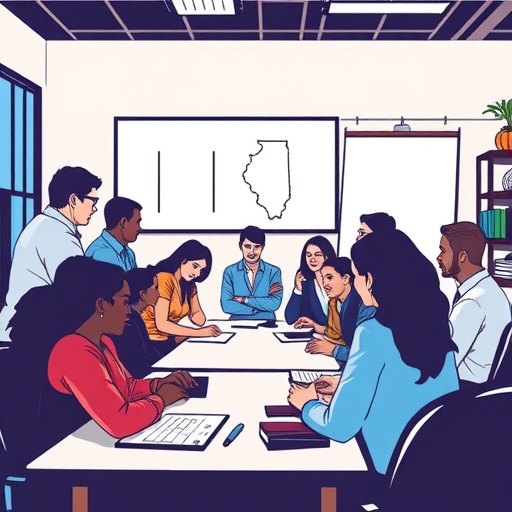
A quiet transformation is underway in behavioral healthcare: people with lived experience of mental health and substance-use challenges are increasingly being trained to become professional peer support workers. These workers do not replace clinicians. Instead, they offer a distinct form of assistance grounded in personal experience, mutuality, practical guidance, and hope. A new qualitative study of Illinois’s CRSS Success Program examines what it takes to prepare this expanding workforce—and why simply offering a certification course is not enough. The researchers found that successful programs must balance accessibility with academic and professional readiness, provide extensive support beyond the classroom, and adapt to a rapidly changing system of recovery services.
The Illinois CRSS Success Program was created to help students pursue one or both of two state-recognized credentials: Certified Recovery Support Specialist, or CRSS, and Certified Peer Recovery Specialist, or CPRS. Although the names are similar, the credentials are connected to different professional pathways and requirements. Both rely on the principle that carefully supported lived experience can become a valuable resource in recovery-oriented care. Peer workers may help people navigate treatment systems, connect with community services, develop recovery goals, manage everyday challenges, and maintain hope during periods of crisis or transition. Their contribution is especially important as behavioral-health systems confront workforce shortages, rising demand for substance-use services, and persistent barriers to care.
Rather than measuring the program through test scores or employment statistics, the study investigated implementation: how the program operated in real educational settings and how participants experienced it. Researchers conducted semi-structured interviews with 11 program coordinators, 11 instructors, and eight student success coaches. They also held two focus groups involving 10 students and recent alumni. Together, these conversations brought perspectives from the people who designed and administered the courses, taught the material, supported students, and completed the training themselves. The study used qualitative thematic analysis, a method that identifies recurring patterns in detailed spoken accounts. Because no datasets were generated or analyzed, the findings are not a statistical evaluation of every Illinois student. Instead, they provide an unusually close look at the practical conditions that can help or hinder a statewide peer-workforce initiative.
One of the central challenges was recruiting students equitably while ensuring that they were prepared to succeed. Peer-certification programs are often intended to reach people who have historically been excluded from professional education, including individuals with limited formal schooling, unstable housing, criminal-legal-system involvement, disabilities, or their own histories of substance use and mental-health treatment. Removing unnecessary barriers can open the door to a more representative workforce. Yet instructors and administrators described the difficulty of supporting students who may also need help with academic writing, digital technology, transportation, childcare, time management, or the emotional demands of discussing recovery. The study suggests that accessibility should not be confused with lowering expectations. Instead, programs need bridges into learning: clear explanations, flexible assistance, early identification of difficulties, and practical preparation for the responsibilities of professional peer work.
Course delivery created a second tension between flexibility and standardization. The program operated at 11 institutions, each with its own instructors, schedules, student population, and local resources. Flexibility allowed schools to respond to community needs and accommodate students whose lives did not fit a conventional college timetable. It also made it possible to adjust teaching methods, offer additional clarification, and recognize different learning styles. At the same time, variation can produce uneven experiences. If one institution emphasizes crisis response while another focuses primarily on documentation or recovery planning, students may complete the same credential with different levels of preparation. The implementation findings point toward a technical solution familiar from other professional-training systems: establish common competencies and quality benchmarks, while allowing local educators freedom in how those competencies are taught.
Internships were another pressure point. Field placements are designed to convert classroom knowledge into supervised practice, but peer recovery services are evolving quickly. New reimbursement rules, changing organizational structures, workforce shortages, and uncertainty about how employers define peer roles can make placements difficult to arrange. A student may learn about advocacy, boundaries, motivational communication, trauma-informed practice, and recovery planning, only to enter an internship where the job is poorly defined or where supervisors do not fully understand peer support. This mismatch can undermine both training and role integrity. The study emphasizes that internships work best when educational institutions and employers share expectations, provide qualified supervision, and protect the distinctive value of lived-experience work rather than treating peer workers as inexpensive substitutes for clinical staff.
Credentialing examinations generated a related concern: students and instructors did not always know what the tests expected. Certification exams are intended to protect professional standards, but unclear content outlines or inconsistent guidance can turn preparation into guesswork. Students may understand the principles of recovery support yet struggle to determine which concepts will be emphasized, how scenarios will be evaluated, or how much technical knowledge is required. The issue is not merely test anxiety. Ambiguous examinations can introduce an avoidable barrier between training and certification, particularly for students who already face educational disadvantages. The researchers’ findings support stronger alignment among curriculum designers, credentialing bodies, instructors, and students. Transparent competency frameworks, practice materials, sample questions, and timely feedback could make the pathway more predictable without making the credential less rigorous.
Students’ success depended on much more than instruction. Coordinators and coaches described the importance of comprehensive resources that could address academic, personal, and professional needs simultaneously. Student success coaches served as navigators through problems that might otherwise cause someone to leave the program: missed assignments, technology failures, transportation difficulties, financial stress, family responsibilities, or uncertainty about the next certification step. This approach reflects a broader finding in workforce-development research: persistence is often shaped by the surrounding support system as much as by the quality of the course content. For students preparing to work with vulnerable people, emotional support is particularly significant. Training can bring unresolved experiences to the surface, and students need guidance on boundaries, self-care, confidentiality, and the responsible use of personal disclosure.
The study also revealed the power of community. A supportive learning environment helped students recognize that they were not isolated applicants attempting to enter an unfamiliar profession; they were members of an emerging workforce with a shared mission. Relationships among classmates, instructors, coaches, and program staff created opportunities for encouragement, accountability, and collaborative problem-solving. Such communities can have a technical function as well as an emotional one. Peer work depends on communication, cultural humility, reflective practice, and the ability to build trust across differences. These skills are developed not only through lectures but also through repeated interaction, feedback, role-play, and observation. Participants additionally described a sense of purpose as a major source of motivation. The prospect of transforming personal experience into meaningful support for others gave the training significance that conventional employment preparation may not provide.
The Illinois experience arrives as states across the United States attempt to expand behavioral-health capacity through peer specialists and other paraprofessional roles. Research has documented the potential benefits of peer-delivered recovery support, but implementation determines whether that potential becomes dependable service. Certification alone cannot guarantee that workers will be respected, fairly paid, or retained. The study therefore ends with a message directed beyond educational institutions. Employers must provide professional development, effective supervision, psychologically safe workplaces, and competitive salaries. Without those conditions, programs may train people faster than the system can retain them. Illinois’s CRSS Success Program shows that building a peer-support workforce is not simply a matter of issuing credentials. It is an exercise in designing an ecosystem—one that connects equitable recruitment, rigorous education, supervised experience, clear certification, and long-term professional support. As demand for recovery services grows, that ecosystem may become one of behavioral healthcare’s most important laboratories for turning lived experience into a durable public resource.
Cite Scienmag News
Glenn Wilkins. (August 26, 2026). Illinois Implements CRSS Program to Expand Recovery Support Workforce. Scienmag. https://scienmag.com/illinois-implements-crss-program-to-expand-recovery-support-workforce/
Glenn Wilkins. "Illinois Implements CRSS Program to Expand Recovery Support Workforce." Scienmag, 26 August 2026, https://scienmag.com/illinois-implements-crss-program-to-expand-recovery-support-workforce/. Accessed 4 September 2026.
Glenn Wilkins. "Illinois Implements CRSS Program to Expand Recovery Support Workforce." Scienmag. August 26, 2026. https://scienmag.com/illinois-implements-crss-program-to-expand-recovery-support-workforce/


