


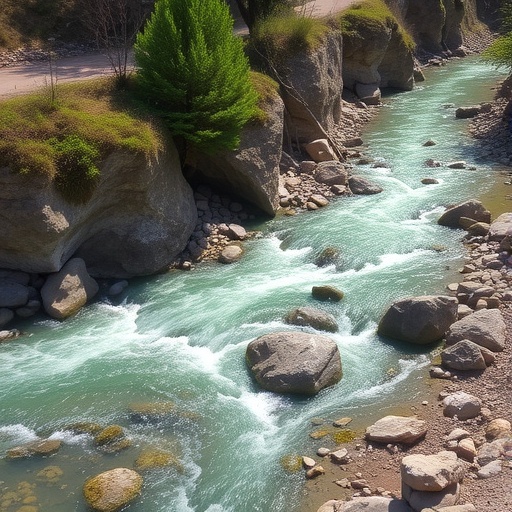
River forecasting has entered a new phase in which artificial intelligence is being asked to do more than follow yesterday’s hydrograph. A study published in Earth Science Informatics reports that a transformer-based model equipped with an attention mechanism substantially outperformed several established deep-learning approaches in predicting daily streamflow across three rivers in West Azerbaijan Province, Iran. The research compares six architectures—Long Short-Term Memory, Attention-LSTM, Encoder-LSTM, CEEMDAN-LSTM, Informer, and Attention-Informer—and concludes that the last of these, known as A-Informer, delivered the most reliable predictions across all monitoring stations. Its performance remained strong not only during ordinary flow conditions but also during the sudden discharge surges that often accompany floods.
The stakes behind this technical comparison are considerable. River discharge forecasts support reservoir operations, irrigation planning, drought response, flood warnings, and the allocation of limited water resources. In regions where rainfall is highly variable and hydrological systems are influenced by complex terrain, seasonal climate patterns, and rapidly changing atmospheric conditions, a small forecasting error can have practical consequences. Traditional statistical models often struggle with nonlinear relationships and long-term dependencies in environmental data. Deep-learning systems can identify such relationships, but their effectiveness depends heavily on how they represent time, how they select relevant information, and how efficiently they learn from multiple interacting variables. The West Azerbaijan study focuses on that problem by testing recurrent and transformer architectures under the same multivariate forecasting framework.
The models were trained with daily measurements of precipitation, air temperature, relative humidity, evaporation, air pressure, and wind speed. These variables provide a compact description of the atmospheric conditions that influence the movement of water through a watershed. Rainfall can produce a rapid rise in discharge, while temperature affects snowmelt and evaporation; humidity, pressure, and wind help describe the broader meteorological setting in which precipitation and water loss occur. By combining these inputs, the researchers sought to move beyond single-variable forecasting based only on historical river flow. The approach is particularly relevant to ungauged or sparsely monitored basins, where meteorological observations may be more widely available than detailed information about every physical process occurring within the catchment.
At the heart of the comparison is the difference between recurrent neural networks and transformers. LSTM networks process a sequence step by step, carrying forward an internal memory that helps them connect current conditions with earlier events. Their gating system allows the network to retain or discard information, making LSTMs more capable than conventional recurrent networks of learning delayed hydrological responses. However, sequential processing can make it difficult to capture relationships across long time windows, and the model may devote too much capacity to information that is not equally important. Attention mechanisms address this limitation by assigning different weights to elements of the input sequence. Instead of treating every previous observation as equally influential, attention allows the model to emphasize the meteorological patterns most relevant to the discharge being predicted.
The Informer model extends the transformer concept for long-sequence time-series forecasting. Standard transformers rely on self-attention, a mechanism that compares each time step with others in the sequence to identify relationships. That procedure can become computationally expensive as the sequence grows. Informer reduces this burden through more efficient attention calculations and a strategy designed to identify the most influential patterns rather than processing every possible interaction with equal intensity. It also uses an encoder-decoder structure to transform historical observations into future predictions. In the study, the Attention-Informer architecture adds another layer of selective focus, allowing the system to concentrate on the meteorological signals and temporal features that matter most for streamflow dynamics.
The results presented by the researchers show a consistent advantage for A-Informer. Across the three rivers, the model achieved correlation coefficients above 0.90 and Nash–Sutcliffe efficiency values exceeding 0.88. The correlation coefficient measures how closely predicted and observed discharge vary together, while the Nash–Sutcliffe efficiency compares the model against a basic benchmark based on the mean observed flow. A value approaching one indicates that the forecasts reproduce the observed pattern with high skill. A-Informer also produced the lowest reported errors, with root mean square error values of approximately 1.53 to 3.33 and mean absolute error values of about 0.87 to 1.84, depending on the station. Because root mean square error gives greater weight to large mistakes, its reduction is especially important when forecasting flood-related peaks.
The study’s visual analyses add an important dimension to the numerical scores. According to the authors, A-Informer tracked both low-flow periods and extreme peaks more accurately than the competing architectures. This distinction matters because a model can achieve a strong average score while still smoothing away short-lived floods or exaggerating minor fluctuations. Low-flow prediction is essential for assessing water availability and ecological stress, whereas accurate peak detection is central to flood preparedness and infrastructure safety. The researchers also evaluated peak-flow agreement, deviation, and bias, finding that A-Informer showed the highest concordance and the smallest departures from observed peak events. In practical terms, the model was less likely to miss or misrepresent the timing and magnitude of the sharp rises that challenge operational forecasting systems.
The CEEMDAN-LSTM model included in the comparison represents a different strategy for improving recurrent forecasting. Complete Ensemble Empirical Mode Decomposition with Adaptive Noise, or CEEMDAN, separates a complex signal into components operating at different time scales before those components are processed by an LSTM. Such decomposition can reveal oscillations, trends, and irregular fluctuations that may be hidden in the original discharge series. Although this hybrid design can improve a recurrent model’s ability to handle nonstationary data, the reported results indicate that signal decomposition alone did not match the performance achieved by the attention-enhanced transformer. The comparison suggests that the capacity to identify relevant relationships directly across long sequences may be more valuable than relying primarily on pre-processing to simplify the streamflow signal.
The authors describe their work as a systematic evaluation of advanced deep-learning models in a heterogeneous hydrological environment, but the findings also highlight important limits. The study used existing observations rather than generating a new dataset, and the underlying data and code are not openly provided; the authors state that code may be requested from the corresponding author. Strong performance across three rivers in West Azerbaijan does not automatically guarantee the same results in basins with different climates, land cover, snow regimes, reservoir operations, or data quality. Transformer models can also require substantial computational resources and careful tuning, and high predictive accuracy does not by itself explain the physical causes of a flood. Even so, the results offer a compelling signal for water-management agencies: combining efficient long-sequence attention with multivariate meteorological information may provide a more responsive and dependable route to daily streamflow forecasting, particularly when the next forecast must capture not just the river’s usual rhythm, but its most dangerous departures from it.
Cite Scienmag News
Violet Maxwell. (August 26, 2026). Study compares attention and transformer models predicting daily river flows in Iran. Scienmag. https://scienmag.com/study-compares-attention-and-transformer-models-predicting-daily-river-flows-in-iran/
Violet Maxwell. "Study compares attention and transformer models predicting daily river flows in Iran." Scienmag, 26 August 2026, https://scienmag.com/study-compares-attention-and-transformer-models-predicting-daily-river-flows-in-iran/. Accessed 3 September 2026.
Violet Maxwell. "Study compares attention and transformer models predicting daily river flows in Iran." Scienmag. August 26, 2026. https://scienmag.com/study-compares-attention-and-transformer-models-predicting-daily-river-flows-in-iran/


