


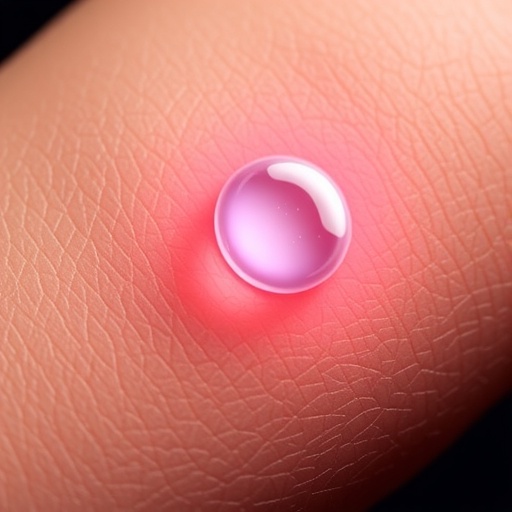
Wearable drug-delivery patches are moving beyond the familiar image of a passive adhesive strip. A new critical review in Biomedical Microdevices describes how flexible microfluidic platforms integrated with responsive hydrogels could turn the skin into the interface for programmable, localized and potentially personalized treatment. These systems combine soft channels, drug-loaded hydrogel reservoirs, skin-conformal materials and, in some designs, microneedles or electrical stimulation. Their purpose is not simply to place a medicine on the body, but to control how that medicine is stored, released, transported through skin and ultimately delivered to the tissue or circulation. The review, authored by Abhisekh Sah, Bishal Singh, Dilpreet Singh, Rajesh Gautam, Bijoy Ghosh and Deepak Kumar, maps the engineering principles behind this emerging class of wearable therapeutics.
The technology brings together two fields that have developed rapidly but often separately: microfluidics and hydrogel-based drug delivery. Microfluidic networks can guide very small liquid volumes through channels measured on the millimetre or micrometre scale, while hydrogels are water-rich polymer networks capable of holding drugs and changing their physical properties in response to the surrounding environment. In a wearable patch, a hydrogel reservoir may act as the drug depot, and connected channels can regulate fluid movement toward the skin. Flexible substrates, including elastomeric materials such as polydimethylsiloxane, allow the device to bend and stretch with the body. The result is a platform that can be engineered for topical treatment at the skin surface, dermal delivery into local tissue, wound-bed therapy, or deeper transdermal administration.
A central message of the review is that “release” is not a single event. Drug liberation from a hydrogel reservoir is only the first stage of a much longer chain. Once released, a compound must pass through the device outlet, partition between the formulation and the skin, move across the skin barrier, accumulate in the intended tissue or enter the bloodstream, and finally produce a therapeutic response. Each step can be influenced by molecular size, charge, solubility, hydrogel mesh structure, skin hydration, temperature, pH, tissue condition and contact pressure. A patch that releases a drug rapidly into a test liquid may therefore perform very differently on human skin. Separating these stages, the authors argue, is essential for interpreting experimental data and avoiding the common mistake of treating reservoir release as equivalent to successful transdermal delivery.
The review pays particular attention to stimuli-responsive hydrogels, which are designed to alter their swelling, permeability or mechanical state when exposed to a trigger. Temperature, pH, glucose, enzymes, electric fields and other chemical or physical signals can be used to influence transport. Poly(N-isopropylacrylamide), or PNIPAM, is one of the best-known thermoresponsive polymers in this area. It exhibits a lower critical solution temperature, commonly referred to as the LCST. Below this transition, the polymer network is relatively hydrated and expanded; above it, the network becomes more hydrophobic and contracts. That change can modify the pathways available for drug diffusion. The review emphasizes that PNIPAM should not be described simplistically as a material that merely “releases more drug when heated.”
Instead, heating above the LCST may produce a short, deswelling-driven expulsion phase as water and dissolved drug are forced out of the contracting network. After that initial burst, the collapsed structure may reduce pore accessibility and slow sustained diffusion. This time-dependent behaviour is important for wearable designs because skin temperature is not uniform and can vary with body location, activity, environment and inflammation. A device triggered by external heating must also avoid damaging tissue or destabilizing the payload. The authors therefore present thermoresponsive systems as dynamic transport platforms whose output depends on the timing and intensity of the stimulus, the degree of network collapse, the drug’s interaction with the polymer and the resistance of the downstream skin interface.
Different clinical routes require different architectures. For topical and dermal treatment, the objective may be to maintain a high local concentration while limiting systemic exposure. Wound-bed delivery introduces additional challenges, including exudate, changing pH, inflammation, bacterial contamination and fragile tissue. A hydrogel dressing must remain hydrated, conform to an irregular wound and release its payload without interfering with healing. Microneedle-assisted systems take another approach by creating temporary microscopic pathways through the outer stratum corneum, the principal barrier to many drugs. Dissolvable, coated or hollow microneedles may deliver compounds into the epidermis or dermis, while a microfluidic reservoir supplies a controlled stream. Electrically enhanced systems, such as iontophoretic patches, use a mild electric field to increase movement of charged or polar molecules across the skin.
The engineering problem extends well beyond selecting a responsive polymer. A practical wearable must control dehydration, because water loss can shrink or stiffen a hydrogel and alter its release profile. It must tolerate repeated bending, stretching and shear without leaking or delaminating. Adhesion must be strong enough to preserve skin contact but gentle enough to prevent irritation or injury during removal. Channel dimensions, reservoir geometry, fluid resistance and outlet design determine whether the intended dose reaches the target area. Manufacturing choices, including soft lithography, printing and other scalable processes, can introduce variation in channel dimensions, cross-link density and drug loading. Even small differences may produce clinically meaningful changes in flow or release, making reproducibility a major obstacle between laboratory prototypes and mass-produced medical products.
To manage this complexity, the review examines empirical release models, mechanistic transport descriptions and numerical simulation using COMSOL Multiphysics. Classical approaches such as Higuchi-type equations, Korsmeyer–Peppas analysis and Fickian diffusion models can help describe release curves, but they must be applied within their assumptions. A fitted exponent or correlation coefficient does not automatically reveal the physical mechanism, particularly when swelling, polymer relaxation, degradation, convection and changing boundary conditions occur simultaneously. Mechanistic models can instead couple diffusion with fluid flow, heat transfer, electric fields, swelling and skin permeability. In a finite-element environment such as COMSOL, researchers can alter channel geometry, hydrogel thickness, diffusion coefficients, temperature, applied voltage or skin-layer properties and examine how each parameter affects predicted delivery.
The authors position computational modeling as a tool for design-space exploration rather than a substitute for experiments. Simulations can identify sensitive parameters, reveal bottlenecks and reduce the number of prototypes required, but their predictions depend on the quality of the input data. Skin is heterogeneous, anisotropic and variable between individuals, while hydrogel properties may change over time as the material absorbs fluid, dries or interacts with the drug. A model that reproduces release into a simple laboratory medium may still fail to predict performance on living tissue. Credible modeling therefore requires verification of the numerical implementation, validation against independent experiments, transparent reporting of assumptions and careful distinction between calibrated and genuinely predictive results. The review links this need to regulatory expectations for computational modeling in medical-device submissions.
Translation is presented as the decisive test for wearable hydrogel microfluidics. Candidate systems must demonstrate stable payloads, predictable dosing, acceptable sterilization and storage, biocompatibility, low irritation, reliable adhesion and resistance to mechanical fatigue. They must also be usable by patients: patches should be easy to apply, comfortable during motion, safe to remove and clear about when a reservoir is empty or a dose has been delivered. Devices that combine a medicine with an active delivery component may be regulated as drug–device combination products, with requirements that vary by jurisdiction. The review uses qualitative Technology Readiness Level estimates only to compare evidence maturity, not as formal regulatory classifications. Its broader conclusion is that responsive hydrogel patches are scientifically promising because they unite sensing, fluid handling and controlled release in a skin-compatible format, but their future will depend on rigorous dose accounting, realistic skin models, manufacturing discipline and clinical evidence.
Cite Scienmag News
Louis Brooks. (August 26, 2026). Smart Wearable Hydrogel Devices Promise Precision Drug Delivery Through Skin. Scienmag. https://scienmag.com/smart-wearable-hydrogel-devices-promise-precision-drug-delivery-through-skin/
Louis Brooks. "Smart Wearable Hydrogel Devices Promise Precision Drug Delivery Through Skin." Scienmag, 26 August 2026, https://scienmag.com/smart-wearable-hydrogel-devices-promise-precision-drug-delivery-through-skin/. Accessed 5 September 2026.
Louis Brooks. "Smart Wearable Hydrogel Devices Promise Precision Drug Delivery Through Skin." Scienmag. August 26, 2026. https://scienmag.com/smart-wearable-hydrogel-devices-promise-precision-drug-delivery-through-skin/


