


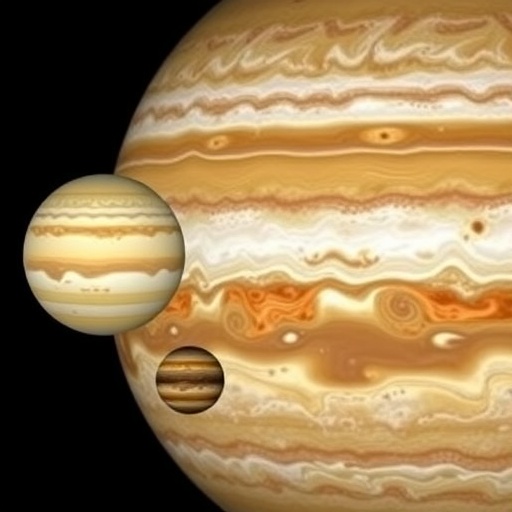
The Galilean satellites—Io, Europa, Ganymede and Callisto—may look like four neighboring worlds, but together they preserve one of the most important records of planetary formation in the Solar System. A major review in Space Science Reviews brings their origin and evolution into sharper focus, revealing a system shaped by a delicate balance between gas, ice, rock, heat, magnetic fields and orbital migration. Io is a volcanic furnace, Europa hides a global ocean beneath a fractured ice shell, Ganymede possesses its own magnetic field, and Callisto may still retain a primitive, incompletely differentiated interior. Their differences are striking, yet their arrangement is orderly: density decreases smoothly with distance from Jupiter, while Io, Europa and Ganymede remain locked in the celebrated 1:2:4 Laplace resonance. The new synthesis argues that the moons probably formed in a changing circumplanetary disk around young Jupiter, rather than inside a single, massive reservoir of material. Their final properties were determined not by one event, but by a prolonged sequence of accretion, cooling, migration, tidal heating and chemical alteration.
The story begins with Jupiter itself. The leading model of giant-planet formation proposes that Jupiter first accumulated a concentration of heavy elements inside the solar nebula and then captured an enormous hydrogen-helium envelope. Solids and gas were acquired simultaneously, although solids dominated the early stages and gas became increasingly important later. Incoming planetesimals were likely vaporized as they plunged into the growing planet’s hot atmosphere, distributing heavy elements through an extended region rather than leaving them in a compact central core. This interpretation is consistent with measurements from NASA’s Juno mission, which indicate that Jupiter’s heavy elements are not confined to a small center but are mixed outward through much of the planet’s interior. Jupiter’s formation therefore influenced the moons in several ways. The rate at which gas reached the planet controlled the density and temperature of the circumplanetary disk, while the angular momentum of that inflow determined where material began orbiting Jupiter. The planet’s early luminosity may also have been intense enough to keep the inner disk hot and strip water from the embryos of the innermost moons.
The circumplanetary disk, or CPD, was the crucial nursery in which the satellites assembled. Gas arriving from the solar nebula carried angular momentum and could not fall directly onto Jupiter, so it settled into orbit at a centrifugal radius. Estimates place this region anywhere from a few to roughly one hundred Jupiter radii, with simple calculations suggesting a scale comparable to the modern Galilean system. Viscosity then transported angular momentum through the disk, allowing gas to move inward toward Jupiter while other material spread outward. The disk’s behavior depended strongly on the centrifugal radius. If gas was deposited near the satellite-forming region, the disk behaved mainly as an accretion disk, with inward gas flow and rapid loss of solids. If the deposition radius was small, the outer disk could become a decretion disk, flowing outward and creating zones where drifting particles accumulated. These pressure and flow structures may have acted as traffic jams for dust and pebbles, increasing the concentration of solids until gravitational instabilities produced larger “satellitesimals.” The uncertain angular-momentum budget of the inflowing gas is therefore one of the central mysteries of Galilean satellite formation.
For decades, researchers often imagined the moons forming inside a minimum-mass subnebula: a dense disk containing all the material needed to build the satellites at once. That model faces severe problems. Its high gas density would have driven Galilean-sized bodies inward through Type I migration on timescales as short as hundreds of years. Unless the gas disappeared almost immediately, the growing moons would have spiraled into Jupiter. The same dense disk would also have been hot, especially if viscosity efficiently converted orbital energy into heat. In such conditions, ice-rich Callisto and Ganymede would have been difficult to preserve, and rapid accretion would have generated enough internal heat to melt ice and separate rock from water. The review instead favors versions of the “starved disk” model, in which gas and solids arrived gradually over hundreds of thousands to millions of years. A lower surface density would slow migration, while a declining inflow rate would allow the disk to cool and its water-ice line to move inward. This model naturally provides a window in which Ganymede and Callisto could acquire abundant ice without undergoing immediate, complete differentiation.
Callisto may be the most valuable witness to this ancient process because its surface and interior appear to have escaped the extreme geological rewriting experienced by the other moons. Its heavily cratered terrain records a long history of relative inactivity, and gravity measurements have suggested that it may not be fully differentiated. In a completely differentiated moon, dense rock and metal sink toward the center while ice forms an outer shell. Callisto’s possible intermediate moment of inertia instead hints at a mixed rock-ice interior. This observation places demanding limits on its formation. Accretion from large planetesimals would have converted much of the impact energy into heat; a simplified estimate indicates that assembling a Callisto-sized body from large impacts could raise its temperature by roughly a thousand kelvin. Pebble-sized material is less destructive because it deposits energy near the surface, where radiation can remove it, but even pebble accretion must proceed slowly. Models suggest that Callisto’s growth may have taken longer than several hundred thousand years, particularly if radioactive aluminum-26 was still present. If future spacecraft confirm that Callisto is only partially differentiated, many rapid-formation scenarios will be ruled out.
The changing temperature of the disk may also explain why the moons become progressively richer in ice with distance from Jupiter. During periods of rapid gas inflow, viscous dissipation, shocks and radiation from young Jupiter could have pushed temperatures above the stability limit of water ice throughout much of the satellite region. As the inflow weakened, the disk cooled. Calculations indicate that ice could remain stable near Ganymede and Callisto only when the gas supply had fallen below approximately ten Earth masses per million years, depending on opacity and viscosity. The water snow line would then migrate inward, separating an inner region dominated by refractory rock from an outer region where water condensed as ice. Yet the observed pattern is not easy to reproduce. Vapor released from inward-drifting ice can diffuse outward and recondense at the snow line, creating a “cold finger” rich in ice. That process might make Ganymede, which lies closer to the snow line than Callisto, more ice-rich than its outer neighbor—the opposite of what observations suggest. The moons may therefore preserve a record of several competing processes, including sublimation, radial mixing, volatile loss and changing disk chemistry.
Another possibility is that the satellites grew by pebble accretion. In this scenario, large seeds—perhaps captured planetesimals tens to hundreds of kilometers across—swept up small particles drifting through the gas. Aerodynamic drag removes energy from a passing pebble, allowing Jupiter’s gravity to capture it temporarily inside a seed’s Hill sphere. The pebble then settles onto the growing body. This mechanism can be highly efficient in cold, quiescent disks, but it requires seeds large enough to overcome the onset barrier and depends sensitively on the particles’ Stokes number, a measure of how strongly they are coupled to the gas. Small particles may be too tightly tied to the gas, while intermediate-sized pebbles can drift inward so rapidly that they pass the embryos before being captured. Some models begin with four or more outer seeds that grow slowly as pebbles arrive. Others suggest that planetesimals entering the CPD were heated and ablated, enriching the disk with heavy elements that later coagulated into pebbles. Pebble accretion can preserve compositional gradients more effectively than chaotic collisions, but its efficiency problem is serious: if only ten percent of the pebble mass is captured, roughly one Earth mass of solids must pass through the disk to build the Galilean system.
The moons’ orbital architecture adds another layer of mystery. Today, Io completes four orbits while Europa completes two and Ganymede completes one, maintaining the Laplace resonance. This configuration drives eccentricity tides, transforming orbital energy into heat. The traditional explanation is that Jupiter’s tides caused the moons to migrate outward, with rapidly moving Io first locking to Europa and the pair later capturing Ganymede. But the resonance could instead have formed during the gas-rich stage, when satellites migrated inward through the CPD and converged near an inner disk cavity. Numerical simulations show that this process is far from orderly: growing moons can scatter one another, collide or enter temporary resonances. Even so, a fraction of modeled systems produce long chains of bodies in 2:1 resonances. Ganymede’s bright terrain, potentially created by a major tidal-heating episode around two billion years ago, may indicate that it occupied a different resonance before reaching its present orbit. Conversely, isotopic enrichment of sulfur and chlorine in Io’s atmosphere implies that intense volcanism has persisted for most of Solar System history, suggesting that the current resonance—or an equivalent earlier configuration—may be ancient.
The coming generation of spacecraft could finally resolve several of these competing ideas. ESA’s JUICE mission and NASA’s Europa Clipper will refine the gravity fields and orbital motions of the moons, while China’s planned Tianwen-4 mission could provide especially important measurements at Callisto. Repeated flybys may determine whether Callisto is hydrostatic and partially differentiated, or whether its apparent interior simplicity is an artifact of incomplete gravity data. Improved ephemerides could measure present-day migration at the scale of centimeters per year, revealing how strongly Jupiter dissipates tidal energy. Spectral and geochemical observations may constrain the original sources of water, carbon and other volatiles, although surface materials have often been altered by radiation, impacts and internal activity. The most decisive evidence may require sample return. Precise isotopic measurements of elements such as titanium, chromium, zinc, iron, molybdenum and tungsten could determine whether the moons formed from material inside or outside Jupiter’s early barrier in the solar nebula. For now, the leading picture is a slowly evolving, relatively cold and intermittently replenished disk, but the Galilean satellites remain less a solved family portrait than a set of ancient clues waiting to be decoded.
Cite Scienmag News
Grant Pearson. (August 26, 2026). How Jupiter’s Galilean Moons Formed and Evolved Within the Jovian System. Scienmag. https://scienmag.com/how-jupiters-galilean-moons-formed-and-evolved-within-the-jovian-system/
Grant Pearson. "How Jupiter’s Galilean Moons Formed and Evolved Within the Jovian System." Scienmag, 26 August 2026, https://scienmag.com/how-jupiters-galilean-moons-formed-and-evolved-within-the-jovian-system/. Accessed 3 September 2026.
Grant Pearson. "How Jupiter’s Galilean Moons Formed and Evolved Within the Jovian System." Scienmag. August 26, 2026. https://scienmag.com/how-jupiters-galilean-moons-formed-and-evolved-within-the-jovian-system/


