


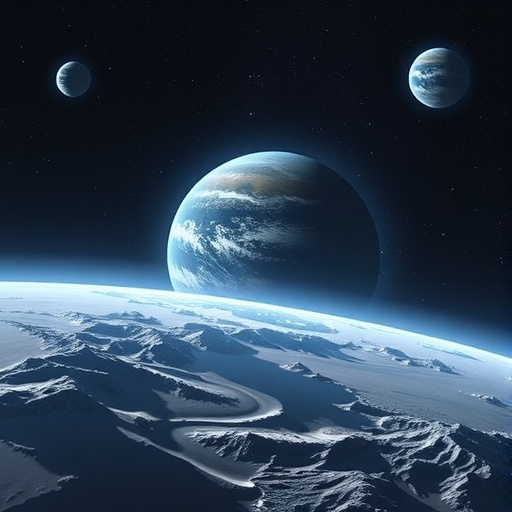
A new study from Stanford researchers proposes an explanation for one of the most puzzling discoveries in exoplanet science: how some worlds covered in oceans of molten rock can retain thick atmospheres despite orbiting so close to their stars that intense radiation should rapidly strip their gases away. The finding introduces a new region in the evolving map of planetary atmospheres, suggesting that lava itself may act as a planetary life-support system—not for life as we know it, but for the survival of an atmosphere under conditions that appear almost impossible. The researchers call this newly proposed regime the “cosmic sandbar,” a term inspired by the submerged ridges that form offshore along Earth’s coastlines. Their model indicates that the molten surfaces of hot, close-in planets can regulate atmospheric loss and replenish gases from below, allowing some atmospheres to persist for billions of years.
The result challenges a widely used idea known as the “cosmic shoreline,” a framework developed to describe the boundary between rocky planets that can retain atmospheres and those that are stripped bare by stellar radiation. In the simplest version of the concept, a planet’s distance from its star, combined with the star’s energy output and the planet’s gravity, determines whether its atmosphere survives. Worlds too close to their stars should lose their gases, while planets farther away have a better chance of keeping them. Yet observations have revealed several lava-covered planets located well inside the predicted atmospheric danger zone. These planets appear to possess substantial gaseous envelopes, forcing scientists to reconsider whether the cosmic shoreline is a fixed boundary or part of a more complex, evolving landscape.
The most prominent example is 55 Cancri e, a super-Earth nearly eight times as massive as our planet. It races around its host star at a distance roughly 20 times closer than Mercury’s orbit around the Sun, completing an orbit in less than a day. Its dayside is believed to be hot enough to maintain a global or nearly global ocean of molten rock. Under conventional expectations, radiation and charged particles from the star should drive atmospheric particles into space at extraordinary rates. However, observations made with the James Webb Space Telescope in 2024 indicated that 55 Cancri e has a remarkably thick atmosphere. The planet is not alone: recent observations have begun to reveal a growing population of similarly hot rocky worlds whose atmospheres seem to defy the conditions that should destroy them.
“A major question has been why these planets can still have atmospheres when they are so close to their stars,” said Barron Nguyen, a graduate student in the laboratory of Laura Schaefer at Stanford’s Doerr School of Sustainability and lead author of the study. “These lava worlds have pointed to something being wrong with the cosmic shoreline boundary, but we’ve found a way for them to preserve their atmospheres by proposing a new regime beyond it.” The key, according to the study, is that the atmosphere of a lava world is not simply a passive layer being eroded from above. It is part of a constantly changing system in which the molten surface, the planet’s interior, and the atmosphere exchange gases while the star attempts to remove them.
Nguyen and his colleagues constructed a model that follows this exchange over planetary timescales. The simulation accounts for atmospheric escape, the release of gases from the interior through volcanic and chemical processes, the absorption and dissolution of gases into molten rock, and the gradual cooling and solidification of the lava surface. Atmospheric escape can occur through several mechanisms. High-energy ultraviolet and X-ray radiation can heat the upper atmosphere, giving molecules enough energy to stream into space. Stellar winds can also erode the atmosphere, while intense irradiation may produce hydrodynamic outflow, in which a rapidly expanding atmosphere carries heavier particles outward with it. The strength of these processes depends on the star, the planet’s mass and gravity, the atmospheric composition, and the evolving temperature of the surface.
On a conventional rocky planet, atmospheric replenishment may come from volcanic outgassing, the release of gases dissolved in magma, or chemical reactions between rocks and the atmosphere. But the Stanford model shows that a lava ocean can change the balance dramatically. Molten rock can dissolve and store large quantities of volatile compounds, including oxygen-bearing molecules, carbon dioxide, water vapor, sulfur-containing gases, and other species. At the same time, gases from the planet’s interior can continue to rise into the atmosphere. As the lava remains hot and mobile, it prevents the planet from sealing away its volatile inventory too quickly. The atmosphere is therefore not replenished in a single catastrophic event; instead, it may be maintained through a long-lived, regulated exchange between the surface and the interior.
This creates a planetary regime in which atmospheric escape and outgassing can approach equilibrium. Radiation removes gas from the upper atmosphere, but the molten surface and interior release additional material at a comparable rate. The atmosphere may still be turbulent, chemically active, and constantly losing particles to space, yet its overall mass can remain substantial over geological timescales. This balance is the defining feature of the cosmic sandbar. According to the researchers, it lies beyond the conventional cosmic shoreline in the region where extreme stellar heating would normally be expected to eliminate an atmosphere. The sandbar is not a physical structure around a star, but a theoretical zone in the relationship between stellar irradiation, planetary mass, surface temperature, atmospheric escape, and interior evolution.
The model also explains why planets at somewhat greater distances from their stars may paradoxically be more vulnerable to becoming airless. These worlds can be cool enough for their magma oceans to solidify relatively quickly, locking gases inside minerals and the solidifying crust. Once the surface hardens, outgassing may slow dramatically. The planet then loses its remaining atmosphere to stellar radiation without an efficient mechanism for replacing it. The researchers describe this region as the “airless valley,” positioned between the cosmic sandbar and the more familiar cosmic shoreline. In this valley, planets are close enough to their stars to experience severe atmospheric erosion but not hot enough to preserve a molten surface capable of sustained replenishment. Mercury may represent a nearby example of the kind of airless world that cooled and solidified before it could maintain a durable atmosphere.
Farther from a star, cooler rocky planets may avoid the most destructive forms of atmospheric escape. Their surfaces can solidify, yet their atmospheres may survive because stellar irradiation is weaker and their volatile compounds are not removed as rapidly. Earth and Venus occupy this broader, more temperate portion of the planetary spectrum, although their histories and present conditions are very different. The new model suggests that the boundary between atmospheric and airless worlds cannot be defined by distance alone. A planet’s mass determines how strongly it holds onto gas, its star determines the intensity and evolution of high-energy radiation, and its interior determines how long it can continue supplying atmospheric material. Surface temperature and the timing of planetary cooling may be equally important, because they determine whether a world remains geologically active or becomes a sealed, volatile-trapping rock.
The concept could reshape how astronomers prioritize planets for future observations. Searches for potentially habitable environments have traditionally focused on the presence of liquid water and the orbital regions where temperatures might permit it. But before scientists can assess habitability, they must determine whether a planet has an atmosphere at all. The cosmic shoreline, amended by the sandbar and airless valley, offers a way to estimate which rocky planets are likely to retain detectable gaseous envelopes. It also provides a framework for interpreting apparently contradictory observations. A thick atmosphere on an ultra-hot super-Earth may not be an anomaly that invalidates the shoreline concept; it may be evidence that the planet occupies a different atmospheric regime, one in which a lava ocean is sustaining the gas layer from below.
Future observations will test whether the cosmic sandbar is a real population of planets or a compelling theoretical possibility. The James Webb Space Telescope and upcoming exoplanet surveys will be able to measure atmospheric compositions, temperature patterns, and signs of chemical disequilibrium on some of these worlds. Detecting molecules associated with volcanic outgassing, identifying differences between the dayside and nightside atmospheres, and comparing planets of different ages could reveal whether molten surfaces are actively regulating atmospheric mass. Such measurements may also show how quickly lava worlds evolve from atmosphere-rich planets into airless bodies as their surfaces cool. “The cosmic shoreline isn’t a lost cause,” Nguyen said. “There’s a broader set of parameters that can enable a planet to generate and maintain an atmosphere.” If the prediction holds, some of the most inhospitable-looking planets in the galaxy may become crucial laboratories for understanding how atmospheres are born, transformed, and preserved.
News Publication Date: 25-Aug-2026
Web References: https://doi.org/10.3847/2047-8213/ae9743; https://science.nasa.gov/universe/exoplanets/oceans-beaches-cosmic-shorelines-our-changing-views-of-habitable-planets/; https://planets.stanford.edu/people/laura-schaefer
References: The Astrophysical Journal Letters, DOI: 10.3847/2047-8213/ae9743
Keywords
Lava worlds, exoplanets, cosmic shoreline, cosmic sandbar, atmospheric escape, planetary atmospheres, 55 Cancri e, James Webb Space Telescope, outgassing, super-Earths, habitability, planetary evolution
Cite Scienmag News
Grant Pearson. (August 26, 2026). Why Some Planets Possess Atmospheres That Defy Existing Theories. Scienmag. https://scienmag.com/why-some-planets-possess-atmospheres-that-defy-existing-theories/
Grant Pearson. "Why Some Planets Possess Atmospheres That Defy Existing Theories." Scienmag, 26 August 2026, https://scienmag.com/why-some-planets-possess-atmospheres-that-defy-existing-theories/. Accessed 3 September 2026.
Grant Pearson. "Why Some Planets Possess Atmospheres That Defy Existing Theories." Scienmag. August 26, 2026. https://scienmag.com/why-some-planets-possess-atmospheres-that-defy-existing-theories/


