


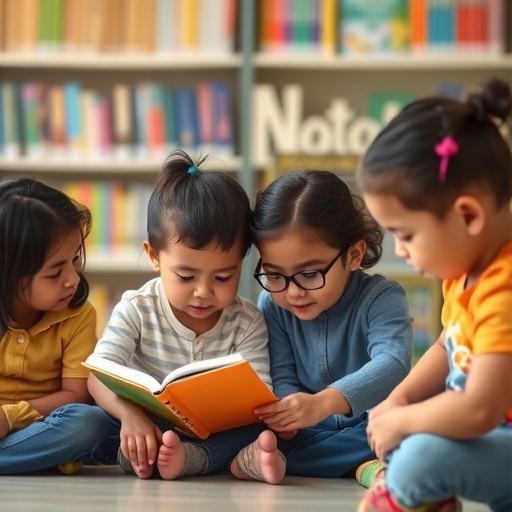
A major international analysis suggests that expanding early childhood education may help shrink the reading gap between children from high- and low-socioeconomic-status families—but only when expansion reaches disadvantaged children as well. The study, based on two decades of data from 64 education systems, challenges the assumption that simply increasing preschool enrollment is enough to make education more equal. Instead, the researchers found that the distribution of access matters. When overall participation increased while the socioeconomic gap in participation narrowed, the reading achievement gap observed at the end of primary school also tended to decline.
The research, published in Large-scale Assessments in Education, examined 225 country-by-year observations drawn from five cycles of the Progress in International Reading Literacy Study, or PIRLS, conducted in 2001, 2006, 2011, 2016 and 2021. PIRLS assesses reading comprehension among students generally in the fourth grade and combines standardized achievement tests with background information collected from students, parents, teachers and schools. Because the same education systems were observed repeatedly, the researchers used country-fixed-effects models. This statistical approach compares each country with itself over time, helping to remove the influence of stable national characteristics such as language, historical institutions, geography and long-standing education traditions.
The study defined early childhood education as formal education outside the home before primary school, corresponding broadly to Level 0 of UNESCO’s International Standard Classification of Education. Participation was measured using parent-reported information about whether children had attended such programs. The researchers also examined whether participation lasted at least two years. Socioeconomic status was classified using parental education: children were placed in the low-SES group when neither parent had completed short-cycle tertiary education or a higher qualification, while children with at least one parent holding such a qualification were categorized as high-SES. The central outcome was the difference in average PIRLS reading scores between these two groups.
Across all observations, early childhood education participation ranged from 17.8 percent to almost universal coverage at 99.9 percent. The international average rose substantially, from approximately 86 percent in 2001 to 96 percent in 2021. Longer participation also increased, from about 64 percent to 88 percent. Yet expansion did not automatically eliminate inequality. High-SES children participated at equal or higher rates than low-SES children in nearly every country-year observation. The absolute participation gap ranged from a slight advantage for low-SES children in some cases to a high-SES advantage of 45 percentage points in others, with an average gap of 7.6 percentage points.
The researchers then tested the mechanism behind the proposed “equalizing” effect of preschool. Their mediation model treated overall early childhood education participation as the starting factor, socioeconomic inequality in participation as the mediator, and the reading achievement gap as the final outcome. The analysis showed that a one-percentage-point increase in overall participation was associated with roughly a one-third percentage-point reduction in the participation gap between high- and low-SES children. In turn, a one-percentage-point reduction in the participation gap was associated with approximately a one-third-point reduction in the reading achievement difference. These relationships remained broadly similar when the researchers controlled for economic and demographic changes.
The full mediation analysis produced a small but statistically significant indirect association. A one-percentage-point increase in overall early childhood education participation was linked to an estimated 0.14-point decrease in the socioeconomic reading gap, but only through a reduction in inequality of access. The direct association between higher participation and the reading gap was not statistically significant. In other words, countries did not appear to narrow achievement differences merely by enrolling more children. The reduction emerged when enrollment growth was accompanied by improved access for children from less advantaged backgrounds.
The findings were more complicated when the researchers focused on participation lasting at least two years. Longer participation increased sharply over the study period, but its socioeconomic distribution did not show the same clear relationship with reading inequality. In these analyses, the link between inequality in longer participation and inequality in reading achievement was not consistently significant. By contrast, an alternative measure that expressed the participation gap relative to the overall enrollment rate reproduced the main pattern: higher participation was associated with lower relative inequality, which was in turn associated with a smaller reading achievement gap. This suggests that the way researchers measure inequality can influence the conclusions, particularly in countries where almost all children attend preschool.
The overall international trends also revealed an important paradox. Early childhood education participation increased significantly over time, but the absolute gap between high- and low-SES children did not show a clear international decline. Nor did the reading achievement gap display a consistent downward trend. The only notable increase in achievement inequality occurred in the 2021 assessment, a result the authors suggest may partly reflect the unequal educational effects of the COVID-19 pandemic. However, that increase was no longer statistically significant in one robustness analysis that excluded country-year observations with high levels of missing data.
Why might disadvantaged children benefit especially strongly from early education? Children from more affluent families are often exposed to books, language-rich conversation, educational activities and other learning resources at home. High-quality early childhood programs can provide similar developmental stimulation to children whose families have fewer financial, educational or social resources. They may support vocabulary, early literacy, self-regulation and familiarity with classroom routines before children enter primary school. But access is shaped by cost, availability, transportation, parental information, eligibility rules and cultural expectations. If new places are taken primarily by families who are already well positioned to secure them, expansion can reproduce what researchers call the “Matthew effect,” in which benefits flow disproportionately to those with existing advantages.
The authors emphasize that the study does not establish definitive cause and effect. Country-fixed-effects models improve the analysis by controlling for stable differences between education systems, but they cannot eliminate all time-varying confounding factors. Countries expanding early childhood education may also introduce other reforms, including changes in teacher staffing, school organization, remedial instruction, school choice or grade-entry rules. The full mediation model could not include all control variables because of the limited number of observations and the complexity of the statistical structure. In addition, the PIRLS questionnaires contained some differences in wording across cycles, and missing responses for participation and parental education were substantial in several country-year observations.
The study also could not measure the quality of early childhood programs, the number of hours children attended each week or the precise duration of participation across all assessment cycles. These factors may be crucial: attending a low-quality program for several years may not produce the same benefits as attending a well-resourced setting with trained staff, stimulating curricula and strong language support. The analysis further relies on country-level relationships, meaning that its estimates describe patterns across education systems rather than proving that every individual low-SES child will gain a particular number of reading points from preschool enrollment.
Even with these qualifications, the research delivers a clear policy message. Universal expansion alone is not necessarily an equalizer. To reduce later achievement inequalities, governments may need to design early childhood policies around equitable participation from the beginning. That could include free or subsidized places, targeted outreach, guaranteed access in underserved communities, transportation support and programs that meet the needs of families facing language, financial or administrative barriers. Quality must also be monitored, because unequal access to high-quality provision could preserve disparities even when enrollment statistics appear impressive.
The analysis ultimately reframes the debate over preschool expansion. The key question is not simply how many children attend early childhood education, but which children attend, for how long, and under what conditions. Across the countries studied, participation rose dramatically between 2001 and 2021, yet the benefits for educational equality appeared only when access became more evenly distributed. The results offer cautious encouragement for governments investing in early learning: expanding provision can help narrow the reading achievement gap, but the equalizing power of early childhood education depends on making sure that disadvantaged children are not left at the edge of the system.
Cite Scienmag News
Courtney Benton. (August 25, 2026). Can Higher Early Childhood Education Participation Narrow Primary Students’ SES Reading Gap? Scienmag. https://scienmag.com/can-higher-early-childhood-education-participation-narrow-primary-students-ses-reading-gap/
Courtney Benton. "Can Higher Early Childhood Education Participation Narrow Primary Students’ SES Reading Gap?" Scienmag, 25 August 2026, https://scienmag.com/can-higher-early-childhood-education-participation-narrow-primary-students-ses-reading-gap/. Accessed 5 September 2026.
Courtney Benton. "Can Higher Early Childhood Education Participation Narrow Primary Students’ SES Reading Gap?" Scienmag. August 25, 2026. https://scienmag.com/can-higher-early-childhood-education-participation-narrow-primary-students-ses-reading-gap/


