


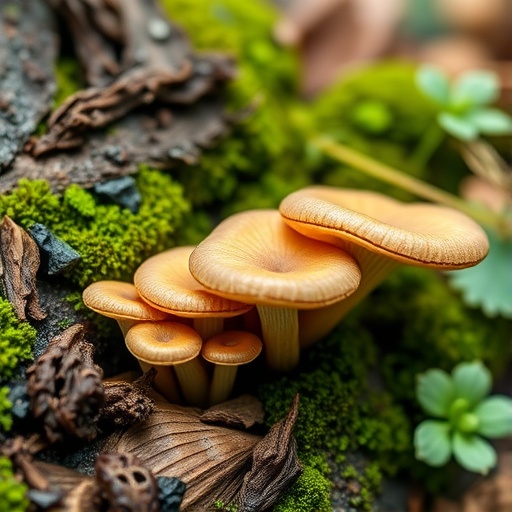
Nitrogen deposition is quietly rewriting the biological life of forests, and a new study suggests that one of the most overlooked victims may be deadwood. Researchers have found that chronic exposure to atmospheric nitrogen changes which microorganisms inhabit decomposing logs, suppresses the activity responsible for natural nitrogen fixation, and reorganizes the ecological connections between fungi and nitrogen-fixing bacteria. The findings point to a hidden consequence of air pollution: even after a tree has fallen, excess nitrogen can continue to reshape the microbial systems that determine how its carbon and nutrients return to the forest.
Deadwood is often treated as a symbol of decay, but biologically it is a highly active ecosystem. Fallen trunks and branches provide habitat for fungi, bacteria, insects, and microscopic predators while serving as long-term reservoirs of carbon. As wood decomposes, microbial communities break down complex compounds such as cellulose, hemicellulose, and lignin. These processes release nutrients and gradually incorporate organic matter into soil. Nitrogen is especially important because it is frequently scarce in forest ecosystems. When external nitrogen enters through rainfall, dust, or atmospheric pollution, it can alter the balance between organisms competing to obtain, transform, and retain this essential element.
The new research focuses on diazotrophs, microorganisms capable of biological nitrogen fixation. These bacteria and archaea convert atmospheric nitrogen gas, or N₂, into ammonia through the nitrogenase enzyme complex. Because most plants cannot use atmospheric N₂ directly, diazotrophs act as a critical gateway, making nitrogen biologically available to other organisms. In deadwood, nitrogen fixation can help sustain microbial growth in a substrate that is often chemically challenging and nutritionally imbalanced. The process is energetically expensive, however, and microorganisms may reduce it when reactive nitrogen is already abundant in their environment.
The study indicates that prolonged nitrogen deposition does more than simply increase the amount of nitrogen available in deadwood. It alters the composition of the diazotrophic community itself, favoring some nitrogen-fixing lineages while reducing the relative presence or activity of others. This distinction is important because different diazotrophs occupy different ecological niches and respond differently to acidity, carbon availability, oxygen conditions, and competition. A community containing the same number of nitrogen-fixing microorganisms may therefore perform very differently if its species and functional genes have changed. The researchers report that chronic nitrogen inputs were associated with a decline in biological nitrogen fixation, suggesting that increased environmental nitrogen can weaken the very process that naturally supplies new nitrogen to nutrient-poor wood.
The mechanism may involve several interacting pressures. Excess nitrogen can suppress the expression or activity of nitrogenase, reducing the energy microorganisms invest in converting atmospheric nitrogen. Nitrogen deposition may also acidify the substrate, shift the balance of carbon compounds available to microbes, or stimulate organisms that acquire nitrogen more efficiently through decomposition and mineral nutrient uptake. Under these conditions, diazotrophs can lose their competitive advantage. Instead of investing energy in fixing N₂, microbial communities may rely increasingly on ammonium, nitrate, or organically bound nitrogen already present in the wood. The result is a potential decoupling between nitrogen abundance and nitrogen acquisition: a system may receive more nitrogen from the atmosphere while becoming less capable of fixing it biologically.
The most striking result concerns the relationship between fungi and diazotrophs. Fungi are the principal decomposers of woody material, and their filaments create a three-dimensional network through logs, transporting enzymes, carbon compounds, minerals, and water. Diazotrophs can live on fungal hyphae, exploit compounds released during fungal decomposition, or contribute nitrogen that supports fungal growth. In return, fungi may provide shelter and energy-rich substrates to bacteria. These relationships are not necessarily direct partnerships in every case, but they form a network of ecological associations that can influence decomposition and nutrient cycling across the entire deadwood habitat.
By comparing microbial co-occurrence patterns under different nitrogen conditions, the researchers found that chronic deposition restructures fungal-diazotroph networks. Co-occurrence networks do not prove that two organisms physically interact, but they reveal patterns of repeated presence and absence that can indicate shared environmental preferences, potential cooperation, competition, or dependence on common resources. A network may become less connected, lose particular hubs, or develop new clusters as environmental conditions change. Such structural shifts matter because highly connected microbial communities can distribute resources and functions across many partners, while simplified networks may be more vulnerable to disturbance and less capable of maintaining ecosystem processes.
A reduction in biological nitrogen fixation could have consequences extending well beyond individual logs. Decomposition depends on a continuous exchange of carbon, nitrogen, phosphorus, and other elements. If nitrogen-fixing microorganisms become less active, fungi and other decomposers may encounter stronger nutrient constraints at particular stages of decay, potentially changing the rate at which deadwood loses mass. Alternatively, nitrogen enrichment could accelerate some decomposition pathways while slowing others, depending on the chemical composition of the wood and the organisms that become dominant. Either outcome could affect how long carbon remains stored in deadwood before entering the soil or atmosphere. Because deadwood can persist for years or decades, even modest changes in microbial activity may accumulate across forest landscapes.
The findings also challenge the assumption that nitrogen pollution simply fertilizes ecosystems. In agricultural systems, added nitrogen can stimulate plant production, but natural forests often respond in more complex ways. Chronic deposition can disturb nutrient limitation, acid-base chemistry, microbial competition, and the relationships linking plants, fungi, and bacteria. The new evidence adds deadwood to that list of sensitive compartments. Forest monitoring that focuses only on living trees, soil chemistry, or plant productivity may miss substantial ecological changes occurring inside fallen trunks. Understanding these responses will require combining measurements of nitrogen fixation, microbial genes, enzyme activity, decomposition rates, and network structure over long periods.
As atmospheric nitrogen emissions continue to vary across regions, the study offers a warning about ecological effects that are easy to overlook because they occur at microscopic scales. Deadwood is not merely forest debris; it is a biochemical reactor and a refuge for microbial diversity. When nitrogen deposition changes its diazotrophic communities and fungal partnerships, it may alter the timing and direction of nutrient release, carbon storage, and microbial succession. The broader message is that pollution can reshape ecosystems not only by removing species, but also by rewiring the relationships among organisms that remain. Protecting forest function will therefore depend on tracking these invisible networks as carefully as the trees above them.
Cite Scienmag News
Russell Cooper. (August 25, 2026). Chronic Nitrogen Deposition Reshapes Diazotrophs, Suppresses Fixation, Rewires Deadwood Fungal Networks. Scienmag. https://scienmag.com/chronic-nitrogen-deposition-reshapes-diazotrophs-suppresses-fixation-rewires-deadwood-fungal-networks/
Russell Cooper. "Chronic Nitrogen Deposition Reshapes Diazotrophs, Suppresses Fixation, Rewires Deadwood Fungal Networks." Scienmag, 25 August 2026, https://scienmag.com/chronic-nitrogen-deposition-reshapes-diazotrophs-suppresses-fixation-rewires-deadwood-fungal-networks/. Accessed 5 September 2026.
Russell Cooper. "Chronic Nitrogen Deposition Reshapes Diazotrophs, Suppresses Fixation, Rewires Deadwood Fungal Networks." Scienmag. August 25, 2026. https://scienmag.com/chronic-nitrogen-deposition-reshapes-diazotrophs-suppresses-fixation-rewires-deadwood-fungal-networks/


