


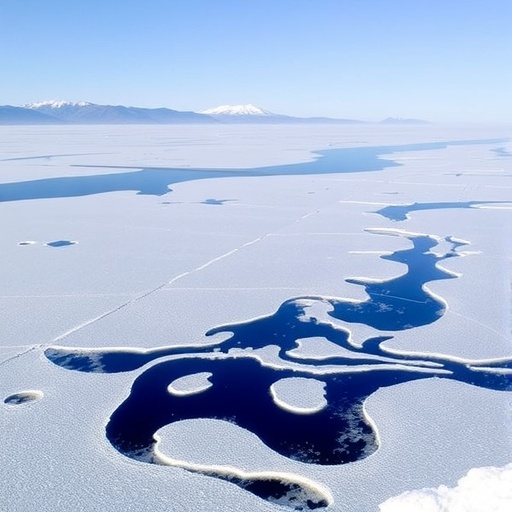
Xinjiang’s largest lakes are responding to climate change in opposite ways, revealing a striking pattern of “split-screen” winter change across one of China’s most climatically diverse regions. A new study of nine lakes larger than 100 square kilometers shows that the timing of freezing and thawing is not moving uniformly toward shorter winters. Instead, low-elevation lakes on the plains are generally losing ice more quickly, while high-elevation plateau lakes are experiencing longer ice-covered seasons. The findings challenge the assumption that warming produces a single, predictable pattern of lake-ice decline and suggest that altitude, lake size, wind, sunlight and regional atmospheric conditions are interacting in complex ways across Xinjiang.
Lake ice phenology—the seasonal timing of ice formation, maximum coverage and disappearance—is one of the most sensitive natural indicators of environmental change. Unlike long-term temperature records, the freezing and thawing of a lake integrates the effects of air temperature, solar radiation, wind, snow, water depth and the physical properties of the lake itself. A shift of only a few days can influence evaporation, water circulation, oxygen availability, algae growth and the timing of activity for organisms living in and around the water. Ice conditions also matter directly to communities that depend on frozen surfaces, winter transportation, water management and cold-season ecosystems. Because lakes respond to both climate and local geography, their ice records can expose regional differences that broad climate averages conceal.
The researchers used the Google Earth Engine platform to analyze MODIS satellite observations collected between 2000 and 2024. Google Earth Engine allows scientists to process large volumes of Earth-observation data in the cloud, while MODIS provides frequent images that can track seasonal changes in surface reflectance. Ice, open water, snow and cloud cover have different spectral signatures, allowing the researchers to identify the transition between frozen and unfrozen conditions. From these time series, they extracted three key indicators: freeze-up start, or FUS, marking the beginning of seasonal ice formation; break-up end, or BUE, representing the completion of ice disappearance; and ice-cover duration, or ICD, the length of time a lake remained ice-covered. Together, these measurements created a two-and-a-half-decade record of winter behavior across nine major Xinjiang lakes.
The contrast between plain and plateau lakes was especially pronounced. Plain lakes, located below approximately 1,500 meters above sea level, tended to freeze later, thaw earlier and remain ice-covered for a shorter period than their high-elevation counterparts. Plateau lakes above 1,500 meters generally froze earlier, lost their ice later and retained a continuous frozen surface for longer. This difference is consistent with the colder conditions typically found at higher elevations, but the study indicates that elevation alone does not explain the full pattern. Lake morphology, water volume, exposure to wind and changes in surrounding climate may alter how quickly a lake gains or loses heat. A shallow lake can react rapidly to atmospheric conditions, whereas a deeper or larger lake stores more heat and may continue releasing it well into winter.
The long-term trends were even more surprising. Across the plain-lake group, freeze-up start advanced by an average of 3.09 days per decade, while break-up end advanced by 4.23 days per decade. In other words, these lakes were beginning to freeze earlier and finishing their thaw earlier over the study period. Their total ice-cover duration nevertheless shortened slightly, by about 0.84 days per decade. The apparently contradictory movement of the two dates suggests that the winter season may be shifting rather than simply shrinking: freezing is occurring earlier, but the end of the ice season is also arriving earlier, with the latter change exerting a stronger influence on the total duration. Such a pattern could reflect variations in autumn and spring climate, snow conditions or the timing of cold-air outbreaks.
The plateau lakes showed the reverse tendency. Their freeze-up start was delayed by approximately 2.03 days per decade, while break-up end was delayed by a much larger 8.10 days per decade. As a result, the ice-cover duration increased significantly, by about 6.40 days per decade. This means that, despite later initial freezing, the ice persisted substantially longer into the warm season. The result is a powerful reminder that separate phenological milestones can respond differently to climate forcing. A lake may freeze later but still experience a longer ice season if spring warming is delayed, summer onset shifts, or conditions favor the persistence of snow and ice after freezing has begun. At high elevations, the balance between incoming solar energy, cold-air retention, snow insulation and wind-driven heat exchange can be particularly sensitive to regional circulation patterns.
Temperature remained the most important individual influence on the beginning of freezing. The analysis estimated that air temperature accounted for an average of 32 percent of the variation in FUS. This relationship is physically intuitive: sustained cooling removes heat from the lake surface until the water reaches the freezing point and an ice layer can begin to form. However, temperature was not sufficient to explain the complete record. The end of ice break-up and the length of the ice-covered period were controlled primarily by the combined effects of air temperature and lake area. Air temperature explained 24.01 percent of BUE variability and 37.20 percent of ICD variability, while lake area contributed 30.82 percent and 23.32 percent, respectively.
Lake area influences ice phenology because larger water bodies generally possess greater thermal inertia. They absorb and store more heat during the warm season, delaying autumn freeze-up, but the same stored energy can also affect the rate at which ice disappears in spring. Large lakes may additionally experience stronger wind mixing, which redistributes heat through the water column and can break up thin ice. Conversely, once a stable ice cover develops, it can reduce heat exchange between the water and atmosphere and modify the lake’s energy balance. The impact of area therefore depends on season and on other characteristics, including depth, shoreline geometry and exposure. The study’s results show why lake size must be considered alongside air temperature rather than treated as a secondary geographic detail.
Wind speed and incoming shortwave radiation, or SW, also affected the timing of ice transitions. Wind can delay freezing by mixing relatively warm water upward, but it can also fracture ice and accelerate break-up when temperatures rise. Solar radiation is the main energy source driving spring melt, although its effect can be amplified or reduced by snow cover, ice thickness and surface reflectivity. Bright snow and fresh ice reflect much of the incoming sunlight, while darker, aging ice absorbs more energy and melts faster. Precipitation had only a minor influence in the study’s overall assessment, although snowfall can still matter locally by insulating ice from cold air or increasing surface reflectance. These interactions help explain why lakes separated by only a few hundred kilometers—or even lakes within the same broad climate zone—can display very different seasonal trajectories.
The consequences extend beyond the dates shown in satellite images. Changes in ice duration can alter winter heat exchange, water-column mixing and the amount of light reaching organisms beneath the ice. Earlier ice loss may expose lake surfaces to sunlight and wind sooner, influencing evaporation and spring warming. In contrast, prolonged ice cover can delay the onset of open-water biological activity and reshape the seasonal timing of aquatic ecosystems. In Xinjiang’s arid environment, where lakes are closely linked to water availability, mountain runoff and human demands, changing ice conditions may also affect hydrological planning and ecological protection. The researchers emphasize that their findings reveal divergent responses rather than a single regional rule. Monitoring programs and climate-impact assessments will therefore need to distinguish between lowland and plateau lakes, while incorporating local lake geometry and atmospheric conditions. Xinjiang’s frozen lakes are not delivering one message about climate change; they are transmitting several at once, and decoding those signals may be essential for predicting the future of cold, water-limited landscapes.
Cite Scienmag News
Sloane Callahan. (August 25, 2026). Ice Cover Timing Varies Across Large Lakes in Xinjiang, China. Scienmag. https://scienmag.com/ice-cover-timing-varies-across-large-lakes-in-xinjiang-china/
Sloane Callahan. "Ice Cover Timing Varies Across Large Lakes in Xinjiang, China." Scienmag, 25 August 2026, https://scienmag.com/ice-cover-timing-varies-across-large-lakes-in-xinjiang-china/. Accessed 4 September 2026.
Sloane Callahan. "Ice Cover Timing Varies Across Large Lakes in Xinjiang, China." Scienmag. August 25, 2026. https://scienmag.com/ice-cover-timing-varies-across-large-lakes-in-xinjiang-china/


