


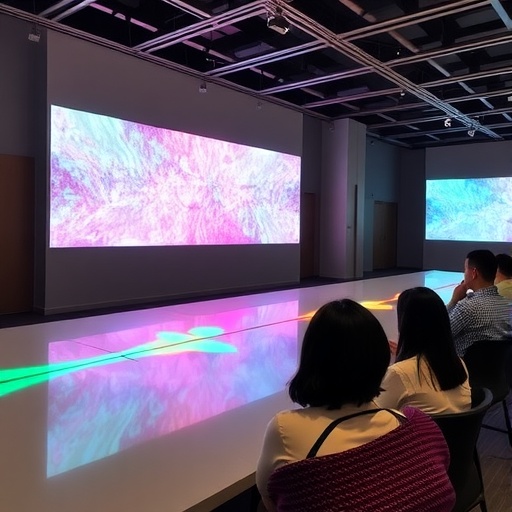
A five-university Japan–Taiwan research consortium has been selected for the 2026 Japan–Taiwan Exchange Association Joint Research Grant Program in Natural and Applied Sciences, launching a three-year effort to develop a new generation of circularly polarized organic light-emitting diodes, or CP-OLEDs. Led by Yoshitane Imai, professor at Kindai University, and Ming-Chia Li, associate professor at National Yang Ming Chiao Tung University, the collaboration brings together researchers specializing in optical spectroscopy, organic electronics, chiral materials, semiconductor processing, self-assembly, and structural analysis. The project seeks to overcome one of the most persistent challenges in advanced light-emitting technology: producing strongly circularly polarized light without sacrificing brightness, efficiency, or design flexibility.
The consortium includes Kindai University, Ibaraki University, Osaka Metropolitan University, National Yang Ming Chiao Tung University, and National Central University. Its central objective is to establish foundational technologies for semiconductor light-emitting devices that generate circularly polarized luminescence directly from electrical energy. Unlike conventional displays, which typically emit unpolarized light and require additional optical components to manipulate polarization, CP-OLEDs are designed to produce light whose electric field rotates in a defined direction as the wave travels. This additional property could allow light to carry information through intensity, color, and rotational direction simultaneously, opening possibilities in displays, optical communications, three-dimensional imaging, sensing, information security, and emerging spin-based technologies.
Circularly polarized light exists in two forms, commonly described as left- or right-handed, depending on the direction in which the electric field vector rotates. The degree of circular polarization is often evaluated using the dissymmetry factor, a parameter that compares the intensity of left- and right-circularly polarized emission. In practical devices, however, achieving a high dissymmetry factor is only part of the problem. A material may emit strongly polarized light but perform poorly as a light source, while another may offer excellent luminous efficiency but almost no polarization. The Japan–Taiwan project will therefore focus on the difficult balance between polarization density, electrical efficiency, brightness, operating stability, wavelength range, and manufacturability.
The researchers plan to move beyond the standard strategy of embedding chiral light-emitting molecules in an organic electroluminescent device. Chiral molecules possess structures that cannot be perfectly superimposed on their mirror images, and this asymmetry can influence how they interact with light. Although such molecules have enabled important advances in circularly polarized luminescence, they can impose limitations on material selection, device architecture, emission wavelength, and large-scale fabrication. The new collaboration will investigate whether magnetic fields, electric fields, electron spins, and hierarchical material structures can create or control optical asymmetry during the emission process, potentially enabling CP-OLED designs that are less dependent on conventional molecular chirality.
One major research direction is magnetic-field-induced circularly polarized luminescence, or MCPL. When luminescent molecules or electronic states interact with an external magnetic field, their energy levels and spin-related populations can be altered. These changes may affect the balance between left- and right-handed emission, allowing the polarization state of the light to be controlled externally. The Japanese team will contribute expertise in measuring circularly polarized luminescence and evaluating photoluminescence under magnetic fields. Such measurements can reveal how excited states, magnetic interactions, and molecular environments influence the final polarization of emitted light, providing design rules for materials and devices.
The project will also examine electric-field-induced circularly polarized luminescence, known as ECPL. Electric fields can modify charge distribution, energy-level alignment, carrier transport, and the recombination processes that produce light in an organic semiconductor. In an OLED, electrons and holes are injected from opposite electrodes and meet within an emissive layer, where they form excited states before releasing energy as photons. By controlling these processes with electric fields, researchers hope to influence the spin and symmetry of the excited states and produce circularly polarized emission on demand. This approach could provide a route toward electrically tunable polarization, an important capability for compact optical systems and information technologies.
A further component involves the chiral-induced spin selectivity effect, or CISS, in which electrons moving through chiral molecular structures can experience spin-dependent transport. In principle, a chiral pathway may favor the transmission of one electron-spin orientation over the other, linking molecular structure to spin-polarized electronic behavior. The consortium will investigate whether CISS can be integrated with organic semiconductor materials and device structures to control the spin populations involved in light emission. Combining CISS with magnetic and electric field effects could allow the team to manipulate the relationships among charge, spin, and light without relying exclusively on chiral emitters. The research will span visible and near-infrared wavelengths, broadening its potential relevance to both displays and optical sensing.
The Japanese and Taiwanese teams bring complementary capabilities to this challenge. Researchers in Japan specialize in circularly polarized light spectroscopy, magnetic-field-dependent photoluminescence, organic electroluminescent device fabrication, and electrical and optical evaluation. Their Taiwanese partners contribute expertise in circularly polarized luminescent materials, polymers, semiconductor materials, molecular self-assembly, structural characterization, simulation, and semiconductor manufacturing. By combining these areas, the project aims to connect microscopic electronic and spin behavior with macroscopic device performance. The researchers will study how molecular and supramolecular structures organize, how carriers move through complex materials, and how external fields alter emission during device operation.
The collaboration will officially begin with the 2026 Taiwan–Japan Joint Symposium on Next-Generation Circularly Polarized Luminescence Technology, scheduled for September 1 and 2, 2026, in Taiwan. The first day will be held at the Bo-Ai Campus of National Yang Ming Chiao Tung University in Hsinchu, followed by a second day at National Central University in Taoyuan. Thirteen faculty members and students from the five participating universities are expected to attend, along with auditors from Taiwanese universities. The two-day program will include scientific presentations, dedicated sessions for early-career researchers, laboratory tours, and planning meetings intended to coordinate the three-year research program. Graduate students and young scientists will be central participants, reflecting the consortium’s goal of building a lasting scientific network rather than a short-term exchange.
During the project’s planned period from fiscal year 2026 through fiscal year 2028, the researchers hope to establish quantitative design benchmarks for future circularly polarized light-emitting materials and devices. These benchmarks will need to define how polarization strength can be improved while maintaining high luminous efficiency, stable operation, and compatibility with practical fabrication processes. The team also expects to investigate interactions among magnetic fields, electric fields, light, and electron spins, an area that could connect organic electronics with spintronics and quantum-enabled communication. Although the consortium is still at the research and development stage, its approach could influence how optical information is generated, transmitted, secured, and detected. If successful, the work may help transform circular polarization from an additional optical feature into an active control parameter for next-generation optoelectronic devices.
Web References: https://mediasvc.eurekalert.org/Api/v1/Multimedia/c9bc560e-f2df-4630-94f8-e000d4a5ef53/Rendition/low-res/Content/Public
Keywords
Circularly polarized light, CP-OLEDs, organic light-emitting diodes, circularly polarized luminescence, magnetic-field-induced luminescence, electric-field-induced luminescence, chiral-induced spin selectivity, organic semiconductors, spintronics, Japan–Taiwan research collaboration
Cite Scienmag News
Denise Maddox. (August 25, 2026). Taiwan hosts kickoff symposium for bilateral circularly polarized light project. Scienmag. https://scienmag.com/taiwan-hosts-kickoff-symposium-for-bilateral-circularly-polarized-light-project/
Denise Maddox. "Taiwan hosts kickoff symposium for bilateral circularly polarized light project." Scienmag, 25 August 2026, https://scienmag.com/taiwan-hosts-kickoff-symposium-for-bilateral-circularly-polarized-light-project/. Accessed 3 September 2026.
Denise Maddox. "Taiwan hosts kickoff symposium for bilateral circularly polarized light project." Scienmag. August 25, 2026. https://scienmag.com/taiwan-hosts-kickoff-symposium-for-bilateral-circularly-polarized-light-project/


