


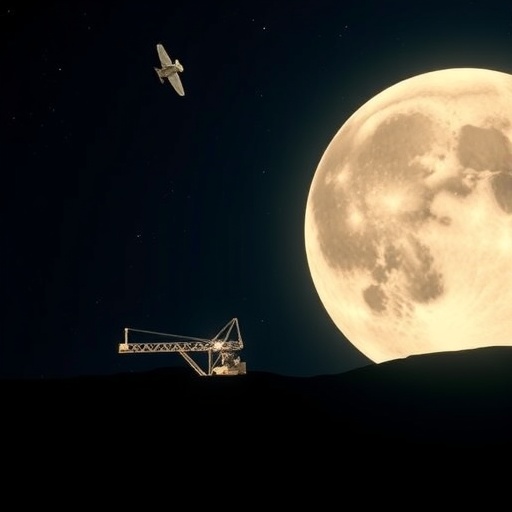
The Moon is preparing for its busiest era yet—not with runways, control towers or flashing airport lights, but with spacecraft following invisible lanes carved by gravity. NASA’s planned Gateway lunar station could eventually serve as a traffic hub for Orion crew capsules, cargo spacecraft, lunar landers and astronauts moving between Earth, the Moon and deeper destinations. Before that vision becomes reality, mission planners must solve a problem that has never existed on this scale: how to safely coordinate multiple vehicles in the same highly complex lunar orbit. Researchers from Texas A&M University, NASA’s Johnson Space Center and Purdue University have developed new algorithms and operational strategies for managing spacecraft that must wait, maneuver and approach Gateway without wasting fuel or drifting into dangerous proximity. Their work offers a mathematical framework for what may become the first form of celestial air-traffic control.
Gateway is designed to operate in a Near Rectilinear Halo Orbit, or NRHO, a specialized path created by the combined gravitational influence of Earth and the Moon. Unlike a conventional circular orbit around a single body, an NRHO is shaped by the restricted three-body problem, in which the motion of a spacecraft is affected by two massive objects as well as its own velocity and position. Gateway’s planned orbit will carry it close to the Moon’s north pole before sending it far beyond the south pole, creating a long, elongated loop through cislunar space. The orbit offers important advantages: it can provide nearly continuous communication with Earth and requires relatively little propellant for station keeping. Yet its apparent stability does not mean the environment is simple. Every visiting vehicle must navigate a constantly evolving gravitational landscape, where small errors in timing, position or velocity can grow into major operational challenges.
The researchers focused on a deceptively ordinary-sounding activity: loitering. In spaceflight operations, loitering means maintaining a spacecraft near a designated orbit or trajectory while it waits for a future maneuver, docking opportunity or departure window. On Earth, an aircraft may wait at a gate, hold over a navigation point or circle while air-traffic controllers organize arrivals. Around Gateway, however, nothing is stationary. A spacecraft that appears to be “parked” is continuously moving along its own trajectory while also being influenced by Earth’s gravity, the Moon’s gravity and the gravitational dynamics of the NRHO. The central challenge is to keep each vehicle sufficiently close to its planned location for efficient operations while maintaining enough separation to protect the station, crew and other spacecraft. The study treats these waiting positions as carefully designed elements of a larger traffic-management system rather than as improvised holding patterns.
To investigate how such a system might work, the team conducted thousands of computer simulations. These simulations examined the behavior of spacecraft positioned at different locations relative to Gateway and tested how well those vehicles remained within safe operational boundaries over time. The models incorporated realistic complications, including navigation uncertainty, imperfect thruster performance and small disturbances that can alter a spacecraft’s trajectory. In an idealized calculation, a vehicle might execute every maneuver exactly as planned and know its position with perfect accuracy. Actual missions face no such conditions. Sensors have limitations, engines deliver slightly different amounts of thrust from one burn to the next and the spacecraft’s estimated state always contains some uncertainty. By including these effects, the researchers could evaluate not only the most efficient trajectories, but also the degree of robustness required for safe lunar operations.
The results showed that modestly increasing station-keeping activity could significantly improve a spacecraft’s positional accuracy without imposing a large propellant penalty. Station keeping involves small corrective maneuvers that counteract deviations from a desired orbit. Such burns consume fuel, so mission designers traditionally seek to minimize them. But using the absolute minimum number of maneuvers may not produce the most useful or safest traffic pattern. The simulations indicated that carefully selected corrections can keep loitering vehicles much closer to their intended relative positions, making their future movements easier to predict. The trade-off is not simply fuel versus no fuel; it is fuel expenditure versus uncertainty. A small amount of additional propellant may reduce the likelihood that a spacecraft will require a larger emergency maneuver later, while also improving the timing and coordination of docking and rendezvous operations.
A key concept emerging from the study is a formation the researchers describe as a “string of pearls.” In this arrangement, visiting spacecraft would be distributed along the lunar orbit at calculated intervals ahead of or behind Gateway. Each vehicle would follow its own trajectory, but its position would be managed relative to the station and the other vehicles in the sequence. The formation could allow spacecraft to remain close enough to Gateway for practical access while preserving predictable separation between them. This is particularly important when several different types of vehicles are operating in the same neighborhood. An Orion capsule might be approaching with astronauts, a cargo vehicle might be waiting for a delivery window and a lunar lander might be preparing for a transfer to the surface. Rather than allowing each mission to navigate independently, a relative formation would give planners a shared spatial framework for deciding who moves, who waits and when each maneuver can safely occur.
The importance of relative positioning becomes clearer because NRHO operations are not governed by simple distances alone. Two spacecraft can be separated by a substantial distance at one moment yet follow trajectories that bring them into closer proximity later. Conversely, vehicles that appear relatively near each other may remain dynamically separated if their orbital phases and velocities differ appropriately. Mission designers therefore must consider position, velocity, orbital phase, uncertainty and future trajectory evolution at the same time. In a multi-spacecraft environment, a safe traffic plan must also account for communication delays, maneuver execution windows and the possibility that a vehicle will not perform exactly as expected. The Texas A&M-led work addresses these concerns by using operational rules based on spacecraft motion relative to Gateway, rather than relying only on fixed locations in space. That approach could help controllers identify safe holding regions and define procedures for responding to deviations.
The research could become increasingly important as NASA’s Artemis campaign develops a sustained presence in lunar orbit. Gateway is intended to support a sequence of crewed and robotic missions, and its traffic environment may eventually include spacecraft arriving from Earth, vehicles departing for the lunar surface and others returning from exploration activities. Each mission will have different propulsion capabilities, navigation systems, schedules and safety requirements. A vehicle with limited fuel may need to remain in a low-energy trajectory, while another may have more flexibility to change its orbit. The traffic-management system must accommodate these differences without compromising the station’s safety. Predictable spacecraft positions would allow mission planners to coordinate rendezvous sequences more effectively, reduce conflicts between arrival and departure operations and establish contingency plans if a docking attempt is delayed. The same principles could later apply to commercial lunar vehicles and international spacecraft operating in shared cislunar space.
For Diane Davis, an associate professor of space engineering at Texas A&M University and an author of the study, the problem is part of a broader transition in space exploration. Davis previously worked at NASA’s Johnson Space Center as a principal engineer and Gateway mission-design lead, bringing direct experience in the astrodynamics and operational planning challenges surrounding the lunar station. She has emphasized that future exploration will depend not only on rockets and spacecraft, but also on the systems that allow those vehicles to interact safely. In this view, space traffic management is infrastructure—an invisible layer of rules, models and decision tools that must exist before lunar transportation becomes routine. As more nations and companies plan missions beyond low Earth orbit, the absence of coordinated traffic procedures could become a major source of risk. The new study provides one possible foundation for managing that growing complexity.
Humanity’s first lunar “airport” will therefore be built from equations rather than concrete. Its lanes will be trajectories, its holding areas will be carefully maintained orbital positions and its control system will depend on continuous calculations of gravity, uncertainty and fuel. The researchers’ simulations suggest that the safest and most efficient strategy may not be to push every spacecraft as close as possible to Gateway or to minimize every corrective maneuver. Instead, success may come from maintaining a controlled rhythm in which vehicles remain close enough to serve their missions, far enough apart to avoid collisions and predictable enough for all operators to coordinate their actions. As Gateway prepares to become a central element of lunar exploration, this quiet mathematics could determine whether cislunar space becomes a chaotic collection of independent missions or the first organized transportation network beyond Earth.
Web References: NASA Gateway mission; Diane Davis, Texas A&M University; Article DOI
References: Acta Astronautica, “Cislunar traffic management: Orbit maintenance and loitering in the Gateway NRHO,” DOI: 10.1016/j.actaastro.2026.06.006, publication date 1 November 2026.
Cite Scienmag News
Courtney Benton. (August 25, 2026). Moon’s First Airport Planned 240,000 Miles From Earth. Scienmag. https://scienmag.com/moons-first-airport-planned-240000-miles-from-earth/
Courtney Benton. "Moon’s First Airport Planned 240,000 Miles From Earth." Scienmag, 25 August 2026, https://scienmag.com/moons-first-airport-planned-240000-miles-from-earth/. Accessed 4 September 2026.
Courtney Benton. "Moon’s First Airport Planned 240,000 Miles From Earth." Scienmag. August 25, 2026. https://scienmag.com/moons-first-airport-planned-240000-miles-from-earth/


