


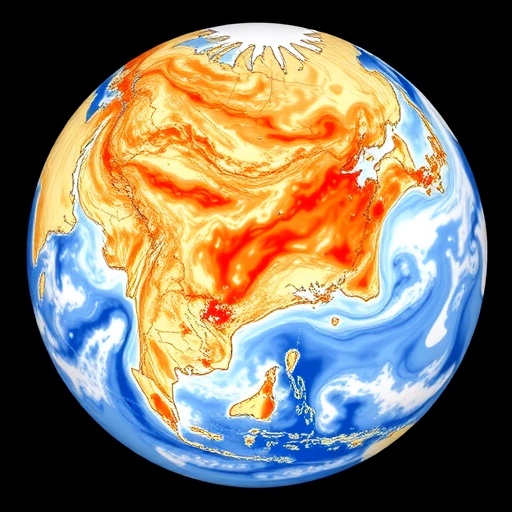
A new study is challenging one of the most familiar explanations for the long-term rhythm of the Asian summer monsoon. Rather than being controlled primarily by changes in Earth’s orbital eccentricity—the degree to which Earth’s path around the Sun shifts from nearly circular to more elongated—the monsoon appears to respond much more directly to atmospheric carbon dioxide and the precession of Earth’s rotational axis. The finding, reported by J. Millot-Weil, P. J. Valdes and A. Farnsworth in Nature Communications, offers a new way to understand why monsoon strength has waxed and waned across deep time, and it could reshape how scientists interpret both ancient climate records and future monsoon risks.
The Asian summer monsoon is one of the planet’s most powerful seasonal climate systems. Each year, intense heating over the Asian landmass creates a large-scale contrast between the hot continent and the comparatively cooler Indian Ocean and surrounding seas. This thermal contrast helps draw moist air northward, producing rainfall across India, Southeast Asia, southern China and adjacent regions. The rains support agriculture, recharge rivers and reservoirs, and influence ecosystems and economies affecting billions of people. Yet the monsoon is not fixed. It has repeatedly intensified and weakened over thousands to millions of years, responding to changes in incoming sunlight, greenhouse-gas concentrations, ice sheets, vegetation and ocean conditions.
For decades, orbital forcing has provided the dominant framework for explaining these ancient variations. Earth’s orbit changes in several predictable ways. Eccentricity describes the shape of the orbit and follows cycles of roughly 100,000 years, while obliquity describes changes in the planet’s axial tilt over approximately 41,000 years. Precession, often called the wobble of Earth’s axis, alters the timing of the seasons relative to Earth’s position along its orbit on cycles of about 19,000 to 23,000 years. Because monsoon rainfall depends strongly on the amount of solar energy received during the Northern Hemisphere summer, these orbital changes can alter the seasonal heating that drives the system.
The new research focuses on a critical distinction: an orbital factor may correlate with monsoon changes without being the immediate physical cause of those changes. Eccentricity influences the total contrast between the seasons only indirectly, because it modifies how strongly precession can redistribute sunlight between the hemispheres and between different times of year. Precession, by contrast, can directly change Northern Hemisphere summer insolation—the solar energy received per unit area—by shifting summer closer to or farther from perihelion, the point at which Earth is nearest the Sun. According to the study’s interpretation, that direct seasonal energy signal, together with carbon dioxide-driven changes in the climate system, provides a more convincing explanation for monsoon variability than eccentricity alone.
The researchers used climate modelling and orbital experiments to investigate how the monsoon responds when the planet’s astronomical and atmospheric conditions are altered. Such simulations allow scientists to isolate individual mechanisms that are difficult to separate in geological evidence. By changing orbital parameters and carbon dioxide concentrations independently, models can reveal whether rainfall responds to the orbit’s overall shape, the seasonal timing of solar radiation, or the greenhouse effect that changes atmospheric temperature and circulation. This approach is especially important because geological records often preserve the combined outcome of several processes rather than a single clean climate signal.
Carbon dioxide can affect the monsoon through several linked pathways. As a greenhouse gas, it changes the atmosphere’s energy balance and can warm the land and ocean differently. It also influences the vertical structure of the atmosphere, the strength of temperature gradients and the amount of moisture the air can hold. A warmer atmosphere generally has a greater capacity to store water vapour, while changes in land-surface temperature can strengthen or weaken the pressure contrast that drives monsoon winds. These effects can amplify or counteract the influence of seasonal sunlight. In this view, atmospheric CO2 is not merely a background number accompanying orbital cycles; it can actively shape the intensity and hydrological expression of the monsoon.
The study’s central message is therefore not that orbital variations are irrelevant, but that their effects must be interpreted more precisely. Precession can act as a direct astronomical pacemaker by controlling when peak Northern Hemisphere summer heating occurs. Carbon dioxide can then alter the climate system’s sensitivity to that seasonal forcing. Eccentricity may still matter as part of the orbital configuration, particularly because it modulates the strength of precessional changes, but the authors argue that it should not be treated as the primary clock controlling Asian summer monsoon variability. The distinction could help resolve longstanding disagreements between model results and climate records that have sometimes appeared to point toward different orbital drivers.
That reassessment has implications for paleoclimate research. Scientists reconstruct ancient monsoon intensity using evidence such as wind-blown dust, mineral deposits, lake sediments, marine sediments, pollen, soil formation and chemical signatures left by rainfall and erosion. Many of these archives contain repeating cycles that resemble astronomical periods, but matching a cycle to a specific orbital mechanism is not straightforward. A signal near 100,000 years, for example, may reflect the indirect influence of eccentricity, the response of ice sheets, carbon-cycle feedbacks or the way multiple climate processes combine. The new findings encourage researchers to look beyond simple frequency matching and examine the physical chain connecting solar radiation, greenhouse gases, circulation and precipitation.
The results also carry a modern warning. Today’s atmospheric carbon dioxide increase is occurring because of human activity rather than the slow orbital changes that operate over thousands of years. The study does not provide a direct forecast of next season’s rainfall, and ancient simulations cannot reproduce every feature of the modern climate. However, the research reinforces the idea that CO2 can influence monsoon behaviour by changing the background state in which seasonal heating operates. Even if orbital precession remains effectively unchanged over human timescales, a rapidly altered atmosphere can modify rainfall intensity, moisture transport and the likelihood of extreme wet or dry conditions.
For the billions of people living within the Asian monsoon region, that scientific refinement is more than a question of terminology. Understanding whether monsoon variability is paced by eccentricity, precession, carbon dioxide or interactions among them determines how researchers read the past and design projections for the future. Millot-Weil, Valdes and Farnsworth’s study presents the monsoon as a system governed by direct seasonal solar forcing and atmospheric composition, rather than by a single broad orbital cycle. By shifting attention toward the mechanisms that actually connect astronomical change to rainfall, the work could make both ancient climate reconstructions and future monsoon assessments more physically realistic.
Cite Scienmag News
Violet Maxwell. (August 24, 2026). Asian summer monsoon variability paced by CO2 and precession, not orbital eccentricity. Scienmag. https://scienmag.com/asian-summer-monsoon-variability-paced-by-co2-and-precession-not-orbital-eccentricity/
Violet Maxwell. "Asian summer monsoon variability paced by CO2 and precession, not orbital eccentricity." Scienmag, 24 August 2026, https://scienmag.com/asian-summer-monsoon-variability-paced-by-co2-and-precession-not-orbital-eccentricity/. Accessed 4 September 2026.
Violet Maxwell. "Asian summer monsoon variability paced by CO2 and precession, not orbital eccentricity." Scienmag. August 24, 2026. https://scienmag.com/asian-summer-monsoon-variability-paced-by-co2-and-precession-not-orbital-eccentricity/


