


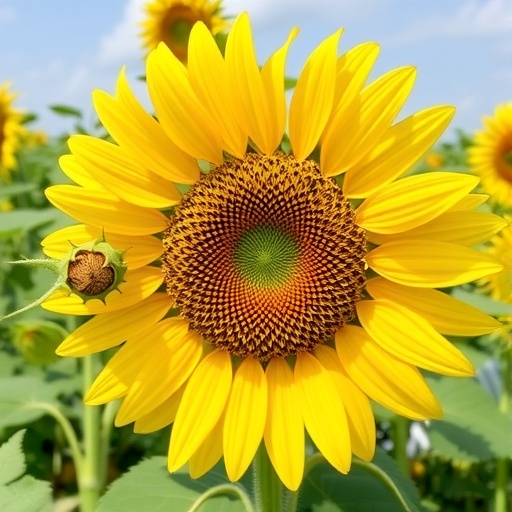
A pair of prairie plants with roots deep enough to reach several meters into the soil has moved closer to becoming a new generation of climate-resilient crops. Researchers at The Land Institute, HudsonAlpha Institute for Biotechnology and collaborating institutions have assembled the first chromosome-scale, haplotype-phased genomes for two North American perennial species, Silphium integrifolium, commonly known as rosinweed or silflower, and Silphium perfoliatum, known as cup plant or silphie. The genomic maps, published in Nature Communications, give breeders an unprecedented view of plants that could eventually provide food, oil, fiber, forage and pharmaceutical compounds while remaining productive for years after a single planting.
Modern agriculture depends heavily on a narrow group of annual crops. More than half of the calories consumed worldwide come from rice, wheat, corn, sugarcane and barley, crops that must generally be replanted every season. Annual cultivation can leave soil exposed, increase erosion and require repeated inputs of fuel, fertilizer and water. Perennial crops offer a different model. Once established, they can regrow for multiple years, maintaining living roots between harvests and potentially reducing the environmental costs associated with tillage and replanting. The challenge is that many wild perennial plants have complex genomes and traits that have not yet been organized into a form that modern breeding programs can readily use.
The new Silphium genomes are unusually large, measuring approximately 7.6 billion DNA base pairs in S. integrifolium and 7.5 billion in S. perfoliatum. By comparison, the human genome contains roughly 3.2 billion base pairs. Genome size alone does not determine biological complexity, but very large plant genomes can contain extensive repeated DNA sequences, making them difficult to assemble accurately. Repetitive regions may look nearly identical even when they occur in different parts of the genome, causing conventional sequencing and assembly methods to collapse or misplace them. The researchers overcame these obstacles using newer, more affordable genomic approaches capable of resolving the plants’ chromosomes in much greater detail.
The assemblies are described as haplotype-phased because they distinguish the two inherited versions of much of the genome rather than blending them into a single consensus sequence. This distinction is particularly important for breeding. Each plant receives genetic material from two parents, and the alternative versions, or haplotypes, may carry different forms of genes influencing drought response, disease resistance, flowering time, seed production or oil composition. A phased genome allows scientists to track those variants more precisely through successive generations. The chromosome-scale maps also reveal where genes and regulatory regions lie along entire chromosomes, creating a framework for connecting DNA differences with visible characteristics in the field.
The study uncovered another striking feature: several Silphium chromosomes are among the largest known in plants and appear to possess an unusual helical organization. Chromosomes are not loose strands of DNA; they are long molecules compacted around proteins and folded into increasingly complex structures inside the cell nucleus. In giant chromosomes, the way DNA is looped, coiled and packaged may affect how genes are accessed, how chromosomes pair during reproduction and how genetic material is exchanged between parents. Understanding this structure could be essential for breeders, because unusual chromosome behavior may influence fertility, recombination and the rate at which useful traits can be combined.
For Silphium improvement, the new reference genomes function like detailed navigational charts. Researchers can now develop genetic markers—identifiable DNA differences that act as signposts across the chromosomes—and use them to screen plants before traits are fully visible. This approach, known as marker-assisted or genomic-informed breeding, can help identify seedlings likely to withstand drought, tolerate heat, resist disease or produce larger seed heads. Instead of waiting several growing seasons to evaluate every plant in the field, breeders can use DNA fingerprints to narrow the population to individuals carrying promising genetic combinations. The method does not replace field testing, but it can make selection faster, more accurate and less expensive.
The potential agricultural value of S. integrifolium is especially significant because the species is being developed as a perennial oilseed crop. Reported seed oil content ranges from 11.8 to 25.3 percent, and the oil may have applications in food and medicine. The seeds also contain squalene, a compound used in cosmetics and valued as an ingredient in some vaccine formulations. A perennial oilseed would not automatically solve the environmental problems associated with agriculture, but a crop that remains rooted and productive over several years could reduce soil disturbance and create opportunities for farming systems designed around ecological persistence rather than annual replacement.
That persistence is tied to the plants’ underground biology. Silphium roots can extend as deep as 4.5 meters, allowing the plants to explore soil layers that shallow-rooted annual crops cannot reach. Deep perennial roots may improve soil stability, increase the movement of water into the ground and contribute organic carbon below the surface as roots grow, die and regenerate. They can also help plants endure periods of drought by accessing moisture stored deeper in the soil. At the same time, Silphium species support prairie communities that include pollinators and other organisms. Their value, therefore, may extend beyond harvested products to the ecological functions they perform while growing.
The researchers are now developing methods to fingerprint thousands of plants each year, potentially through coordinated genotyping efforts among institutions. Such a system would allow breeders to monitor genetic diversity more efficiently and identify populations that contain rare or valuable traits. It could also help conserve genetic “hotspots” before they are lost. The work is being conducted with attention to the cultural and ethical dimensions of domestication. Silphium species are native to eastern and central prairies, grasslands and plains in the United States and southern Canada—landscapes shaped by fire, grazing and the long-standing stewardship of Indigenous communities. Collaborators are pursuing ethnobotanical research, educational initiatives, participatory civic science and approaches to data governance that recognize those relationships. By combining chromosome-scale biology with ecological and cultural knowledge, the project aims not merely to create another crop, but to establish a more informed path for bringing wild perennial plants into agriculture.
News Publication Date: 9-Jul-2026
Web References: https://doi.org/10.1038/s41467-026-75205-3
References: Nature Communications, DOI: 10.1038/s41467-026-75205-3
Cite Scienmag News
Juliet Wilcox. (August 24, 2026). Giant Sunflower Family Genome Assembly Opens Path to New Perennial Crops. Scienmag. https://scienmag.com/giant-sunflower-family-genome-assembly-opens-path-to-new-perennial-crops/
Juliet Wilcox. "Giant Sunflower Family Genome Assembly Opens Path to New Perennial Crops." Scienmag, 24 August 2026, https://scienmag.com/giant-sunflower-family-genome-assembly-opens-path-to-new-perennial-crops/. Accessed 4 September 2026.
Juliet Wilcox. "Giant Sunflower Family Genome Assembly Opens Path to New Perennial Crops." Scienmag. August 24, 2026. https://scienmag.com/giant-sunflower-family-genome-assembly-opens-path-to-new-perennial-crops/


