


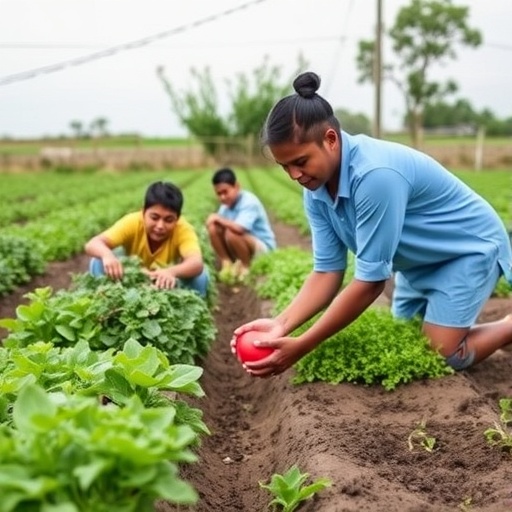
LAWRENCE, Kansas — The internet’s favorite prescription for feeling better may sound simple: “touch grass.” Now, research from the University of Kansas suggests that for resettled refugees, immigrants and English language learner farmers, literally working with soil can provide far more than a break from screens. A community-based study of New Roots, a sustainable agriculture training program in Kansas City, Missouri, found that farming gave participants opportunities to improve their physical and emotional well-being, build social connections, develop professional independence and prepare to operate agricultural businesses of their own. The findings portray urban farming not merely as a food-production strategy, but as a form of community infrastructure that can influence health, identity, economic opportunity and belonging at the same time.
New Roots is a four-year program operated through a partnership involving Cultivate KC and Catholic Charities of Northeast Kansas. Participants lease approximately one-quarter acre of land within the program’s 7.5-acre farm site, where they grow and sell crops while receiving technical and business training. Many already had farming experience before arriving in the United States, but the program helps them adapt that knowledge to American agricultural markets, regulations and consumer expectations. Training includes climate-resilient growing techniques, pest management, equipment operation, record keeping, tax preparation, business planning and produce marketing. Farmers sell through farmers markets, Community Supported Agriculture programs and wholesale channels, gaining practical experience in the full chain of production, from seed selection and cultivation to pricing, customer communication and distribution.
The University of Kansas research team became involved in 2022, after Joonmo Kang, an assistant professor in KU’s School of Social Welfare, brought one of his classes to the farm. Kang and research project director Cheryl Holmes subsequently attended monthly meetings, community events and other activities, gradually building relationships with staff, farmers and volunteers. Rather than beginning with a predetermined set of questions, the researchers first held focus groups with New Roots staff to identify the issues most important to the organization. They then interviewed participating farmers about their experiences. The process reflects a community-based participatory research model, in which researchers and community members collaborate to define the problem, interpret the findings and determine how the results can be used. Although the program’s research listing identifies the method as a survey, the project description emphasizes interviews, focus groups, observation and sustained community engagement.
Participants repeatedly described the farm as a healthier environment than many of their primary workplaces. A large number held full-time jobs in warehouses, meatpacking facilities or service-sector positions—jobs that farmers commonly referred to as “company jobs.” They reported limited flexibility, little or no sick leave, pressure to maintain repetitive motions for long periods and restrictions on talking with co-workers. Some said workplace policies made it difficult to care for family members or respond to personal needs. The contrast with New Roots was striking. On the farm, participants could set their own schedules, communicate freely with others and see a direct relationship between their effort and the outcome. These accounts do not establish that farming alone caused improvements in health, and the study was not a clinical trial, but they reveal how control over time, movement and work conditions can shape perceived mental and physical well-being.
That sense of control was one of the most important themes in the research. Farmers described New Roots as a place where they could work toward something they owned, rather than simply performing tasks assigned by an employer. “You are your own boss,” one participant said. The phrase captures the program’s emphasis on agency: farmers make decisions about what to grow, how to cultivate it, how to present it to customers and how to manage the financial side of the operation. They may earn more from conventional employment in some cases, yet still choose to remain involved because the farm provides independence, meaningful work and opportunities to use skills that are often overlooked in other jobs. One participant also described volunteering as an interpreter for newly resettled refugees—an activity enabled by the flexibility of farming but not by his company job.
The program’s technical training is designed to transform existing agricultural knowledge into a viable enterprise within the United States. Participants learn methods intended to improve resilience to changing weather conditions, including approaches to soil management, crop planning and pest control that can reduce environmental stress and protect yields. They receive instruction in equipment use and farm safety, while business lessons address taxes, bookkeeping and legal responsibilities. These subjects are crucial because a successful small farm requires more than the ability to grow crops. Farmers must estimate production costs, understand market demand, maintain records, comply with regulations, communicate with buyers and determine whether a crop can generate enough revenue to justify the labor and resources invested. New Roots also offers English language classes during the nongrowing season, helping participants navigate customer interactions, business documents and the broader vocabulary of American agriculture.
The social effects of the program were equally significant. Researchers observed farmers, staff members and volunteers sharing responsibilities beyond the formal agricultural curriculum. At one early meeting, participants and staff took turns holding a farmer’s newborn baby while children from both families played around the farm. On another occasion, farmers gathered to share a meal of traditional Burmese food prepared by one of the trainees. These moments illustrate how a farm can function as a social setting as well as a workplace. Participants also spoke about the pleasure of meeting customers at farmers markets, where selling produce became an exchange of recipes, cultural knowledge and stories. Crops unfamiliar to some Kansas City shoppers, including mchicha, were introduced alongside explanations of how to prepare them. The market therefore became a point of reciprocity: farmers supplied food and knowledge, while customers provided recognition, relationships and a sense of participation in the wider city.
Kang said the research itself was intentionally organized around the same principles of trust and shared participation that shaped New Roots. The team spent years attending events, listening to participants and receiving feedback before drawing conclusions. That slower process can be difficult to reconcile with the speed expected in academic publishing and online news, but it allowed the researchers to see forms of cooperation that might have disappeared in a short survey. Relationships developed through ordinary activities—working side by side, eating together, caring for children and discussing the challenges of farming—became part of the evidence. The researchers also produced a report for New Roots and translated it into the native languages of the participating farmers, making the findings accessible to the community that contributed to the study.
Published in the Journal of Community Practice, the study argues that sustainable urban agriculture can serve several functions simultaneously: it can strengthen food systems, provide occupational training, support entrepreneurship and create spaces where immigrant and refugee communities exercise cultural and economic agency. Its significance extends beyond the individual farm. Resettled families often face barriers involving language, transportation, employment, credential recognition and unfamiliar legal systems. A program that combines land access with business education, language support and social connection addresses several of those barriers through one practical activity. The researchers caution, implicitly through the study’s qualitative and community-engaged design, that the findings should not be interpreted as proof that farming is a universal treatment for stress or illness. They do, however, show why access to meaningful work, green space, flexible schedules and supportive relationships may matter as much as income when communities are rebuilding their lives.
The New Roots experience offers a vivid example of how sustainable agriculture can become a public-health and community-development intervention without being designed as a conventional medical program. Participants cultivate crops, but they also cultivate autonomy, professional confidence and connections across cultures. For farmers accustomed to tightly controlled workplaces, the ability to decide when and how to work can be a powerful form of well-being. For Kansas City customers, the farm provides access to diverse produce and new culinary traditions. And for researchers, it demonstrates that scientific knowledge can emerge from long-term collaboration rather than rapid extraction of data. In a culture increasingly encouraged to disconnect from devices and reconnect with the physical world, New Roots suggests that “touching grass” can also mean learning a trade, feeding a neighborhood and building a place to belong.
News Publication Date: 23-Jul-2026
Web References: University of Kansas; New Roots program: https://www.cultivatekc.org/new-roots/; Climate and Ecological Justice Collaborative: https://socwel.ku.edu/research/climate-justice-collaborative
References: Journal of Community Practice. DOI: 10.1080/10705422.2026.2708030
Cite Scienmag News
Alan Morgan. (August 24, 2026). Sustainable Farming Program Helps Refugees and Immigrants Improve Health, Launch Agribusinesses. Scienmag. https://scienmag.com/sustainable-farming-program-helps-refugees-and-immigrants-improve-health-launch-agribusinesses/
Alan Morgan. "Sustainable Farming Program Helps Refugees and Immigrants Improve Health, Launch Agribusinesses." Scienmag, 24 August 2026, https://scienmag.com/sustainable-farming-program-helps-refugees-and-immigrants-improve-health-launch-agribusinesses/. Accessed 3 September 2026.
Alan Morgan. "Sustainable Farming Program Helps Refugees and Immigrants Improve Health, Launch Agribusinesses." Scienmag. August 24, 2026. https://scienmag.com/sustainable-farming-program-helps-refugees-and-immigrants-improve-health-launch-agribusinesses/


