


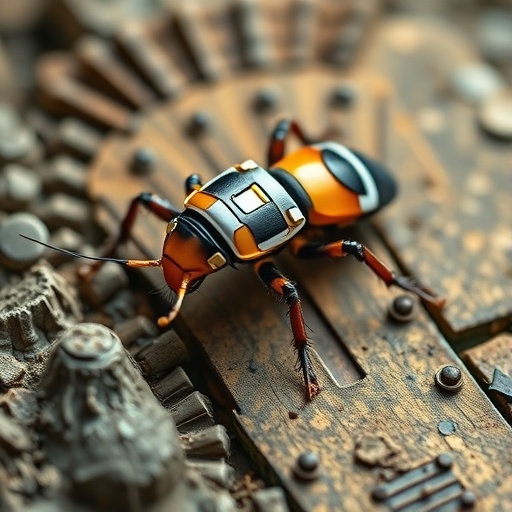
Cyborg insects may soon become more than remotely controlled curiosities. A research team from The University of Osaka in Japan and Universitas Diponegoro in Indonesia has developed an autonomous navigation system that allows electrically enhanced cockroaches to recognize terrain in real time and use their natural climbing ability instead of automatically detouring around every obstacle. The approach could lead to smaller, more efficient search-and-rescue machines capable of moving through collapsed buildings, narrow passages, and other environments where conventional robots struggle to operate.
Cyborg insects combine the biological capabilities of living animals with miniature electronic systems attached to their bodies. In the new study, cockroaches were equipped with a control system that could influence their movement through electrical stimulation while still allowing them to rely on their own legs, body mechanics, and instinctive behaviors. Unlike fully artificial robots, the insects already possess highly efficient locomotion, strong environmental adaptability, and the ability to climb surfaces without requiring complex mechanical hardware. The challenge was to guide those abilities without suppressing them.
Most autonomous navigation systems are designed around a basic robotic principle: detect an obstacle and avoid it. That strategy is useful for wheeled or rigid-bodied machines, but it is not always the best option for an insect that can climb. A wall, raised edge, or sloping structure may represent a barrier to a conventional robot while serving as a passable route for a cockroach. Forcing the insect to move around such features can produce unnecessary detours, consume more time, and reduce the area that the animal can explore. The researchers therefore sought to develop a navigation strategy that could distinguish between obstacles that should be avoided and terrain that could be crossed naturally.
Their system combines several behavioral commands, including movement toward a target, obstacle avoidance, wall-following, and reactive climbing. These commands are coordinated by stimulating the insect in ways that encourage changes in direction or forward movement. Earlier versions of this type of controller, however, faced a critical limitation: they could influence motion but could not reliably determine what kind of surface the insect was currently traversing. During climbing, the controller could continue issuing steering commands as if the insect were on flat ground. That interference sometimes caused hesitation, unstable movement, or inefficient progress.
To solve the problem, the researchers added an artificial-intelligence module based on a multilayer perceptron, a type of neural-network model commonly used to classify patterns in sensor data. The system analyzes signals collected from sensors mounted on the cyborg insect and assigns the surrounding terrain to categories such as flat ground, an ascent, a descent, or a hole. Rather than relying on a detailed map of the environment, the controller makes rapid local decisions based on the insect’s immediate physical experience. This makes the approach reactive and potentially useful in places where the surroundings are too unpredictable or damaged for conventional mapping.
In offline testing, the terrain-recognition classifier achieved 92 percent accuracy. That performance enabled the navigation controller to change its behavior according to the surface beneath or ahead of the insect. When the system identified climbing terrain, it could reduce unnecessary steering commands and allow the cockroach’s innate locomotor behavior to take over. On flatter surfaces, the controller could resume more active directional guidance. The result was a division of labor between artificial intelligence and biology: the algorithm handled recognition and decision-making, while the insect supplied the physical skills needed to negotiate complex terrain.
This arrangement is an example of what the researchers describe as “biohybrid physical AI.” The concept differs from simply placing a camera and processor on a small robot. Instead of reproducing every movement with motors, gears, and software, the system uses a living organism as part of the machine’s physical architecture. The insect’s legs, reflexes, body flexibility, and climbing mechanics perform functions that would be difficult to miniaturize in a purely artificial platform. The electronic system provides high-level guidance, but it does not need to calculate every detail of foot placement or body adjustment.
The technology could be especially valuable in search-and-rescue operations, infrastructure inspection, and exploration of spaces that are too narrow, uneven, or hazardous for larger robots. A cyborg insect could potentially carry lightweight sensors into rubble, industrial structures, or confined cavities while consuming far less energy than a conventional autonomous vehicle. However, practical deployment would still require improvements in communication range, battery life, durability, payload capacity, and reliable operation under dust, moisture, darkness, and extreme temperatures. The researchers’ results represent a navigation advance, not yet a complete field-ready rescue platform.
The study also highlights a broader shift in robotics toward systems that cooperate with biological intelligence rather than attempting to replace it. Living organisms have evolved to move through cluttered environments using remarkably economical control strategies, and their bodies often handle uncertainty without the computational burden required by engineered machines. By recognizing when to guide the insect and when to let it climb naturally, the new system reduces conflict between electronic control and biological behavior. The researchers believe this principle could inspire future robotic platforms designed to remain effective in complex environments, where adaptability may matter more than mechanical precision. The article, “Biohybrid Navigation through Real-Time Terrain Recognition and Natural Climbing in Cyborg Insect,” is published in Device with an article publication date of August 20, 2026.
News Publication Date: 20-Aug-2026
Web References: https://doi.org/10.1016/j.device.2026.101277
References: Mochammad Ariyanto et al., “Biohybrid Navigation through Real-Time Terrain Recognition and Natural Climbing in Cyborg Insect,” Device, DOI: 10.1016/j.device.2026.101277
Cite Scienmag News
Gavin Prescott. (August 21, 2026). AI terrain recognition enables cyborg cockroaches to navigate faster. Scienmag. https://scienmag.com/ai-terrain-recognition-enables-cyborg-cockroaches-to-navigate-faster/
Gavin Prescott. "AI terrain recognition enables cyborg cockroaches to navigate faster." Scienmag, 21 August 2026, https://scienmag.com/ai-terrain-recognition-enables-cyborg-cockroaches-to-navigate-faster/. Accessed 3 September 2026.
Gavin Prescott. "AI terrain recognition enables cyborg cockroaches to navigate faster." Scienmag. August 21, 2026. https://scienmag.com/ai-terrain-recognition-enables-cyborg-cockroaches-to-navigate-faster/


